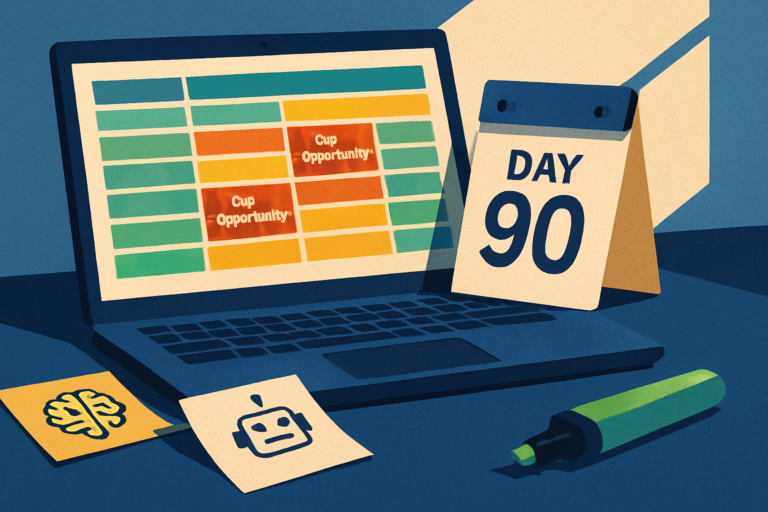
- AI content wins come from precision, not volume
- Refresh existing pages before publishing new ones
- Map search intent across all four layers
- Track impressions and CTR before chasing rankings
- Keep human editors on angle and final edit
In Q1 2025, generative AI deployment across marketing activities more than doubled year-over-year, jumping from 7% to 15.1% of all marketing activities according to the Duke University CMO Survey. Yet most teams using it are still publishing more and ranking less. The marketers winning the 90-day game aren’t the ones writing faster — they’re the ones aiming better.
That’s the reframe this guide is built around. AI-powered content marketing isn’t a volume play. It’s a precision play. And in a 90-day window, precision is the only thing that compounds.
- Speed in AI content marketing comes from gap-capture, not output volume.
- Refreshing existing pages typically ranks faster than launching new ones.
- Intent-layered structure beats keyword stuffing for early traction.
- Track impressions and CTR shifts before obsessing over position rankings.
- Human editorial judgment is the moat AI cannot replicate.
Why 90 Days Is the New Content Marketing Benchmark
Marketing leaders no longer have the patience for 12-month content bets — and AI is what makes shorter sprints viable.
The old playbook assumed you needed a year of publishing before you could read the tea leaves. That math broke when CFOs started auditing content spend quarterly. Generative AI adoption specifically surged 116% year-over-year, now deployed across 15.1% of all marketing activities, up from 7.0% a year ago, and the teams driving that adoption are using it to compress research, drafting, and iteration cycles into weeks.
Realistic 90-day wins look like this: impression growth on refreshed clusters, two to five keywords moving from page two to page one, and a measurable lift in click-through rate. Not viral traffic. Compounding traction.
Step 1: How Do You Find Content Gaps With AI Tools?
You find gaps by analyzing what your competitors rank for, what they cover poorly, and what the SERP is begging someone to answer better.
This is where most teams misuse AI. They prompt it to “write a blog about X” instead of asking it to map the competitive landscape first. AI’s real edge in ai driven content marketing is pattern recognition across hundreds of competing URLs in minutes — the kind of audit a human analyst would need a week to finish.
The goal isn’t high-volume keywords. It’s the underserved subtopics inside clusters your competitors have already validated. Sage’s Suggestions Engine, for example, is built around surfacing these exact openings: the questions ranking pages mention but never actually resolve.
What a content gap audit looks like in practice
- Pull the top 10 ranking URLs for your target cluster.
- Extract their H2s and H3s into a single table.
- Ask AI to flag subtopics mentioned by fewer than three competitors.
- Cross-reference against People Also Ask and related searches.
- Prioritize gaps with commercial intent over informational ones.
Step 2: Build Content That Matches Search Intent at Every Layer
Most AI-generated content fails to rank because it answers the surface question and stops there.
A query like “best CRM for startups” isn’t just informational. It’s commercial, comparative, and frequently navigational — the searcher wants a recommendation, a pricing snapshot, and a path to a demo. A page that only delivers definitions will lose to a page that layers all three.
Google’s guidance is clear: when creating content for the web, focus on accuracy, quality, and relevance, especially when automatically generating the content. This includes metadata like title elements, meta description elements, structured data, and alternate texts. AI-assisted content meets that bar when it’s intent-mapped before it’s drafted, not after.
| Intent Layer | Reader Need | Page Element That Serves It |
|---|---|---|
| Informational | Definition, context | Opening paragraph + Key Takeaways |
| Commercial | Comparison, evaluation | Comparison table + pros/cons |
| Navigational | Vendor or tool path | Named examples + product links |
| Transactional | Next step | Inline CTA or demo link |
Step 3: Optimize Existing Content Before Creating New Pages
The fastest 90-day win is almost always a refresh, not a launch.
Here’s the contrarian claim most agencies won’t make: publishing new content in month one is usually a mistake. A page already indexed, already earning impressions, already carrying internal links — that page is closer to ranking than anything you can write from scratch. Ahrefs’ study analyzing 17 million citations found that AI-cited content is 25.7% fresher than organic Google results. ChatGPT shows the strongest preference for new content, citing URLs that are 393-458 days newer than organic Google results.
Freshness is now a dual signal: it matters for classic SEO and it matters for AI citation. A smart refresh hits both at once.
What AI should flag during a refresh audit
- Semantic gaps — entities or subtopics competitors cover that you don’t.
- Thin sections — H2s with under 100 words of substantive content.
- Outdated stats — anything older than 18 months in a fast-moving category.
- Missing intent layers — informational pages with no commercial pivot.
- Internal linking holes — orphaned pages or under-linked money pages.
Step 4: Systematize Production Without Losing Quality
The teams getting the most from ai-enhanced content marketing keep humans at the center of every editorial decision.
Use AI for the unglamorous middle of the workflow: brief construction, first drafts, internal linking suggestions, meta optimization, schema markup. Keep humans on angle selection, opinion, original examples, and the final edit. In our 2025 State of AI report, 55% of marketers placed content creation as the most popular use case of AI in content marketing. This echoes what we found last year but with an impressive uptick of 12%.
The trap is over-automation. Brand voice dies fast when AI writes the intro, the body, and the conclusion unsupervised. The output reads competent and forgettable — which is the worst possible outcome in a market already drowning in competent, forgettable content.
Measuring Your 90-Day Content Wins
The metrics that matter early are leading indicators, not rankings.
Stakeholders want to see position one. You should show them impression growth, query expansion, and CTR movement first — because those move weeks before rankings do. A page jumping from 12 impressions a day to 400 is ranking somewhere new, even if it hasn’t broken the top ten yet.
Report the trajectory, not the snapshot. That’s how you buy yourself month four.
How do you use AI for content marketing in 90 days?
Start with a content gap audit, refresh your closest-to-ranking pages in weeks one through four, then build new intent-layered content in weeks five through twelve. Measure impressions and CTR before rankings.
What are the best AI tools for content marketing results?
The most effective stack pairs a gap-discovery tool like Sage’s Suggestions Engine with a drafting assistant and an analytics layer. Tool brand matters less than workflow integration.
Can AI-generated content rank on Google?
Yes, when it meets E-E-A-T standards. Google judges helpfulness and originality, not production method. Thin, mass-produced AI content gets penalized; intent-rich, human-edited AI content competes fine.
How do you prove content marketing ROI to stakeholders?
Tie content metrics to pipeline signals — assisted conversions, demo requests from organic landing pages, and branded search lift. Pure traffic numbers no longer satisfy modern CFOs.
The Honest Bottom Line on AI Content Marketing
If your content team is still measuring success by word count published, AI will make you worse, not better. It will scale your mediocrity. The teams that win the next four quarters will be the ones who use AI as a research weapon and a refresh accelerant — and who treat the first draft as the cheapest part of the job, not the most important one. Precision compounds. Volume doesn’t. Pick a side.
Frequently Asked Questions
Why is refreshing content faster than publishing new pages?
What does a realistic 90-day content win actually look like?
Where should AI sit in the editorial workflow?
Why do most AI-generated articles fail to rank?
How fresh does AI-cited content tend to be?
Share this

Related Posts
-
AI-Powered Content Marketing: Tactics That Deliver 90-Day Wins
Key Takeaways AI wins come from precision targeting, not output volume. Refresh existing pages before…
-
AI-Powered Content Marketing: Tactics That Deliver 90-Day Wins
Key Takeaways Precision targeting beats volume for fast AI content wins Refresh page-2 posts before…
-
DNS Verification in Google Search Console: A Troubleshooting Handbook for Agencies
Key Takeaways Domain properties require DNS verification because they cover every subdomain and protocol under…