
Picture a GPT model finely tuned to your sector’s top-performing blogs and proprietary data. This is the power of custom gpt for seo—driving targeted organic traffic and elevating rankings.
Why Off-the-Shelf AI Stumbles on SEO Precision
Off-the-shelf AI models deliver broad-stroke copy—fine for general blog posts but disastrous for precision SEO. They lack industry-specific context, competitive analysis, and often regurgitate overused phrases and generic insights.
You end up with keyword stuffing that triggers search engine penalties, tone mismatches that confuse your brand voice, and shallow analyses that fail to unearth long-tail opportunities, hampering visibility after algorithm updates.
These shortcomings waste resources, slow time-to-publish, and risk your authority. To dominate niche search rankings, you need custom gpt models trained on domain-specific gpt data—tailored from the ground up for your goals.
Understanding Custom GPT Models for SEO
Custom GPT models transform generic language tools into domain experts. By focusing on your sector’s terminology, competitor content, and audience insights, these models deliver precision that standard custom gpt seo tools can’t match. Fine-tuning bridges the gap between raw AI and authoritative industry content by iterating on prompts and accuracy checks.
Core Components of Domain-Specific GPT
- Training Data: Industry reports, top-ranking pages, in-house expertise
- Prompt Engineering: Custom templates to guide tone and structure
- Fine-Tuning AI Models: Iterative adjustments to optimize relevance
Base GPT vs. Custom GPT
While base GPT excels at broad content automation, domain-specific GPT understands context, jargon, and search intent. This difference boosts content authority, helping you outrank competitors and satisfy user queries more effectively. These tailored models produce more coherent analyses and help scale content operations without sacrificing quality. By strengthening E-A-T signals, you foster trust with both users and search engines.
Planning Your Custom GPT for SEO Strategy
Before you build, map out the terrain. A strategic approach ensures your custom gpt models target real opportunities. Start by auditing existing pages to see where AI could fill the gaps.
Identifying Content Gaps
Leverage keyword research tools and SEO optimization tools to spot under-served topics, long-tail queries, and high-intent search patterns. Compare competitor content to find angles they’ve missed. Include semantic keyword clustering to capture related search intents.
Selecting Relevant Data Sources
Gather industry reports, top-ranking pages, and in-house expertise. Clean and organize this data for cohesive training sets—think white papers, case studies, and customer FAQs. Prioritize data freshness and diversity to avoid training biases.
Setting Clear Objectives
Define your goals: traffic growth, engagement metrics, or conversion uplift. Assign benchmarks—such as a 20% increase in target keyword rankings within three months—to measure success. Align with broader marketing KPIs like dwell time and bounce rate.
Building and Fine-Tuning Your SEO-Focused GPT
With your roadmap defined, data preparation and fine-tuning are next. This phase transforms raw documents into an SEO-savvy AI engine that understands your niche’s nuances and search intent.
Data Preprocessing
Clean and label your dataset for SEO relevance: remove duplicates, standardize terminology, and tag headings. Extract key phrases and metadata to feed the model with context-rich examples. Ensure diversity by including various content formats—articles, FAQs, and case studies. Filter out deprecated SEO practices and outdated information to maintain relevance.
Fine-Tuning Steps
Initiate training iterations with carefully crafted prompts. Start small—use a validation set to compare outputs against control samples. Adjust hyperparameters and prompt templates over multiple cycles until the model consistently produces coherent, on-brand copy. Monitor token usage to optimize cost and performance, and integrate performance logs into your workflow. Use learning rate warm-up to avoid overfitting.
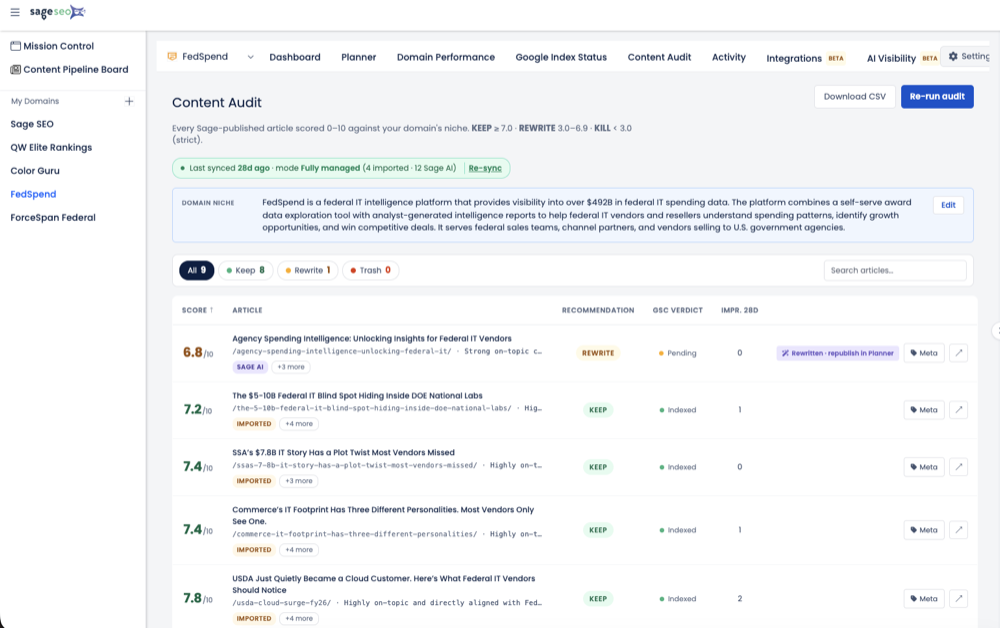
Skip the spreadsheets. Start Sage SEO free.
See how AI content ops transform your agency workflow in minutes.
Ensuring Quality and Consistency
Conduct human-in-the-loop reviews to verify factual accuracy and brand voice alignment. Check for hallucinations or token biases. Use automated scripts to flag SEO issues like keyword drop-offs or irregular structure before deployment. Integrate SEO evaluation tools into your testing pipeline to catch issues automatically.
Integrating Custom GPT into Your Content Workflow
Once fine-tuned, embed your gpt customization for seo into everyday content tasks. Seamless integration maximizes efficiency and maintains quality across teams. This reduces manual research by 50%.
Use Cases
Leverage the model for topic ideation, content briefs, meta description generation, and FAQ sections. AI-driven outlines speed up research and ensure consistency with your SEO strategy. Generate rich snippet ideas to boost click-through rates.
Toolchain Integration
Connect via APIs to your CMS and SEO platforms like Ahrefs or SEMrush. Automate content drafts within your editorial calendar and monitor AI-generated suggestions in real time. Enable version control for AI outputs to ensure traceability.
Collaborative Workflow
Involve editors, subject-matter experts, and SEO analysts. Set up feedback channels to refine prompts. Host regular workshops to share insights and improve model outputs. Define review SLAs and maintain a prompt library for reproducibility.
Measuring Impact and Iterating Your AI SEO Strategy
Measuring impact ensures your custom GPT model delivers on SEO goals. Define KPIs early.
Key Metrics
Track organic traffic, target keyword rankings, and time-to-publish. Include SERP features captured and backlink growth to gauge SEO health. Monitor engagement metrics like dwell time, bounce rate, and conversion rate to assess user satisfaction. Leverage third-party analytics to validate trends.
Feedback Loops
Collect user engagement data and A/B test AI-generated content against human-written posts. Implement heatmaps and scroll-depth analyses to understand behavior. Solicit editor feedback on tone and accuracy. Log prompt variations to trace successful inputs over time. Conduct manual audits monthly.
Continuous Improvement
Retrain your model with fresh data and prompts. Schedule quarterly evaluations and compare against baseline metrics. Automate workflows to ingest new content. Use insights from performance reports to refine prompts and data sources. Incorporate user feedback loops to adapt to shifting search behaviors. Document changes for audit trails.
Future Frontiers in AI SEO Consultancy
Emerging multimodal models will blend text, image, and video analysis to craft rich, interactive content that resonates with diverse audiences. Real-time personalization powered by AI will adjust on-page elements dynamically, aligning with user behavior and search intent.
Agencies can wrap custom GPT models into white-label solutions, delivering scalable, industry-specific content automation that differentiates their services and enables clients to quickly generate briefs, outlines, and metadata at scale.
Voice search optimization and AI-driven schema markup are essential practices. As search engines prioritize structured data and user experience, consultants leveraging these tools will unlock higher search engine rankings and audience engagement.
Empowering Your SEO Strategy with Custom AI
Custom GPT models offer an edge in the SEO landscape. By tailoring AI to your domain, you access precision content automation, robust analytics, and continuous refinement. Embrace this bespoke approach to outpace competitors and enrich user experiences.