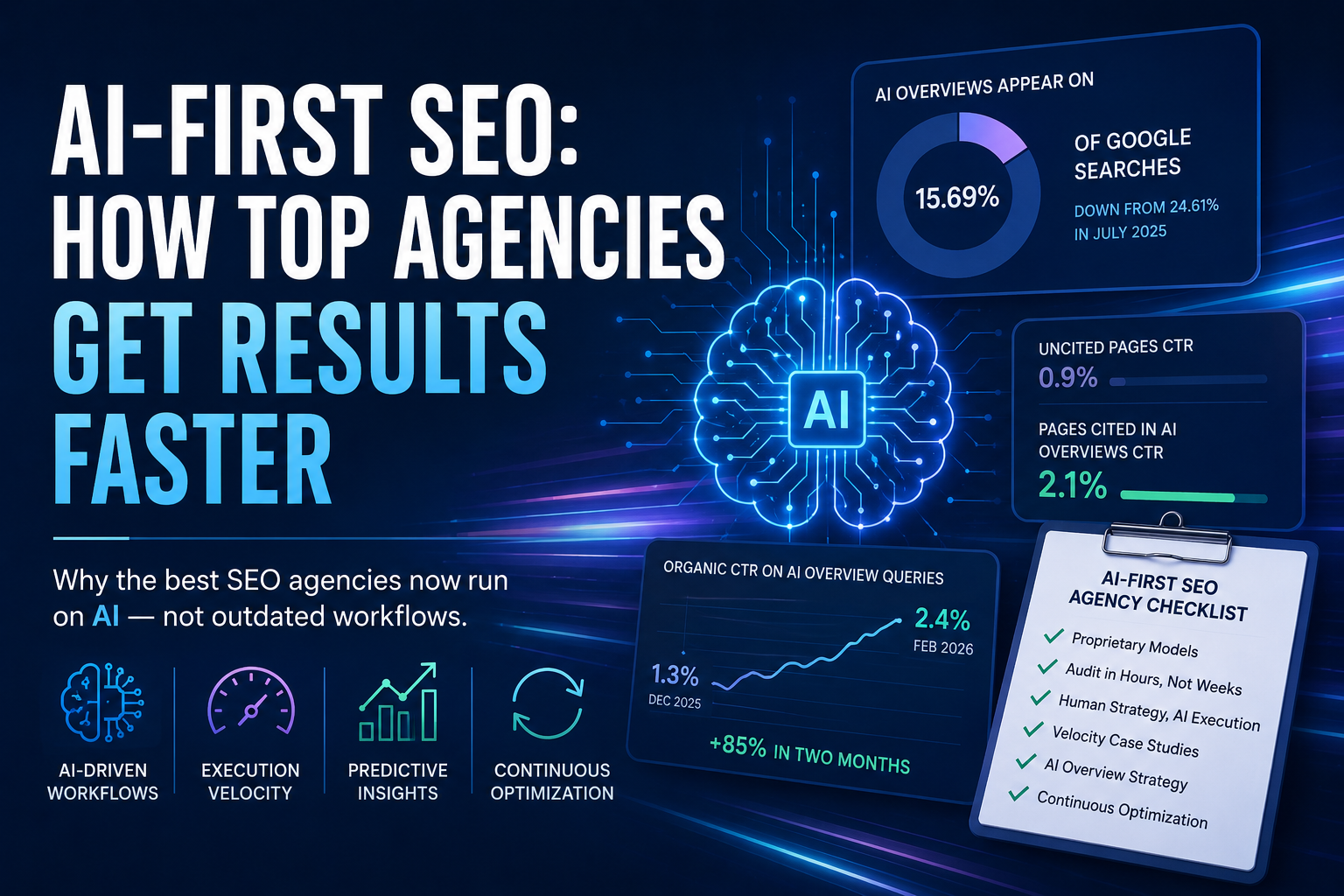
In November 2025, AI Overviews appeared on 15.69% of Google searches — down from a summer peak of nearly 25% but still triggering on roughly one in six queries, according to Semrush’s analysis of 10 million-plus keywords, which found AI Overviews appeared on 6.49% of queries in January 2025, rose to 24.61% in July, and settled at 15.69% in November. Meanwhile, organic click-through rates on those queries bottomed out at 1.3% in December 2025 before climbing back to 2.4% in February 2026 — an 85% jump in two months, according to new data from Seer Interactive. Search didn’t die. It got rewired around AI — and most SEO agencies are still using the old wiring diagram.
Key Takeaways
- AI-first SEO ≠ AI-assisted SEO — the architectural difference defines results.
- Pages cited in AI Overviews earn ~2.1% CTR versus 0.9% for uncited pages.
- 45% of companies say AI now automates 40% of their SEO tasks.
- Vet AI-first agencies by execution velocity, not just ranking case studies.
- AI Overviews appear on roughly 16% of queries and are expanding into commercial intent.
What “AI-First” Actually Means in SEO (Hint: It’s Not a Tool Stack)
AI-first means AI runs the work; humans run the strategy — not the other way around.
An AI-first SEO agency is a firm whose production engine is the AI. Humans set direction, vet outputs, and own client relationships. But the heavy lifting — technical audits, content briefs, internal linking maps, schema, draft production — runs at machine scale.
Compare that to an AI-assisted agency. Same 2018 workflow, with ChatGPT bolted on as a writing assistant. The bottleneck is still the analyst opening tabs at 9 a.m.
The architectural difference matters because it changes what’s possible. An AI-assisted team does SEO faster. An AI-first team does SEO at a different order of magnitude — auditing 50,000 URLs while a traditional agency is still scoping the engagement. Read our foundational primer on AI SEO if you want the longer definition.
Why Manual SEO Hit Its Scale Ceiling
Traditional SEO workflows were designed for a web of 2014 — not one where Google indexes trillions of pages and rewrites answers in real time.
The legacy model has three structural bottlenecks. Keyword research depends on an analyst manually clustering exports. Content production depends on a writer’s calendar. Technical audits depend on a crawl someone runs, reads, and translates into a deck. Every step is gated by a human attention span.
AI-first SEO removes those gates. Large language models cluster intent across millions of queries in minutes. Predictive models forecast which pages will rank before a single word is written. Crawlers parse, score, and prioritize fixes autonomously.
A 2025 SEO statistics roundup from Marketing LTB found AI tools can reduce the time spent on keyword research by 80% and boost content optimization efficiency by 30%, and 45% of companies report that AI automates 40% of SEO tasks, significantly raising productivity.
The Four Pillars Every AI-First SEO Agency Is Built On
An authentic AI-first agency runs on four interlocking systems — strip one out and the model collapses back to “AI-assisted.”
- AI-first technical SEO. Automated crawl analysis, log-file diagnostics, schema generation, and Core Web Vitals fixes pushed as code — not as a 40-page PDF sent for “client review.”
- Content intelligence. Topical authority models map every coverage gap; SERP-aligned briefs are generated against live AI Overview citations, not last quarter’s keyword export. Drafts produced in hours; humans edit for voice and accuracy.
- Predictive analytics. Ranking forecasts and ROI models built on first-party data plus SERP intelligence — so the agency tells a CFO which pages will earn revenue, not “we’ll publish 12 articles.”
- Continuous optimization loops. Real-time monitoring catches ranking drops, AI Overview inclusion changes, and competitor moves within hours. Fixes deploy without a kickoff meeting.
Notice what’s missing: status calls, account-manager middlemen, and a Friday report recapping what already happened. The pillars are about execution velocity, not deliverable theater. (Our case studies show what this looks like in practice.)
Why Traditional Agencies Can’t Catch Up — Even With AI Tools
The math doesn’t work for hybrid agencies, and the gap widens monthly.
A traditional agency’s cost structure is people. Adding AI to a people-heavy P&L makes margins worse, not better, because the workflow still pays for the human in the middle. An AI-first agency inverts the ratio — software does the volume, headcount stays lean.
| Dimension | Traditional / AI-Assisted Agency | AI-First SEO Agency |
|---|---|---|
| Technical audit turnaround | 2–6 weeks | Hours to days |
| Content briefs per month | 10–30 | Hundreds to thousands |
| Cost structure | Human-heavy retainers | Software-leveraged, lean teams |
| Output consistency | Varies by analyst | Standardized by model |
| Re-optimization cadence | Quarterly | Continuous |
Here’s the contrarian part: many AI-enhanced agencies are actually slower than they were pre-AI, because every prompt output gets human-checked twice — once for accuracy, once for brand voice. The legacy workflow ate the productivity gain.
How to Vet AI-First SEO Experts Without Falling for Marketing Theater
Every agency now claims to be “AI-powered.” Most are exaggerating — politely.
Use these questions to separate genuine AI-first SEO experts from rebranded legacy shops:
- Show me your proprietary models. If the answer is “we use ChatGPT and Surfer,” that’s an assisted shop.
- What’s your audit turnaround? An honest AI-first answer is measured in hours, not weeks.
- Where does the human still sit in the loop? A good answer names specific decisions — strategy, brand voice, sensitive topics — not “we review everything.”
- Velocity case studies, please. Rankings are easy to cherry-pick; speed-to-result is harder to fake.
- How do you handle AI Overview citations? If they lack a structured-data and entity-optimization answer, they aren’t tracking what matters in 2026.
Frequently Asked Questions About AI-First SEO
What is an AI-first SEO agency?
An AI-first SEO agency is one whose core production work — audits, briefs, drafts, schema, optimization — is executed by AI systems, with humans directing strategy and quality control. It’s an architectural model, not a tool choice.
How is AI-first SEO different from AI-assisted SEO?
AI-assisted SEO uses AI as a side tool inside a human workflow. AI-first SEO uses humans as a side input inside an AI workflow. The result is a 10x to 100x gap in output velocity.
Does AI-first SEO still work with Google AI Overviews reducing clicks?
Yes — arguably better than traditional SEO. Seer Interactive found that when an AI Overview appears, pages cited in it get more clicks than pages on that same results page that aren’t cited — roughly 2.1% CTR with citation versus 0.9% without, so optimizing for inclusion is now a core deliverable.
How do I choose an AI-first SEO partner for enterprise needs?
Vet on three axes: proprietary AI stack, documented speed-to-result, and clear human oversight of strategy. Ask for timestamps, not just rankings.
The New Baseline, Not a Trend
Gartner reported in late 2024 that 65% of CMOs believe advances in AI will dramatically transform their role within the next two years. That window is now half closed. The brands that adopt AI-first SEO in 2026 won’t have a competitive advantage in 2028 — they’ll have parity. The ones that don’t will be explaining flat organic traffic to a board that already knows the answer. AI-first isn’t the future of SEO. It’s the floor.
Share this

Related Posts
-
ContentOps: Streamlining Your SEO Workflow from Ideation to Publication
ContentOps: Streamlining Your SEO Workflow from Ideation to Publication Imagine a marketing team drowning in…
-
AI Content Writing Services: What Marketers Need to Know in 2024
AI content writing services promise speed, but winners in 2024 don’t outsource thinking to a…
-
AI-First SEO Strategy: Outperform Your Competition
AI-First SEO Strategy: Outperform Your Competition Seventy percent of an SEO professional’s week vanishes into…