
- GA4 misclassifies most ChatGPT sessions as direct traffic
- AI referral traffic surged 693% year-over-year in late 2025
- First-party tracking captures sessions without relying on referrer headers
- The 2026 analytics stack layers first-party tracking over GA4
- UTM discipline on owned links recovers 10–20% more attribution
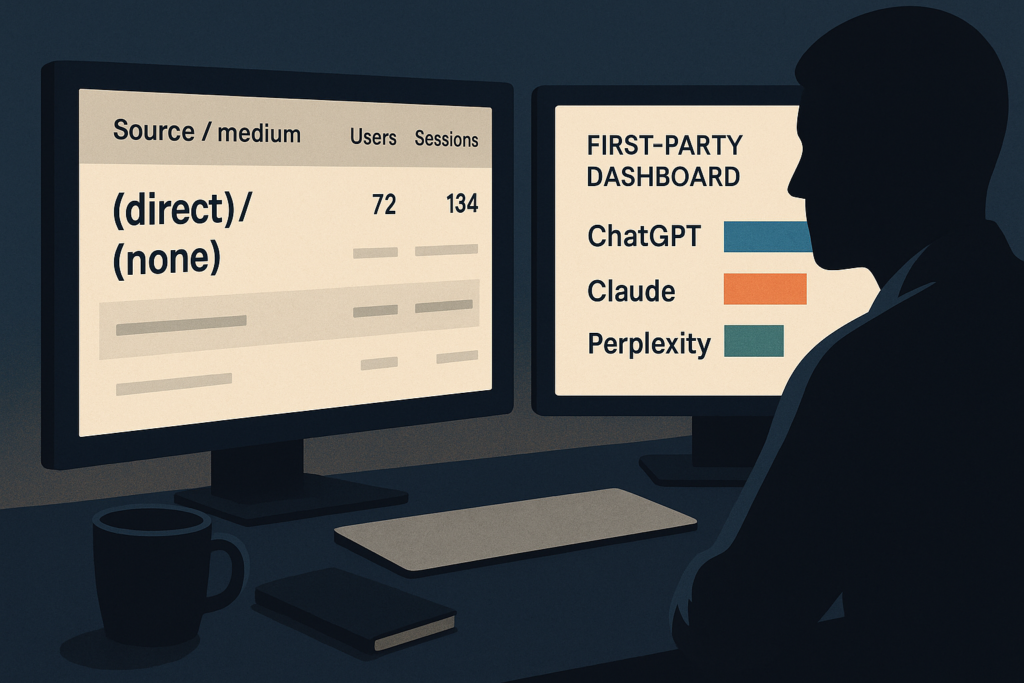
Here’s the uncomfortable truth most analytics leads haven’t fully internalized: when a user clicks a ChatGPT citation and lands on your pricing page, GA4 almost always logs the session as (direct) / (none). No referrer. No source. No campaign. The conversion fires, the revenue books, and the dashboard shows a ghost. Conductor’s November 2025 study found 89% of brands cannot properly attribute AI referral traffic — and that gap is widening every quarter as AI search volume compounds.
This isn’t a misconfigured channel grouping. It’s a structural mismatch between how AI platforms hand off users and how GA4 was designed to listen.
Why AI Referral Traffic Is Invisible to GA4
GA4 depends on the HTTP referrer header to classify a session — and most AI platforms either strip it or never send it at all.
When a user clicks an outbound link inside ChatGPT, the chat surface typically uses a redirect or a noreferrer link policy. The browser never tells your site where the click came from. GA4 sees a session with no referring URL and no UTM string, so it defaults to (direct) / (none) — the same bucket as someone typing your domain by hand.
The scale is not trivial. According to Adobe research, from July 2024 to February 2025, web traffic from AI-driven referrals increased more than tenfold in the United States, and during the November-December 2025 holiday period, AI traffic surged 693% YoY. If even half of that volume is bucketed as direct, your “direct” channel is no longer a vanity metric — it’s a black hole hiding your highest-intent visitors.
Where GA4 Goes Blind on Each AI Platform
Each major AI surface fails GA4 in a slightly different way, which is why a single regex fix never quite holds.
ChatGPT: the largest blind spot
ChatGPT only began passing UTM parameters in June 2025 and still drops attribution entirely from mobile app traffic. Desktop web sessions sometimes carry chatgpt.com as a referrer; the iOS and Android apps almost never do. Free ChatGPT users don’t send referrer data, so some AI clicks appear as “Direct.”
Perplexity: partial, inconsistent
Perplexity passes perplexity.ai as a referrer more reliably than ChatGPT, but the behavior splits across browsers and the Comet app. Perplexity Comet typically passes referrer information and appears as a clear referral source. Atlas often masks its origin, blending in with direct traffic. A custom channel group that catches Perplexity desktop will still miss its mobile and embedded-browser variants.
Claude and Google AI Overviews
Claude’s web app suppresses referrer by default on most outbound clicks. Google AI Overviews is the inverse problem: clicks from an AI Overview citation arrive with google.com as referrer and get bucketed as standard organic — no “AI-click” signal anywhere in the hit. You can’t separate AIO traffic from regular SERP traffic without server-side enrichment.
Layer on GA4’s own quirks — standard (free) properties can process up to 10 million events per single query (and up to 1 billion events per query in GA360 properties). Exceeding this threshold in one Exploration initiates sampling — and the bot-filter list that quietly drops AI-adjacent crawlers, and the picture gets worse before it gets better. Teams running the free tier hit sampling on any meaningful Exploration, which means even the AI traffic that does get classified gets statistically smoothed. For a deeper read on this measurement gap, see our notes on AI in SEO and where it breaks.
Skip the spreadsheets. Start Sage SEO free.
See how AI content ops transform your agency workflow in minutes.
What First-Party Outcome Tracking Actually Captures
First-party scripts like sage-js sidestep the referrer problem entirely by listening at the session and event layer.
Instead of asking the browser “where did you come from?” — a question modern AI platforms increasingly refuse to answer — a first-party tag instruments the page itself. It captures the landing URL, query parameters, scroll depth, time-on-task, and downstream conversion events, then writes them to your own server. The session ID is yours. The data is yours.
That matters for three reasons:
- Referrer independence. Even when ChatGPT strips the header, the script still records the session, the landing page, and any UTM payload you appended to citation-eligible links.
- Privacy resilience. First-party data survives ITP, third-party cookie blocking, and most ad-blocker lists because the calls are same-origin.
- Conversion stitching. Server-side event logging ties the AI-originated session to a signup or purchase hours or days later, even when the GA4 client-side tag has long since timed out.
This is the layer where AI-driven content actually gets measured against revenue, instead of measured against the proxy metric of “did GA4 happen to catch the referrer this time.”
How Do GA4 and First-Party Outcome Tracking Compare Head-to-Head?
GA4 wins on breadth; first-party wins on every dimension that matters for AI attribution.
| Capability | GA4 (Standard) | First-Party Outcome Tracking (sage-js) |
|---|---|---|
| AI source identification | Partial — only when referrer leaks through | Full — UTM + server-side enrichment |
| Referrer dependency | High — core to channel grouping | None — operates on landing URL + payload |
| Conversion fidelity | Client-side, cookie-bound | Server-side, session-stitched |
| Sampling at scale | Yes, above 10M events/query | No sampling on owned data |
| Data ownership | Google-hosted | Your warehouse |
| Setup complexity | Low | Medium — one script + endpoint |
| Real-time availability | Delayed in Explorations | Streaming |
The Analytics Stack We’d Build for 2026
Don’t rip out GA4. Layer around it.
GA4 still earns its keep for Google ecosystem signals — Ads attribution, Search Console integration, behavioral benchmarks against historical data. Pulling it would cost you continuity. What it can’t do is be the system of record for AI-referred sessions, and you shouldn’t ask it to.
The stack we recommend to growth teams in 2026:
- GA4 as the broad behavioral and Google-ecosystem layer.
- First-party outcome tracking (sage-js) as the primary attribution layer for AI, dark social, and any traffic where referrer is unreliable.
- UTM discipline on every link you control inside content that AI engines are likely to cite — your docs, your blog footnotes, your comparison pages.
- A custom GA4 channel group that catches the AI referrers that do leak through, so the two systems can be reconciled rather than contradicted.
For the implementation pattern, our primer on how content and tracking actually connect is the right starting point before you wire anything up.
The Honest Take
GA4 is not broken. It’s doing exactly what it was designed to do in a web where most traffic carried a referrer. That web is gone. AI platforms are the new front door, and the front door doesn’t ring a bell on the way in. Teams who treat first-party outcome tracking as an optional upgrade will spend 2026 explaining to their CFOs why “direct traffic” tripled and revenue per session got weird. Teams who treat it as table stakes will spend 2026 reporting which ChatGPT citations actually closed deals. Pick the conversation you’d rather be having.