
- Data-driven SEO predicts opportunities before committing budget.
- Six metrics carry almost all SEO decision-making weight.
- 58.5% of US searches now end without a click.
- Top-position organic CTR dropped from 28% to 19% in 2025.
- Document decisions to build compounding institutional knowledge.
A Fortune 500 marketing director once admitted her team opened Google Analytics every Monday—then ran the same campaigns regardless of what the dashboard said. That’s the SEO industry in miniature. Most teams confuse dashboard hygiene with decision-making, and the gap is expensive. McKinsey Global Institute found data-driven organizations are 23 times more likely to acquire customers and 19 times more likely to be profitable than competitors running on instinct. The framework below replaces guesswork with something you can actually execute next Monday.
What Does Data-Driven SEO Actually Mean?
Data-driven SEO is the discipline of using search and behavioral evidence to predict opportunities before you commit budget to them—not to explain results after the fact.
The distinction matters. Reactive reporting tells you traffic dropped 14% last month. Proactive data use told you three weeks earlier that impressions were softening on commercial-intent queries, and you shipped a fix before revenue moved. Vanity metrics—raw rankings, total backlinks, domain authority scores—feel productive but rarely correlate with pipeline. Meaningful indicators connect a query to a session to a conversion. If a metric can’t change a decision you’d otherwise make, stop tracking it.
Which SEO Metrics Should Actually Drive Your Strategy?
Six metrics carry almost all the decision-making weight in modern SEO analytics; everything else is supporting context.
Track ranking velocity over raw rank, because position 6 climbing to 3 matters more than a static position 1. Pair organic traffic trends with conversion rate from organic—volume without revenue is a vanity story. And treat click-through rate as a leading indicator: a 2025 GrowthSRC Media study across 200,000 keywords found that organic CTR for the top position dropped from 28 percent in 2024 to 19 percent in 2025, largely because AI Overviews now eat the click before users scroll.
| Metric | What It Tells You | Decision It Drives |
|---|---|---|
| Organic traffic trend | Demand capture momentum | Double down or pivot topic clusters |
| Ranking velocity | Page momentum, not just position | Where to invest internal links |
| CTR by query | Title/meta effectiveness | Rewrite SERP snippets |
| Engagement signals | Content-intent match | Refresh or retire pages |
| Conversion rate | Revenue contribution | Prioritize commercial pages |
| Backlink growth | Authority trajectory | Outreach and digital PR cadence |
Why Rankings Alone Now Mislead
Ranking #1 in 2026 isn’t what it was in 2019. Rand Fishkin’s 2024 SparkToro study found 58.5% of US Google searches end without a click to the open web. If your reporting still celebrates rank without tying it to clicks, conversions, or assisted revenue, you’re measuring a shrinking pie.
Skip the spreadsheets. Start Sage SEO free.
See how AI content ops transform your agency workflow in minutes.
Which Tools Enable Data-Driven SEO Decisions?
Three categories of tools cover nearly every data-driven SEO workflow: first-party search data, behavioral analytics, and competitive intelligence.
- Google Search Console — the only source of true query data, impressions, and CTR from Google itself.
- Google Analytics 4 — event-based behavior, conversion paths, and revenue attribution from organic sessions.
- Ahrefs, Semrush, or Moz — competitive keyword gaps, backlink intelligence, and SERP-feature tracking.
The trap is letting each tool tell its own story. Pull them into a single dashboard—Looker Studio, Power BI, or even a disciplined spreadsheet—so a marketing manager can answer “what changed this week and why” in under five minutes. Tool sprawl without consolidation is one reason SEO spend feels unjustifiable.
How to Build a Repeatable Data-Driven SEO Process
A durable process has five steps, each tied to a business question rather than a tool.
- Define the measurement framework. Start from revenue or pipeline goals, then work backward to the SEO metrics that influence them.
- Set a review cadence. Weekly for anomalies, monthly for trends, quarterly for strategy. Calendar invites, not vibes.
- Prioritize with data, not opinions. Score content and technical opportunities by traffic potential, conversion likelihood, and effort.
- Run SEO as experiments. Change one variable—title, schema, internal links—measure, then keep or kill.
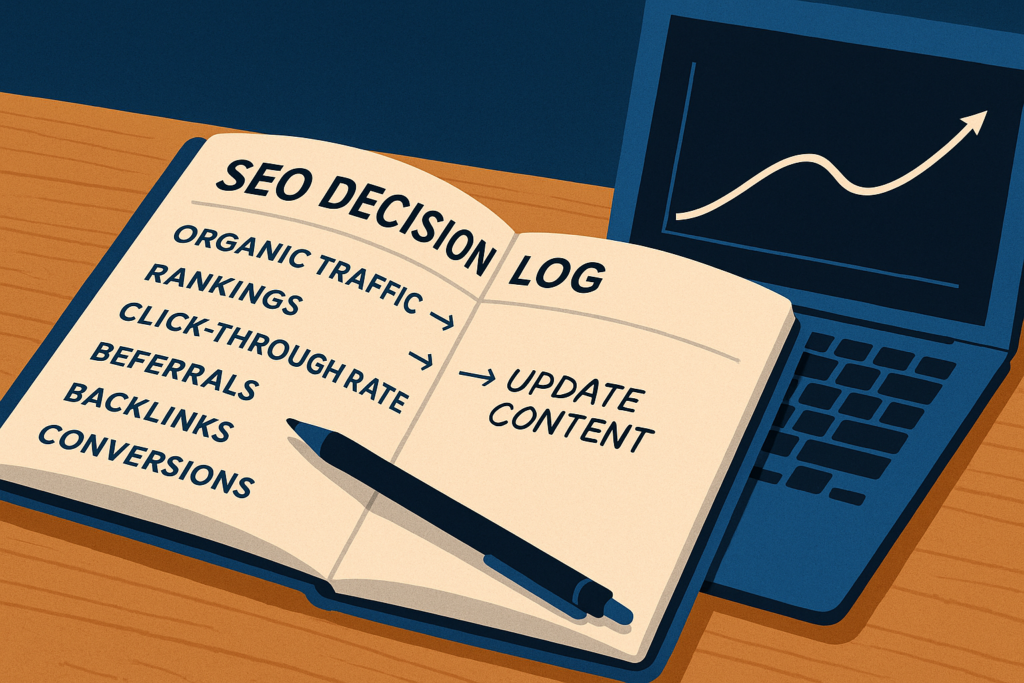
- Document every decision. Decision logs turn individual wins into institutional knowledge that survives staff turnover.
Common Mistakes That Undermine Data-Driven SEO
Most failed “data-driven” programs collapse on the same handful of errors—and none of them are about lacking data.
- Reading rankings without traffic or conversion context.
- Drawing conclusions from 14-day windows when Google’s volatility cycle is closer to 90.
- Ignoring seasonality—an HVAC site comparing January to July is reading weather, not strategy.
- Hoarding insights nobody acts on. A decision delayed by a month is usually a decision made by a competitor.
Turn Data Into Your Compounding Advantage
Data-driven SEO isn’t a software purchase or a one-time audit. It’s a habit of asking better questions—and trusting the answers enough to act on them before competitors do. The teams pulling away in 2026 aren’t the ones with the most dashboards. They’re the ones with the shortest distance between an insight and a shipped change. Pick six metrics, set a cadence, document your decisions, and let compounding do the rest.