
AI content writing services promise speed, but winners in 2024 don’t outsource thinking to a bot. They pair models with editors, structured briefs, and SEO loops to ship better content. That hybrid workflow is the unlock—see Sage SEO’s AI workflows.
AI Content Writing Services, Defined—and Why 2024 Is the Inflection Point
AI content writing services combine large language models with human editorial and SEO processes to plan, draft, and publish content at scale. Unlike a standalone chatbot, they deliver briefs, voice controls, QA, and publishing workflows, not just text.
2024 marks a pivot from experimentation to operationalization. Teams are codifying prompts, templates, and review steps so multiple writers can produce consistent output, while legal and brand leads stay in control. The playbook matters more than the prompt—standardization beats sporadic genius. That’s the turning point in 2024.
The result: faster production cycles, predictable quality, and measurable impact across channels—blogs, landing pages, and product docs. In short, ai content writing services are becoming a managed workflow, not a novelty.
Inside AI-Driven Content Writing: Models, Prompts, and the People Guardrails
Under the hood, ai-powered content generation pairs a base model (GPT-4-class, Claude, etc.) with templates, prompt libraries, and content workflow automation. Teams map content types to structured inputs—audience, angle, SERP gaps, callouts—so the model drafts with context, not guesswork.
Good services maintain brand voice consistency and legal compliance with system prompts, tone sliders, and red-flag rules. They store approved vocab, product facts, and claims so every draft stays accurate and on-message.
Human-in-the-loop editing: why it matters
Editors fact-check sources, add original insights, and prune fluff. They apply checklists for bias, accessibility, and risk. That human layer turns fast generation into publishable content—and it closes the loop by feeding accepted edits back into prompts.
Prompt strategies that scale
- Template by use case: briefs, outlines, meta data, and social snippets.
- Constrain outputs with structure: headings, length bands, and required fields.
- Ground to sources: link inputs, product docs, and expert quotes.
Why Marketers and Agencies Use AI—Real Benefits and Use Cases
Scale is the headliner. With repeatable workflows, teams move from brief to publish in hours, not weeks, and can localize for new regions or segments without reinventing the wheel.
Personalization becomes practical. Dynamic blocks let you tailor intros, examples, and CTAs by industry, persona, or funnel stage while keeping the core article consistent.
ai-powered content generation for agencies: where it shines
- Ideation: turn seed topics into prioritized clusters, angles, and research tasks.
- Outlines: generate section plans with talking points, examples, and internal links.
- First drafts: produce on-brief copy quickly, then layer human editing and subject-matter expertise.
- Repurposing: atomize long-form into emails, social, sales one-pagers, and video scripts.
- Updating aging content: refresh facts, links, and visuals, add depth, and align to current intent.
Agencies gain margin because one strategist can guide several writers through a consistent pipeline, from research to approvals faster.
AI Content Writing SEO: How to Rank Without Risk
Ranking safely starts with search intent alignment. Before drafting, analyze the SERP: formats, depth, and questions. Build outlines that cover the job to be done—definitions, comparisons, steps—and add unique insight so you’re not echoing the top 10.
Signal E‑E‑A‑T with real authors, citations, and bylines. Reference primary data and reputable sources, then link them. Review Google’s Search Essentials to keep content helpful and technically accessible.
Skip the spreadsheets. Start Sage SEO free.
See how AI content ops transform your agency workflow in minutes.
Avoid duplication, thin content, and over-optimization. Use de-duplication checks, vary anchors, and throttle keyword density. When you cite stats, include dates and links; when you make claims, back them with evidence.
AI content writing SEO checklist for 2024
- Confirm intent and competitor depth; document gaps to fill.
- Outline with mandatory sections, schema targets, and internal links.
- Assign author and SME review; add quotes or examples.
- Run plagiarism and duplication scans; rewrite or consolidate overlaps.
- Optimize titles, meta, alt text, and structured metadata.
- Link to your guide on ai content writing seo for team training.
Choosing an AI Content Writing Service: A Practical Checklist
Don’t buy a model; evaluate the workflow and the guardrails. Use this checklist to compare ai content writing services on what actually drives outcomes.
- Editorial quality process: briefs, style guides, human review, SME review.
- Brand voice controls: tone presets, banned/required terms, snippets library.
- Plagiarism and originality: built-in scanning, citation prompts, source tracking.
- Data privacy and security: zero-retention options, SOC 2/ISO 27001, PII controls.
- Pricing and SLAs: seats vs output, rate limits, support response times.
- Analytics and governance: SEO scoring, approval logs, versioning, model audit trails.
Questions to ask providers
- How do you fine-tune or constrain models for our industry and claims risk?
- Where is data stored and processed, and can we opt out of training?
- What evidence shows your workflow improves rankings or conversion?
Ask for a sample package with redlines, not just a clean PDF.
Integrating Sage SEO Workflows and Publishing to Craft CMS
Sage SEO is workflow-first: it turns strategy into briefs, drafts, and approvals your whole team can run.
From brief to first draft in Sage SEO
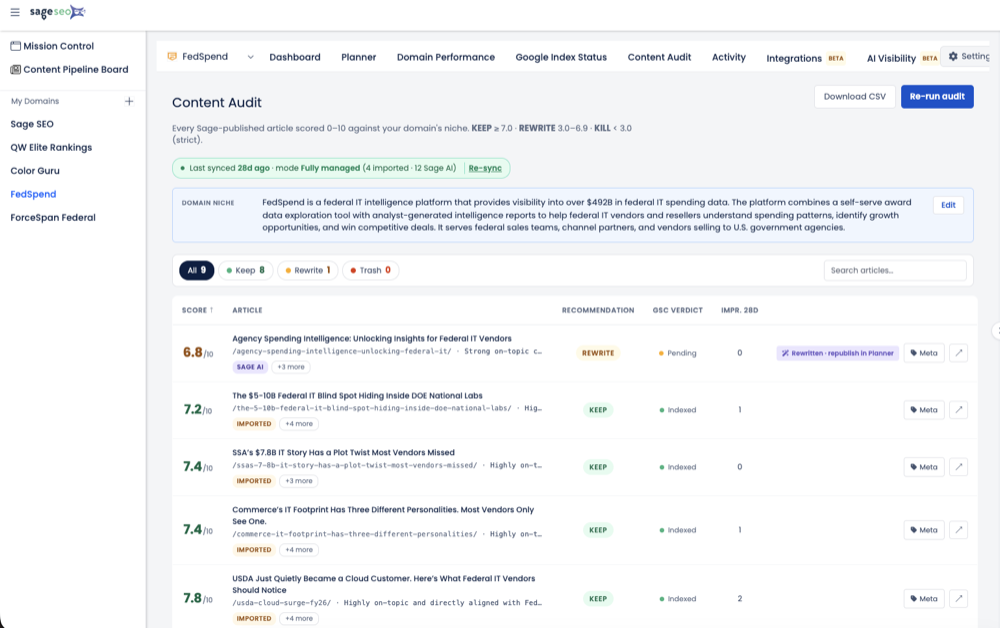
Start with a keyword or topic cluster. The platform generates a structured brief—intent, outline, questions to answer, and internal links—then guides ai-driven content writing with brand voice and compliance rules. Writers get a score as they draft, nudging depth, originality, and readability.
Push to Craft CMS with structured metadata
When approved, push directly to Craft CMS with titles, slugs, meta, alt text, and schema blocks mapped to your fields. Collaboration features keep comments, versions, and approvals in one place, so content ops can publish without copy‑pasting or broken formatting.
Admins can standardize metadata and schema per content type, enforce required fields, and route approvals by brand or region. For multi‑site Craft setups, Sage SEO supports locale variations and canonical rules, preserving structured metadata and internal links on publish.
See the AI workflows and platform overview for how the pieces connect, and review Craft publishing details in the Craft CMS integration.
Measuring ROI: From Speed to Revenue
Track leading indicators first: time‑to‑first‑draft, edit cycles per article, and content velocity per week. Expect a step‑change as templates mature and editors align.
Then monitor lagging outcomes—rankings, qualified traffic, assisted pipeline, and revenue influenced. Tie pieces to briefs and keywords so attribution isn’t fuzzy.
Test‑and‑learn roadmap
Start with a pilot on one content type and region, baseline before/after, and publish in batches. Set quarterly benchmarks, review what won, update prompts and briefs, and expand deliberately. Calculate cost per article, cost per rank‑improved page, and gross margin per content hour to prove impact. Instrument event tracking on CTAs and scroll depth so editorial changes tie to behavior. For benchmarks, review case studies and pricing transparency.
The Workflow Wins—Not the Model
Tools change fast; process compounds. Build a hybrid system where AI drafts, humans decide, and SEO guides the loop—so content scales and compounds into durable search and revenue.