
- Third-party SEO graders caused unexplainable client score drops
- The build vs buy debate consumed three full sprint cycles
- Explainability over feature parity drove the final build decision
- Launch shipped narrow — competitive and content scoring deferred
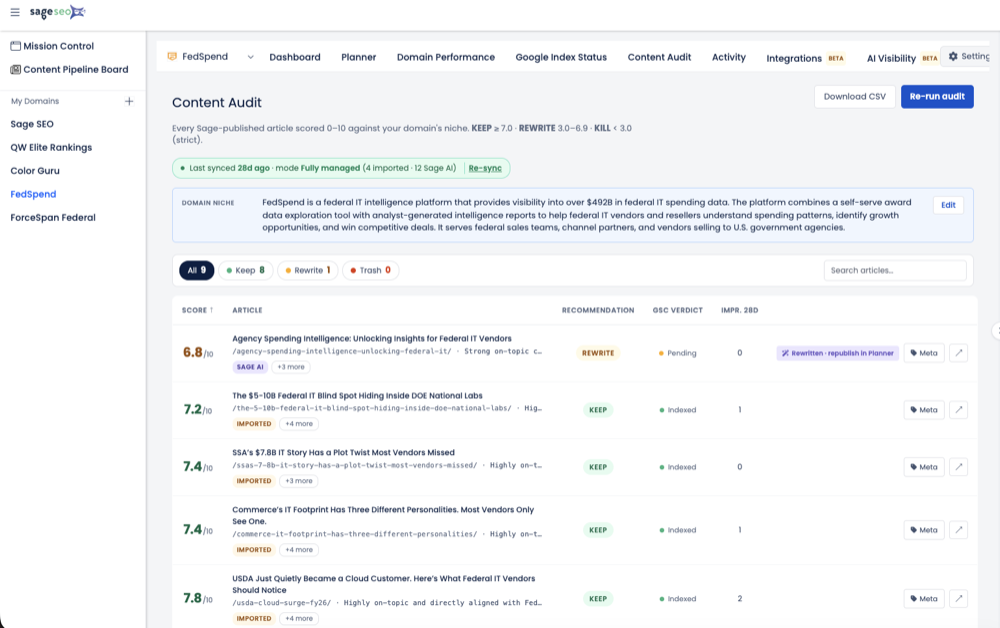
- Every score change in the dashboard traces to a specific factor
Three sprints in a row, the same slide showed up in planning: “Integrate third-party SEO grader (est. 1 sprint) vs. build scoring engine in-house (est. unknown, probably a quarter).” Three sprints in a row, we tabled it. Not because the decision was hard to understand — it’s the oldest build vs buy SEO tools argument in software — but because every time someone on the team pulled up a client account and tried to explain why a page’s score had dropped six points overnight, the room got quiet. Nobody could answer it cleanly. That’s the moment that actually settled Sage SEO product development for us, and it’s the story we want to tell plainly, cuts and all.
The Problem We Kept Running Into
The problem was simple to state and miserable to live with: we could not explain our own clients’ scores in plain language. Every third-party SEO grader we tested used a proprietary blend of signals, and when that blend updated — which happens more often than vendors advertise — scores moved without any visible reason. We’d get a support message asking “why did this page drop from 82 to 71,” and the honest answer was some version of “we don’t fully know, their model changed.” That’s not a posture you can sustain with people paying you to manage their visibility.
| What Clients Noticed | What It Signaled | Why It Eroded Trust |
|---|---|---|
| Score changed with no content edits | Vendor updated weighting silently | Looked like we’d lost control of the number |
| Two tools scored the same page differently | Different proprietary models | Made every report feel arguable |
| Support asked “what does this factor mean?” | Methodology wasn’t documented for us | We couldn’t give a straight answer |
This is the black box SEO scores problem the industry has quietly tolerated for years. We weren’t the first team to notice it, and we won’t be the last. But noticing it during our own sprint planning, on our own product, is what turned a recurring annoyance into a real strategic question: do we keep renting someone else’s opinion of “good SEO,” or do we build one we can stand behind?
Why Integrating a Third-Party Grader Was the Obvious First Choice
Buying was the sane default, and we want to be honest about that. Integrating an existing API meant we could ship a scoring feature in weeks, not quarters. The engineering lift was mostly plumbing — auth, rate limits, a display layer — compared to designing, testing, and validating a scoring model from nothing.
It’s also just how a lot of the SEO tooling market works. Plenty of platforms license or white-label an existing grading engine rather than build their own, and there’s no shame in that; it’s a reasonable allocation of engineering time when scoring isn’t your core differentiator. Under a sprint deadline, “good enough and already built” is a legitimate argument. We made that argument ourselves, more than once, in that same recurring planning meeting.
Where the Debate Got Real: The Trade-Offs We Weighed
The argument stopped being theoretical once we tried to price out both paths honestly. Buying looked cheap in sprint estimates but expensive in dependency risk: API pricing can change, rate limits can tighten, and a vendor can deprecate or re-weight a scoring model on their own roadmap, not ours. We’d be explaining someone else’s decisions to our users forever, with zero ability to adjust the model for how we actually wanted SEO health measured.
Building had the opposite risk profile. A scoring model built from scratch, under deadline, by a small team, could easily end up worse than a mature third-party tool that’s had years of refinement. That’s a real counterargument, and we didn’t dismiss it. Reinventing a wheel badly is worse than renting a good one.
| Factor | Buy (Integrate Third-Party Grader) | Build (In-House Scoring) |
|---|---|---|
| Speed to ship | Fast — days to weeks | Slow — needs design, testing, validation |
| Transparency to clients | Low — methodology not ours to explain | High — every factor is ours to document |
| Customization for our use case | Limited by vendor roadmap | Full control over weighting and scope |
| Dependency risk | Pricing, rate limits, deprecation all external | Risk is internal and self-managed |
| Initial quality vs. mature competitor | Higher on day one | Lower on day one, improves with iteration |
Laid out side by side like that, neither column wins outright. That’s the honest version of this debate, and it’s why it took us three sprints instead of one meeting to resolve.
The Deciding Factor: Explainability Over Feature Parity
What finally broke the tie was a question, not a spreadsheet: could we explain this to a client in one sentence, without hedging? A third-party grader with forty weighted factors could not pass that test for us. A narrower model we built and owned could.
So we made a deliberate trade: fewer bells and whistles at launch in exchange for a scoring model we could fully stand behind. We weren’t trying to match every metric a mature grader offered. We were trying to ship something smaller that we understood completely, down to the line — because a score you can defend builds more trust over time than a score you can impress with.
Skip the spreadsheets. Start Sage SEO free.
See how AI content ops transform your agency workflow in minutes.
That philosophy connects to how we think about rank factors and the data behind them across the rest of the product: we’d rather show our work on fewer signals than wave at a composite number nobody can audit. It’s the same instinct that shaped how we handled turning raw Search Console exports into an on-page score — start from data we can point to directly, not a formula buried in someone else’s backend.
What Shipped First vs. What Got Cut
The first version of the dashboard was intentionally narrow. We shipped a limited set of core on-page and technical factors — things like title and meta alignment, heading structure, internal link coverage, and basic crawl health — because those are signals we could measure directly and explain without caveats.
We cut a lot, on purpose:
- Broader competitive benchmarking against unrelated domains
- Granular content-quality scoring beyond structural basics
- Historical trend modeling across long time windows
- Automated recommendations tied to the score
None of that was cut because it’s unimportant. It was cut because validating the core scoring logic with real usage mattered more than launching with a long feature list we hadn’t proven yet. Premature complexity is its own kind of black box — if we’d shipped twenty factors we half-trusted, we’d be back in the exact position that started this whole debate.
| Scoring Area | Status at Launch | Reasoning |
|---|---|---|
| On-page structure (titles, headings, meta) | Shipped | Directly measurable, easy to explain |
| Technical/crawl health basics | Shipped | Clear pass/fail signals, low ambiguity |
| Internal link coverage | Shipped | Ties cleanly to site architecture |
| Competitive benchmarking | Deferred | Needed more validation before trusting comparisons |
| Deep content-quality scoring | Deferred | Risk of reintroducing a black-box factor |
- We scoped factors we could measure from data we already own.
- We tested the model against real client pages before trusting the output.
- We shipped the narrow version instead of waiting for the complete one.
- We treated every gap as a backlog item, not a hidden limitation.
This is an ongoing process, not a finished product. We expect the scoring model to evolve as we watch how teams actually use it inside tools like GSC Momentum, where real Search Console signal feeds directly into what the dashboard reports.
What This Means for Sage SEO Users
For the people using the product, this means the number on your screen is one we can actually talk through with you. If a score moves, we can tell you which factor moved it — not point at a vendor’s changelog we don’t control.
Building in-house was never about rejecting third-party tools wholesale. It was about owning the specific parts of the experience that directly touch client trust: the score itself, and the reasoning behind it.
| Question You Might Ask | Typical Third-Party Grader | Sage SEO Dashboard |
|---|---|---|
| “Why did my score change?” | Often unanswerable without vendor support | Traceable to a specific factor |
| “Can you adjust how this is weighted?” | No — fixed by vendor | Yes — it’s our model to evolve |
| “What exactly is being measured?” | Partially documented at best | Fully documented, factor by factor |
If you’re using the dashboard now, tell us what you want scored next. That feedback loop is a big part of why we’re treating this as build in public rather than a one-time release — the roadmap gets shaped by what you’re actually asking us, not by what a competitor shipped last quarter. It’s the same logic behind how we rebuilt client reporting around score history instead of static slide decks.
Build vs. Buy Was Never Really About the Engineering Hours
The real cost in this decision was never the sprint estimate. It was the long-term cost of not being able to explain our own product to the people who depend on it. That’s the part most build-vs-buy conversations in SaaS skip — they tally engineering time and licensing fees and stop there, when the number that should scare you is how often you’ll have to say “we don’t know” to a paying customer.
We shipped less than a mature third-party grader offers. We did it on purpose. What we’re exploring next — deeper content scoring, competitive context, more granular technical checks — will get added when we trust it enough to explain it, not before. If that’s slower than chasing feature parity, we’re fine with slower.
Frequently Asked Questions
What finally triggered Sage SEO to commit to building its own scoring engine?
Which factors were included in the first version of the Sage SEO dashboard?
What features were deliberately cut from the initial dashboard launch?
What is the real long-term cost of relying on a third-party SEO grader?
How will Sage SEO decide what to score next in its dashboard?

Related Posts
-
The Hidden Cost of ‘Optimize Later’: What Publishing Unoptimized Content Actually Costs You in 90 Days
Every content team I’ve worked with has made this bet at least once: publish now,…
-
How SEO Ranks Are Calculated: The Complete Data-Backed Guide to Rank Factors and Rank Data
I once watched a client’s “rank” for the exact same keyword read #4 in SEMrush,…
-
SGE SEO Audits: The Definitive Data-Backed Checklist for AI Search Readiness
SGE SEO Audits: The Definitive Checklist for AI Search Readiness I watched impressions for “sge…