
- 44.2% of ChatGPT citations pull from the first 30% of content.
- Only 38% of AI Overview citations overlap with top-10 rankings.
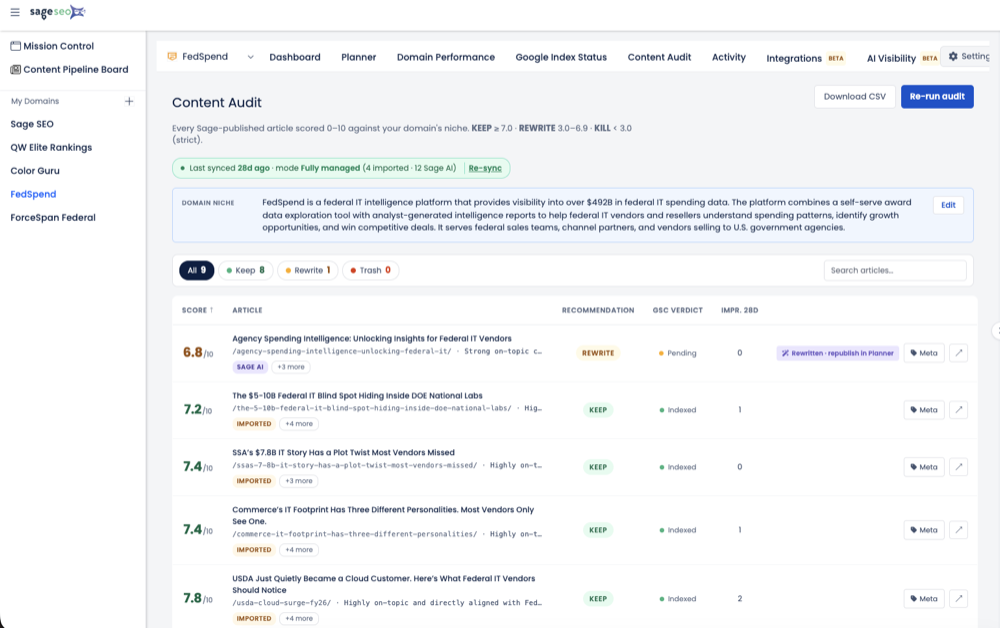
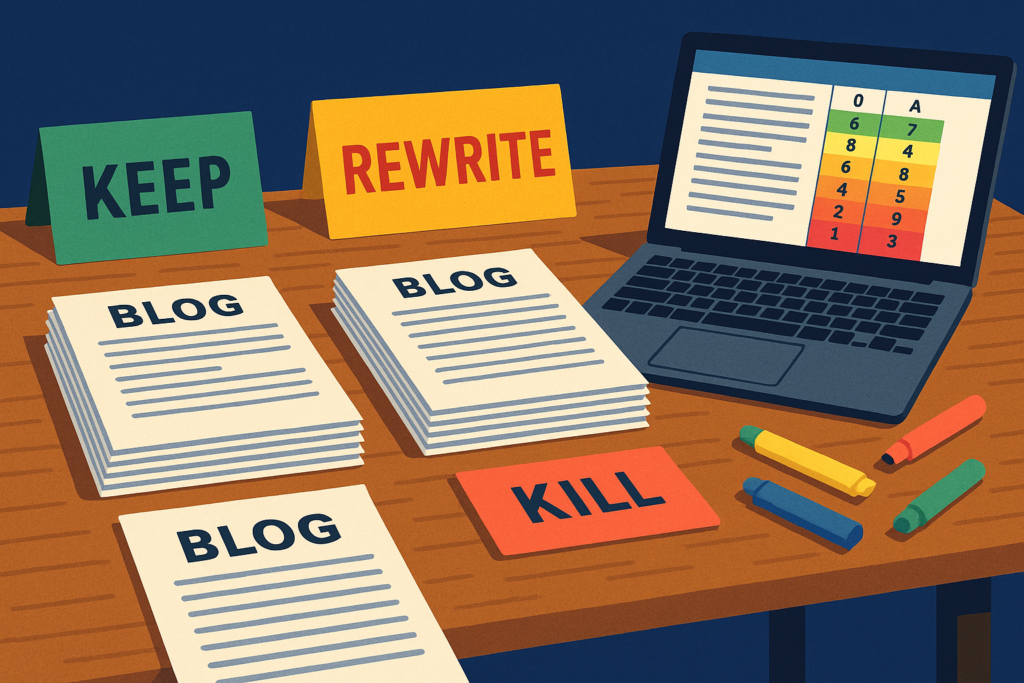
- Score pages 0–10 across five signals, then triage ruthlessly.
- Perplexity favors fresh content; ChatGPT prefers evergreen sources.
- REWRITE pages scoring 6–7 deliver the highest ROI per editor hour.
Last quarter, a B2B SaaS team I worked with discovered their highest-traffic blog post — a 14,000-word “ultimate guide” published in March 2025 — had been cited by ChatGPT exactly zero times. A 900-word comparison page from 2023, buried on page 4 of their analytics dashboard, was getting pulled into Perplexity answers nearly every week. That gap is the whole problem with how most teams are auditing their content libraries right now. Traditional SEO scoring tells you nothing about LLM citation likelihood, and if you are running a content library AI search audit on 2024 rubrics, you are grading the wrong test.
Why Your Existing Content Audit Process Will Fail You in 2026
Legacy audits optimize for crawlability and backlinks — neither predicts whether an LLM will quote you.
Traditional audit tools grade pages on keyword density, internal linking, and Core Web Vitals. AI engines do not care about any of that in isolation. They evaluate answer completeness, structural clarity, original data presence, and source trustworthiness. Google’s Helpful Content guidance hinted at this shift years ago, but the gap widened sharply once retrieval-augmented generation became the default discovery layer. The operators still measuring DA and bounce rate are scoring a game that no one is playing anymore.
The 5 Signals That Determine AI Citation Likelihood
Five content attributes — not ten, not thirty — explain most of the variance in whether a page gets cited.
1. Structural clarity and answer-first formatting
44.2% of citations come from the first 30% of content, according to Kevin Indig’s analysis of 1.2 million ChatGPT responses. Even more striking: 78.4% of citations tied to questions came from headings. Translation: H2s phrased as questions, followed by a direct one-sentence answer, are the single highest-leverage structural pattern you can deploy.
2. Freshness and update cadence
Perplexity and ChatGPT weight recency very differently. 65% of AI bot hits target content published within the past year on Perplexity, and freshness decays fast. ChatGPT, by contrast, leans heavily on evergreen encyclopedic sources — Wikipedia accounts for nearly half (47.9%) of citations among ChatGPT’s top 10 most-cited sources.
3. Original data presence
A proprietary stat, internal benchmark, or original survey is the single most reliable way to earn a citation. Synthesis posts that only aggregate other people’s data tend to lose to the primary sources they cite.
4. Citation-bait positioning
Place your most quotable claim in the first 200 words. Bury it in the conclusion and it functionally does not exist.
5. Entity and authorship clarity
Named authors, organizational affiliation, and outbound links to credible sources all act as trust signals for retrieval models trained to weight provenance.
How Do You Grade Every Page in Under Five Minutes?
Score each URL 0–10 across the five signals, average them, and bucket the result.
This is the scoring rubric I run on every content audit I take over. It deliberately trades precision for speed — you can grade 40 URLs an hour once you have the rubric memorized.
Skip the spreadsheets. Start Sage SEO free.
See how AI content ops transform your agency workflow in minutes.
| Signal | 0–4 (Weak) | 5–7 (Mixed) | 8–10 (Strong) |
|---|---|---|---|
| Structural clarity | Walls of text, no H2s | Some H2/H3, no answer-first | Question H2s + direct answers |
| Freshness | >18 months stale | Updated 6–12 mo ago | Updated <90 days |
| Original data | Zero proprietary stats | 1 benchmark or quote | Multiple original data points |
| Citation bait position | Key claim in conclusion | Claim in middle third | Claim in first 200 words |
| Entity / authorship | No byline | Byline only | Byline + bio + outbound credible links |
Bucket the averages: 8–10 = KEEP, 5–7 = REWRITE, 0–4 = KILL or consolidate. A product comparison post with strong structure but no original data typically lands at 6.4. A how-to tutorial with question H2s and a fresh update lands at 8.6. A 2022 thought-leadership opinion with no data and a buried thesis lands at 3.2. Across 200+ URLs, this rubric drops cleanly into a Google Sheet with a weighted formula.
Which Content Types Win on Which AI Engine?
The same page can be a citation magnet on Perplexity and invisible on ChatGPT — engine fit is its own optimization axis.
| Content format | ChatGPT | Perplexity | Google AI Overviews |
|---|---|---|---|
| Definitional / glossary | High | Low | Medium |
| Structured how-to | High | Medium | High |
| Data-rich comparison | Medium | High | High |
| Original research / benchmark | Medium | High | Medium |
| News / time-sensitive | Low | High | Medium |
Here is the contrarian read: ranking in the top 10 organically matters less than it used to. 37.9% of URLs cited in AI Overviews also appeared within the first 10 blocks — down from 76% in Ahrefs’ mid-2025 study. That collapse means a page sitting at position 35 with the right structure can now out-cite a position-3 page with bad structure. Retrieval-augmented systems are pulling from a much wider pool than blue-link SEO ever did.
The KEEP / REWRITE / KILL Workflow
Triage in this order: REWRITE first, KEEP second, KILL last.
- REWRITE (5–7 band): Pages with strong topical relevance but weak structure or missing data. This is your highest-ROI work. Add a question H2 in the first section, drop in one original stat, update the publish date, and re-link.
- KEEP (8–10 band): Minor freshness updates, a refreshed stat block, and a quarterly recheck. Do not over-edit pages that are already working.
- KILL or consolidate (0–4 band): Thin posts, duplicate intent coverage, or orphaned 2021 content with no traffic floor. 301 the URL into a canonical page that targets the same intent.
Within REWRITE, prioritize the 6–7 score band that targets high-volume informational queries. Those are the pages closest to crossing the citation threshold with the least editor effort.
Running the Audit at Scale: Tools, Templates, and Cadence
Full audit every quarter, micro-audit on priority clusters every month.
For libraries under 100 URLs, a Google Sheet plus a manual rubric pass is honest work. Above 200 URLs, you need a system that ingests structured signals automatically — which is exactly the workflow SageSEO’s content audit engine is built around. Pipe the output directly into your editorial calendar so REWRITE tickets get sprint-planned alongside new content, not after it.
How often should I run a content library AI search audit?
Run a full audit quarterly and a targeted micro-audit on your top revenue-driving content clusters every month. Anything less frequent and freshness decay will erode your Perplexity citation share before you notice.
Does ranking in Google’s top 10 still guarantee AI Overview citations?
No. Only 38% of pages cited in Google AI Overviews also rank in the top 10 for the same query, down sharply from 76% in Ahrefs’ July 2025 study. Structural and entity signals now matter more than absolute position.
Which content gets cited most by ChatGPT?
Encyclopedic, definitional, and structured how-to content dominates. Wikipedia alone accounts for roughly 7–14% of all ChatGPT citations depending on the measurement window, and structured H2-as-question formatting captures most of the rest.
Should I delete low-scoring pages or just leave them?
Delete or consolidate. Thin pages with no citation potential dilute your topical authority and waste crawl budget, and they cannibalize the better pages you are trying to elevate into the KEEP band.
The Real Job Is Editorial Triage, Not More Content
Most libraries do not need more posts. They need fewer, sharper ones — and a rubric that tells you which is which. The teams that win the AI-search era in 2026 are not the ones publishing twice a week. They are the ones running disciplined quarterly triage on the library they already own, killing the dead weight, and rewriting the 6.5-score pages into 8.5-score pages before their competitors do. That is the entire game. The library you inherited is probably 30% citation-ready already; you just have not graded it yet.