
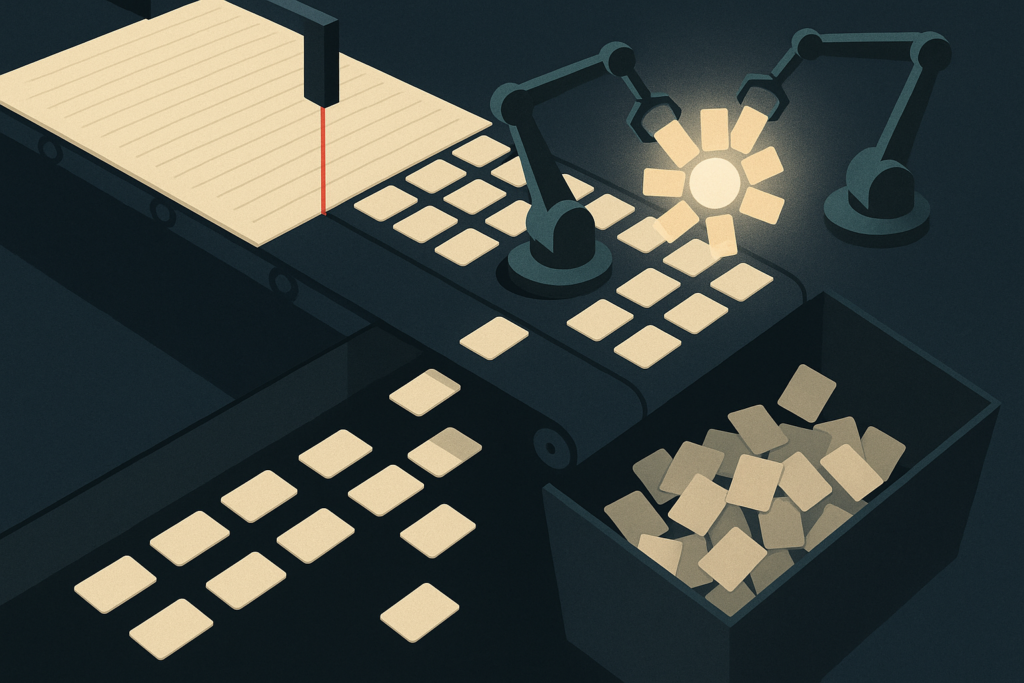
- RAG retrieves content chunks, not entire pages
- Perplexity cites sources in 97% of responses
- Only 11% of domains cited by both ChatGPT and Perplexity
- Statistics can lift AI visibility by 32–41%
- Headers and self-contained answers drive citation, not keywords
Last spring I audited a B2B SaaS client whose flagship guide ranked #2 in Google for a fat commercial keyword — and got cited exactly zero times in ChatGPT, Perplexity, or Google’s own AI Overview. The page wasn’t thin. The writing was good. The architecture was the problem. RAG systems never read that page top to bottom; they pulled disconnected chunks, scored them by embedding similarity, and reassembled an answer from competitors who chunked cleaner. That’s the whole game now, and if your content strategy still treats a page as one indivisible unit, you’re optimizing for a reader the machine never meets.
What Is RAG in AI Search, Really?
Retrieval-Augmented Generation (RAG) is the pattern where an LLM answers a query by first retrieving relevant passages from an indexed source set, then generating a response grounded in what it pulled. This section explains why that “retrieve-first” step is the thing quietly rewriting SEO.
A raw language model only knows its training data, which is frozen, stale, and prone to hallucination. Retrieval fixes that. Instead of trusting memory, the system fetches fresh, external passages at query time and stitches them into the answer.
Here’s the contrast I draw for non-engineer stakeholders. Static LLM knowledge is a closed-book exam from months ago. Retrieval-augmented generation is an open-book exam with a live library. Your content is a book on that shelf — but only if it’s shelved in a way the librarian can pull the right page from.
How Does RAG Power AI Overviews, Perplexity, and ChatGPT Citations?
RAG powers AI citations through a two-step loop: retrieve candidate passages by semantic similarity, then generate an answer that cites only the small subset the model actually leaned on. This section walks the retrieve-then-generate flow and why the same page wins on one engine and vanishes on another.
When you query Perplexity or trigger an AI Overview, the engine runs a semantic search against an index, grabs a handful of top passages, and hands them to an LLM as grounding context. The model writes the answer and attaches citations to the sources it used. Citation isn’t a popularity vote — it’s semantic search relevance scoring plus trust signals.
That scoring is why ranking and citation have split apart. One analysis of roughly 680 million citations found only 11% of domains are cited by both ChatGPT and Perplexity — two nearly separate ecosystems. And Otterly and Yext citation data show Perplexity cites sources in about 97% of responses, Google AI Overviews in 34%, and ChatGPT in only 16%.
So a page can dominate Google and still be invisible in ChatGPT — different retrieval corpus, different recency weighting, different chunking. I learned to stop treating “AI search” as one target the same way I stopped treating real-time AI optimization as a bolt-on to legacy SEO. They’re distinct surfaces.
Inside the RAG Pipeline: Embeddings, Chunking, and Vector Stores
The RAG pipeline turns your page into numerical vectors, stores them, and retrieves the closest ones to a query — so how you split and label content directly controls what gets found. This section breaks the pipeline into the steps that actually change your outcomes.
Here’s the flow I sketch on every kickoff whiteboard:
- Ingestion — the engine crawls and parses your page into raw text.
- Chunking — that text gets sliced into passages, often a few hundred tokens with slight overlap.
- Embedding — each chunk becomes a vector embedding, a coordinate in meaning-space.
- Vector storage — those vectors land in a vector store (think FAISS, Pinecone, or pgvector conceptually).
- Similarity search — the query is embedded too, and nearest chunks are retrieved.
- Generation — the LLM writes an answer grounded in the retrieved chunks and cites them.
Why Chunk Size and Overlap Decide Your Fate
Chunking is where most content quietly loses. If your key answer is split across a 400-word ramble with the payoff in sentence nine, the chunk that gets retrieved may carry the setup and drop the conclusion. I’ve watched a client’s definition get cited only after we tightened it into one self-contained 40-word passage under a clear header.
Skip the spreadsheets. Start Sage SEO free.
See how AI content ops transform your agency workflow in minutes.
Overlap matters too — a little repetition between chunks preserves context so a retrieved passage still makes sense standing alone. That’s not a writing tic; it’s a content chunking strategy. When my team wired this thinking into a custom GPT build for internal drafting, the same discipline that made our RAG bot accurate made our public pages more retrievable. Same mechanics, both directions.
What Content Structures Actually Get Retrieved?
Self-contained sections with clear headers and front-loaded answers get retrieved; long undifferentiated prose does not. This section covers the structural moves that make chunks legible to a retriever.
A September 2025 UC Berkeley study behind the GEO-16 framework analyzed 1,702 citations across Brave, Google AI Overviews, and Perplexity and found three structural pillars — metadata/freshness, semantic HTML, and structured data — most tied to citation. Pages hitting the quality bar reached a 78% cross-engine citation rate.
What that looks like in practice:
- Front-loaded answers — put the direct claim in the first sentence under each header.
- Scoped subsections — one question, one answer, one chunk.
- Entity clarity — name things explicitly; retrievers can’t resolve vague “it” references.
- Schema and tables — FAQ markup and structured data give parsers clean handles.
This is why FAQs and crisp definitions outperform beautiful, meandering essays. If you want a fuller structural teardown, my notes on on-page and technical fundamentals still hold — retrievers just raised the stakes on getting them right.
How to Make Your Brand Content “RAG-Ready”
RAG-ready brand content is chunkable, entity-clear, factually dense, and freshness-signaled — a page a retriever can slice into standalone, citable passages. This section gives the checklist I run before anything ships.
| RAG-Ready Signal | Weak (skipped by retrievers) | Strong (retrieval optimized content) |
|---|---|---|
| Chunkability | Answer buried mid-paragraph | Answer in first sentence under a header |
| Entity clarity | “the platform,” “it,” “this tool” | Named products, people, and concepts |
| Factual density | Adjectives and vibes | Dated stats, sample sizes, sources |
| Freshness | No visible date, 2021 examples | Clear publish date, current-year data |
Treat those four as your rag ready seo data standard. When I retrofit a legacy library, I don’t rewrite prose first — I re-chunk it, then add density. You can pressure-test your own catalog the same way with a structured AI-search readiness audit, and if you want that scored continuously, cross-engine citation tracking tells you which chunks are actually earning mentions instead of guessing.
How Does RAG Improve Content Marketing and SEO Outcomes?
RAG improves outcomes by turning citations into a high-intent traffic and authority channel that traditional rankings no longer guarantee. This section ties the mechanics back to revenue.
The visitors are few but valuable. Ahrefs data shows AI search referred just 0.5% of visitors yet drove 12.1% of signups — a roughly 24:1 conversion edge over organic. Being cited also lifts adjacent organic CTR, so the channels compound instead of cannibalizing. That’s the closed loop I chase: real demand in, structured content out, citations and pipeline back.
Stop Writing Pages. Start Engineering Chunks.
Here’s my earned opinion after a year of these audits: GEO isn’t a new flavor of SEO, and it isn’t a threat to it — it’s a content architecture discipline most teams haven’t staffed for yet. The brands winning AI citations aren’t the ones with the biggest domains. They’re the ones who understood that a retriever reads in fragments and built their content to be quoted, not just crawled. Rewrite one buried answer today, watch what gets cited, and you’ll never structure a page the old way again.