
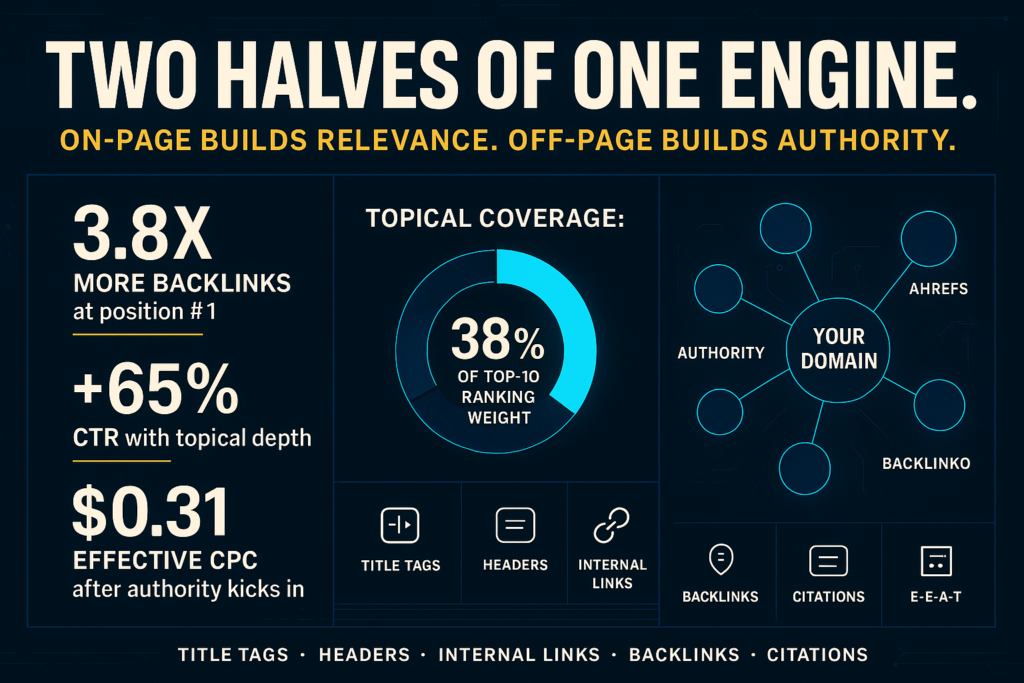
- On-page signals relevance; off-page signals authority.
- Topical depth beats keyword stuffing in 2025.
- Top results have 3.8x more backlinks than rivals.
- AI Overviews favor the same authoritative domains.
- Build strong pages first, then earn links.
Here’s the uncomfortable truth most SEO guides bury: the #1 result in Google has an average of 3.8x more backlinks than positions #2-#10, according to Backlinko’s analysis of 11.8 million search results. But the #1 result also has something else — topical depth most competitors never bother to build. On-page and off-page SEO aren’t two checkboxes on a marketing to-do list. They’re the two halves of one engine. Skip either, and your site idles in page-two purgatory while competitors with worse products outrank you.
What Is On-Page SEO and Why Does It Matter?
On-page SEO is everything you control on your own pages to help search engines understand and rank your content.
That includes the obvious mechanics — title tags and meta descriptions, header structure, keyword placement, internal linking — and the less obvious quality layer that Google now treats as table stakes. Surfer SEO’s 2025 analysis of 1 million SERPs identified topical coverage as the most important on-page factor, beating exact-match keywords and even content length.
Translation: scattering your target phrase across an 800-word post no longer cuts it. Google rewards pages that exhaustively answer the question and its adjacent questions.
On-page SEO also absorbs the technical foundation. Page speed, mobile responsiveness, Core Web Vitals, and clean HTML structure all live here. Google’s own Search Central documentation treats page experience signals as confirmation factors — they won’t push a thin page to the top, but they will drop a strong one off it.
And after the June 2025 Core Update, the Helpful Content system was integrated more deeply into the core algorithm, meaning E-E-A-T signals (Experience, Expertise, Authoritativeness, Trustworthiness) now shape rankings at the sitewide level. A handful of thin pages can drag down your whole domain.
Key On-Page SEO Techniques to Implement Today
The on-page work that moves rankings in 2026 is structural, not cosmetic.
- Front-load primary keywords in title tags. Keep titles under 60 characters and place the target phrase near the start where Google weights it most.
- Write meta descriptions for clicks, not for crawlers. Backlinko’s data shows keyword-rich URLs earn roughly 45% more clicks than generic slugs — the same psychology applies to the snippet.
- Use H1, H2, and H3 tags to build a logical hierarchy. One H1 per page. H2s for major sections. H3s for sub-questions readers actually ask.
- Optimize images with descriptive file names, alt text, and compression. Aim for under 100KB where quality allows.
- Build a deliberate internal linking strategy. Every new post should link to two or three older relevant pages, and vice versa, to distribute authority.
Here’s a quick map of what to prioritize when you sit down to optimize a page.
| Element | What Matters Most | Common Mistake |
|---|---|---|
| Title tag | Primary keyword + click hook | Stuffing modifiers, exceeding 60 chars |
| Meta description | Specific promise of value | Auto-generated boilerplate |
| Headers (H1–H3) | Question-format, semantic depth | Decorative headers with no keywords |
| Body content | Topical coverage of related subtopics | Thin 600-word posts |
| Internal links | Descriptive anchor text, deep linking | Repeated “click here” anchors |
What Is Off-Page SEO and How Does It Build Authority?
Off-page SEO is every signal Google picks up about your site from somewhere other than your site.
Backlinks are the headline act, but the supporting cast — brand mentions, third-party reviews, citations in directories, social references — all feed into how trustworthy your domain looks. Search engines treat these as votes from the wider web because you can’t fake them at scale without leaving fingerprints.
This is where domain authority comes in. It’s not a Google metric, but the underlying concept is real: sites with stronger backlink profiles consistently outrank sites with weaker ones. An Ahrefs analysis cited across the industry in 2024 found that pages with links from domains rated DA 70+ ranked, on average, two positions higher than pages without them. Authority compounds.
Skip the spreadsheets. Start Sage SEO free.
See how AI content ops transform your agency workflow in minutes.
Proven Off-Page SEO Strategies That Drive Results
The link-building tactics that still work in 2026 require effort that scammy shortcuts can’t replicate.
- Digital PR and original research. Publishing proprietary data — surveys, studies, benchmarks — earns natural editorial links because journalists need sources.
- Strategic guest posting. Not on link farms. On the three or four publications your target customer actually reads.
- Content partnerships. Co-marketing with non-competing brands in your niche generates contextual links from trusted domains.
- Local citations and directory listings. For brick-and-mortar or service-area businesses, consistent NAP (name, address, phone) data across Google Business Profile, Yelp, and industry directories drives local pack visibility.
- Unlinked brand mentions reclamation. Search for mentions of your brand that didn’t link back, then politely ask the publisher to add a link.
- Social signals and PR-driven mentions. They’re not direct ranking factors, but they accelerate link discovery and brand search volume, which is a ranking factor.
What to avoid is just as important. Private blog networks, paid link packages from Fiverr, comment spam, and reciprocal link schemes are all in Google’s Spam Brain crosshairs. A single manual action can erase years of work.
And here’s where the AI search shift matters: Semrush found that AI Overviews show roughly 86% domain overlap with traditional Google results. The same authoritative sites being cited by ChatGPT and Perplexity are the ones ranking organically. Authority transfers across surfaces.
How On-Page and Off-Page SEO Work Together
The contrarian point most agencies won’t tell you: on-page and off-page SEO are sequential, not equal.
Earn links to a thin page and the link equity drains into a leaky bucket. Build a definitive, topically-rich page on a no-authority domain and nobody finds it. The right order is build the asset, then promote the asset. Strong on-page content earns natural backlinks because journalists and bloggers cite specific, useful pages — not vague homepages. And off-page authority amplifies pages that already deserve to rank, lifting them from page two to page one. Treat them as one workflow.
What is the difference between on-page and off-page SEO?
On-page SEO covers everything you control on your website — content, HTML tags, internal links, page speed. Off-page SEO covers signals from outside your site, primarily backlinks, brand mentions, and citations that prove your authority to search engines.
How do I build backlinks to improve search engine rankings?
The most durable methods are digital PR, original research, strategic guest posts on relevant publications, and reclaiming unlinked brand mentions. Avoid paid link schemes — Google’s algorithms detect them and the penalty cost outweighs the short-term gain.
How long does SEO take to show results?
Most sites see measurable movement in three to six months, with meaningful organic traffic gains around month nine. Newer domains take longer because trust signals accumulate slowly.
Are backlinks still important with AI search rising?
Yes — arguably more so. AI Overviews and chat-based engines source heavily from high-authority sites, and authority is still built primarily through backlinks. The substrate hasn’t changed; the surfaces have.
Where to Take Your SEO Strategy Next
Stop treating on-page and off-page SEO as separate budgets fighting for attention. They’re the same engine. Audit your top ten landing pages for topical depth and technical hygiene first. Then, and only then, invest in the link-building campaigns that will lift those pages into the territory where 3.8x more backlinks actually means something.