
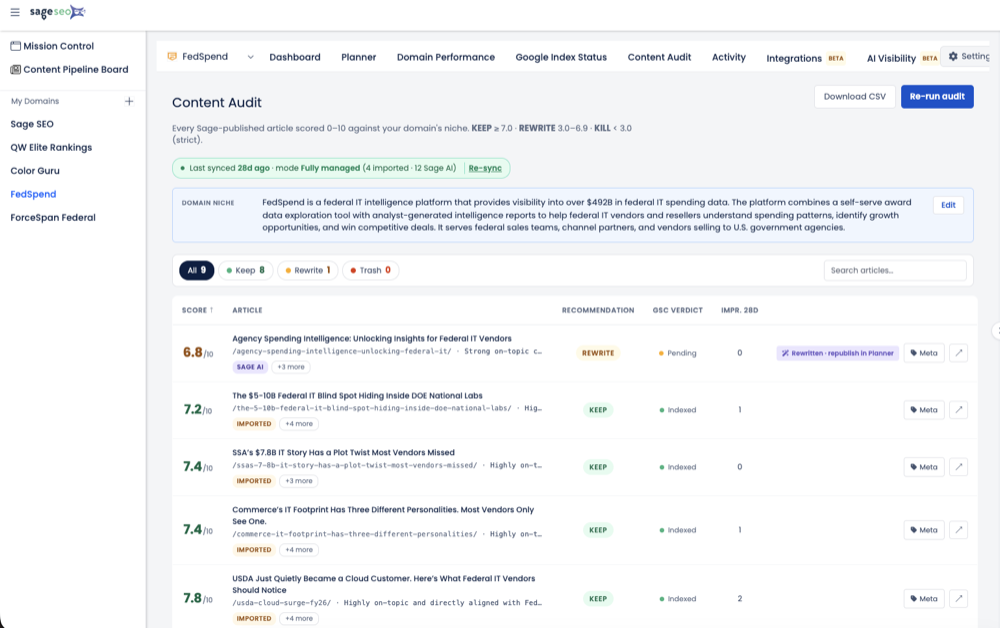

- 214 orphaned posts were found on one six-year-old B2B site
- Orphaned content weakens topical authority across the entire site
- Start with strong pillar pages before relinking orphaned supporting content
- Automated linking tools make reviewing 200-plus posts realistic
- Prioritize reweaving pages that already carry backlinks and traffic history
I audited a six-year-old B2B content site last fall and found 214 blog posts with zero inbound internal links. Every one was indexed. Most still ranked for something, buried on page two or three. The client’s instinct was to nuke the lot and start fresh. That instinct was wrong, and figuring out why reshaped how I approach every legacy site audit since.
Orphaned content isn’t dead content, it’s unattached content. Google already crawled it, already assigned it some link equity, and in a lot of cases already decided it was trustworthy enough to index. The job is to find which of those 214 posts are one or two links away from becoming real supporting evidence for a topic you’re trying to own right now, and reweave them into that structure instead of starting a link-building project from scratch.
The Hidden Cost of Orphaned Content on Legacy Sites
An orphaned page is any indexed URL with zero or near-zero internal links pointing to it, invisible to both crawlers and readers navigating your site even though it technically still exists in Google’s index. Confirm this with a crawl report cross-referenced against your internal link graph: if a page shows up in Search Console’s index coverage but has one or no internal links in a tool like Screaming Frog, it’s orphaned. A proper content audit against the full archive, not just the pages you remember, is the only reliable way to surface the full list.
This accumulates quietly. Publish 15-20 posts a year for five years with no deliberate linking strategy, and you’ll have hundreds of pages never connected to anything published after them. Nobody did this on purpose, it’s just what happens when content outpaces anyone revisiting the archive.
The real damage isn’t to any single post, it’s to topical authority across the whole site. Google’s own guidance on site structure describes a hierarchy where related content should be grouped and interlinked so users and search engines understand how pages relate. When 200 posts sit disconnected from that hierarchy, your site structurally resembles 200 unrelated micro-sites instead of one authority.
| Signal | Healthy Page | Orphaned Page |
|---|---|---|
| Internal links pointing to it | 3+ from relevant pages | 0-1, often from a sitemap page only |
| Indexation status | Indexed, crawled regularly | Indexed, but crawl frequency drops over time |
| Ranking behavior | Stable or improving for target terms | Ranks for long-tail terms it wasn’t written for |
| Traffic trend | Flat to growing | Slow, multi-year decay |
Why “Build More Links” Doesn’t Work on a Site Like This
A link-building project fails here because the problem isn’t a shortage of links, it’s a mismatch between 200-plus pages and the handful of topics the business wants to rank for today. The site I mentioned had orphaned posts scattered across roughly 30 loosely related subtopics, some tied to a product line the company hadn’t sold in three years.
Manually reviewing 214 posts, deciding which cluster each belongs to, and hand-placing contextual links is a multi-week project even for a sharp content lead. It’s inconsistent by nature, too: the person doing link #12 makes different judgment calls than the person doing link #190, and six months later nobody remembers the logic behind either. I’ve seen the same scattershot pattern on high-volume newsroom archives, just with publish-date chaos instead of blog-category chaos.
So I stopped framing it as a link-building problem. It’s a content-mapping and relevance-matching problem first, the same diagnostic instinct behind any solid content audit framework: map before you touch anything. Once you know which old posts belong near which current topic, the linking itself is almost mechanical.
Step 1: How Do You Audit and Map Orphaned Content Against Topic Clusters?
You find orphaned pages by comparing a full site crawl against your internal link report, then group survivors by topic similarity rather than by publish date. Publish date tells you nothing about relevance. Topic does.
A typical legacy audit runs in this order:
- Pull a full crawl (Screaming Frog, Sitebulb, or similar) and export every indexable URL.
- Cross-reference against Google Search Console’s indexation report and your internal link count per URL.
- Flag anything indexed with fewer than two internal links as orphaned.
- Cluster the flagged pages by topical similarity, not category tags or publish date.
- Within each cluster, separate “near misses” from deadweight.
That last step matters most. A near miss is an orphaned post genuinely adjacent to a topic you’re actively building, just never connected to it. A post comparing two project-management tactics from 2021 might be a near miss for a 2026 pillar on remote team workflows. Deadweight is content about a product line you sold off, no matter how well it once performed. I ran a similar spreadsheet-first audit for a B2B SaaS client with 340 published posts, and the mapping took longer than the actual linking once clusters were clear.
Step 2: Establishing Pillar Content as the Anchor Point
Rebuilding authority starts with a strong, current pillar page per topic cluster, not with the orphaned posts themselves. Orphaned content has no gravity of its own, it needs a hub to orbit.
Skip the spreadsheets. Start Sage SEO free.
See how AI content ops transform your agency workflow in minutes.
Think of the pillar as the page you’d want to rank number one for the head term in that cluster. Every near-miss post gets rewoven around it as supporting evidence, a specific angle, a use case, a comparison the pillar only gestures at. It’s the same topic cluster logic applied in reverse: instead of building supporting content after the pillar, you’re excavating supporting content you already published years ago.
Here’s the catch nobody likes hearing: some clusters won’t have a pillar worth anchoring to yet. Linking orphaned posts to each other without a hub just connects orphans to other orphans. In that case, the first deliverable isn’t a linking map, it’s a new pillar page, built before any reweaving starts.
Step 3: Where Automated Internal Linking Changes the Math
An automated internal linking engine scans the full body of existing content for contextual relevance at a scale manual review can’t match, which makes reweaving 200-plus posts realistic instead of theoretical. A human comparing 200 posts against five pillar pages faces roughly a thousand possible pairings. Nobody does that by hand with any consistency.
This is where tools in the automated internal linking category earn their keep. The better implementations don’t auto-publish links blind. They surface contextually relevant pairings, orphaned post to pillar, post to sibling post, and let a human approve, reject, or adjust anchor text before anything goes live. Full automation without review produces technically-relevant-but-tonally-wrong links, the kind that read as spammy even when the topic match is correct.
What this replaces is the slow part: manually scanning hundreds of old posts for a plausible home. What it doesn’t replace is the strategic call on which pillars matter this quarter. That judgment stays human. I’ve watched teams skip it and end up internally linked, with no clear point of view on what the site wants to rank for.
| Approach | Time to Review 200 Posts | Consistency | Best For |
|---|---|---|---|
| Fully manual review | Weeks, often stalls out | Degrades as the project drags on | Sites under ~30 orphaned pages |
| Fully automated, no review | Minutes | High, but relevance can misfire | Nothing, not recommended |
| Automated suggestion + human approval | Hours to a few days | High, judgment applied consistently | Legacy sites with 100+ orphaned pages |
Step 4: How Should You Prioritize Which Orphaned Pages to Reweave First?
Prioritize by existing backlinks and historical traffic first, topical proximity second, and treat everything else as a later pass. A post with three external backlinks and a 2022 traffic peak carries real, recoverable link equity. A post with none of that is lower stakes.
The trap is linking everything to everything because volume feels like progress. It isn’t. A thin, 400-word post duplicating a better page should usually be consolidated into it, not linked to as a separate URL. This is the same logic behind content pruning and consolidation, a strategy SEO practitioners have written about for years: sometimes the right move for a weak page is merging it into something stronger, not giving it a link.
| Priority Tier | Criteria | Recommended Action |
|---|---|---|
| Tier 1 | Existing backlinks + topical proximity to an active pillar | Link into the pillar cluster immediately |
| Tier 2 | Decent historical traffic, moderate topical fit | Link within 1-2 content refresh cycles |
| Tier 3 | Thin content, overlaps an existing stronger page | Consolidate or redirect, don’t link separately |
| Tier 4 | No backlinks, no traffic, no cluster fit | Deprioritize or prune |
Step 5: How Do You Know Topical Authority Is Actually Recovering?
You’ll see it first in indexation stability and reduced internal link depth, well before you see it in rankings. Track how many clicks it takes to reach a page from the homepage, that’s link depth, and watch it shrink for posts you’ve rewoven. Track ranking movement for the cluster’s whole keyword set, not just the pillar’s main term.
Be realistic about pace. Google’s own guidance on creating helpful, people-first content frames quality and structure signals as evaluated over time, not re-scored instantly. A new site can see linking changes reflected in rankings within weeks. A legacy site with years of crawl history moves slower, authority here compounds over months, because the crawler has to re-establish trust in a structure it’s seen a certain way for years.
| Signal | New Site Timeline | Legacy Site Timeline |
|---|---|---|
| Re-crawl of updated internal links | Days to 1-2 weeks | 2-6 weeks |
| Indexation of previously orphaned pages improves | Weeks | 1-3 months |
| Cluster-level keyword rankings shift | 4-8 weeks | 3-6 months |
Common Mistakes When Rebuilding Authority on Old Sites
Most failed reweaving projects make one of three mistakes, and all three are avoidable. I’ve made each one myself before I knew better.
- Treating internal linking as a quantity game. Ten relevant links beat fifty loosely-related ones.
- Ignoring content quality issues a link can’t fix. Linking to a thin or outdated post just sends people to a bad page faster.
- Running this as a one-time project. New posts become tomorrow’s orphans if nobody revisits the link graph, the same lesson I learned with a batch meta title rewrite that helped for a quarter and quietly drifted out of date.
Legacy Sites Don’t Need a Linking Project. They Need Linking Infrastructure.
Every legacy site I’ve audited treats internal linking as something you did once, back when the site was small enough to hold in your head. That’s the actual root cause of orphaned content, not laziness, just a process that never scaled past the first 50 posts. Automation doesn’t replace the strategic call on which pillars matter. It makes it possible to keep the linking current every month instead of once every few years when someone finally notices the traffic graph sliding, the same way a publish cadence you actually maintain beats a calendar nobody opens. Treat this as infrastructure, not a project with an end date, and the orphan problem stops recurring.