

- GSC impression spikes signal rising demand before competitors act
- Daily 10-minute triage catches spikes monthly reviews miss entirely
- A four-stage same-day workflow takes under four focused hours
- Thin same-day articles dilute domain quality—unpublish, don't update
- Requesting indexing immediately after publish closes the time-sensitive loop
Last Tuesday at 7:40 a.m., I opened a client’s Search Console and saw a query that had gone from six impressions to 290 impressions in four days, with exactly zero clicks. No seasonal pattern, no press mention, nothing on the client’s calendar to explain it. By that evening, there was a live, indexed article targeting that exact query. That turnaround — not the spike itself — is the part nobody talks about.
Everyone who’s used Search Console for more than a month has seen a spike like that and done nothing with it. I did that for years. The problem was never spotting demand — Search Console hands you demand signals constantly, for free. The real problem is the gap between “I noticed something” and “it’s live and indexed,” a gap that, in most content operations I’ve audited, runs two to four weeks. By the time the article ships, the query has cooled or a competitor beat you to it.
Why Checking Search Console Once a Month Kills Your Best Ideas
Most content teams treat Search Console like a monthly report instead of a live signal feed, and that cadence is exactly what lets rising queries go cold before anyone acts on them. An impressions spike is a leading indicator — it tells you Google is already testing your domain against a query before you’ve written a word for it. Treated as a lagging indicator, something you review in a quarterly audit, it’s useless by the time you see it.
Here’s the cadence mismatch I see most often, laid out plainly:
| Review Cadence | When You Actually Look | What You Catch | What You Miss |
|---|---|---|---|
| Monthly audit | Once every 30 days | Topics that stayed relevant for weeks | Short-lived spikes, time-sensitive demand |
| Weekly dashboard glance | Once every 7 days | Slower-building trends | Sudden 3-5 day spikes that peak and decay fast |
| Same-day triage (mine) | Daily, 10 minutes | Demand while it’s still rising | Almost nothing, but costs more discipline |
So here’s what I actually do, every single time I see a spike worth acting on — the whole loop, start to finish, inside one working day.
Step One: How I Spot a Rising Impressions Query
A genuine spike looks like a sudden jump over 3-5 days, not a slow seasonal drift, and it almost always shows rising impressions paired with flat or zero clicks. That combination — demand without supply — is the single highest-leverage place to start a content brief, because Google is already showing your pages for the query and you simply haven’t answered it yet.
Demand Without Supply: The Signal I Trust Most
I filter the Performance report for queries with climbing impressions against the trailing week, then sort by click-through rate ascending. Queries near the bottom — impressions in the hundreds, clicks in the single digits — go on my watch list first. It’s a far more underused asset than most teams realize; I’ve written before about how a verified Search Console property often sits quietly ignored for months while the data needed to prioritize content is right there.
I don’t chase every spike. Branded queries, one-off news mentions, and obvious seasonal noise get filtered out immediately. What’s left is usually a handful of queries a week genuinely worth a same-day slot, and I track that momentum using GSC Momentum rather than re-pulling exports manually every morning.
Step Two: Feeding the Signal Into My Content Calendar
Not every spike earns a same-day slot, and skipping this triage step is how speed turns into waste. Before anything touches the calendar, I run three quick qualifying questions: does this query match my audience, does it carry commercial or informational intent worth owning, and can it realistically be covered well inside a single afternoon.
- Is this query relevant to who actually buys from this site, or is it tangential traffic?
- Does it carry enough intent (commercial or clearly informational) to justify a dedicated page?
- Can I say something real about it in a few hours, or does it need a week of research?
Queries that pass all three get logged as same-day candidates inside the content calendar. Everything else gets queued for a normal production cycle.
| Dimension | Same-Day Candidate | Queued Topic |
|---|---|---|
| Audience relevance | Directly matches core buyer or reader persona | Adjacent or secondary audience |
| Intent strength | Clear commercial or specific informational intent | Vague, broad, or navigational |
| Feasibility | Can be covered well from existing knowledge | Needs original research, data, or interviews |
| Window | Spike is days old and still climbing | Trend has existed for weeks already |
Skipping this step feels like it saves time. It doesn’t — it’s exactly how I ended up publishing the thin article I’ll walk through further down.
Step Three: What Actually Goes Into a Same-Day Brief?
A same-day brief gets auto-generated from the query, the current SERP context, and whatever the site already publishes on adjacent topics — but it still gets a human pass before anyone writes a word. The draft pulls in ranking pages for the query, flags the format Google currently rewards (listicle, comparison, how-to), and surfaces existing pages that might overlap or cannibalize.
The Human Checkpoint That Can’t Be Skipped
Review takes roughly 10-15 minutes, checking three things:
- Does the brief’s angle actually match search intent, or did the auto-pull misread an ambiguous query?
- Is there a genuinely differentiated angle, or would this just duplicate a page we already have?
- Is the scope realistic for same-day writing, or does this topic need interviews, data, or a week of research?
That third checkpoint is the one I got sloppy on exactly once, and it’s the direct cause of the failure story later in this piece. Skipping the scope check doesn’t save time on day one — it costs a full rewrite, or a deletion, a week later.
Skip the spreadsheets. Start Sage SEO free.
See how AI content ops transform your agency workflow in minutes.
Step Four: Writing and Publishing in a Single Afternoon
A real same-day article gets written and shipped inside roughly three to four focused hours, split across four time-boxed stages rather than one long unstructured sprint. I’ve tried open-ended “write until it feels done” sessions and they reliably blow past the window. Boxing each stage keeps the whole loop honest.
- Lock the brief and outline — 15 minutes, no exceptions.
- Draft the full article — 60 to 90 minutes, first pass only, no editing mid-write.
- Edit for accuracy, structure, and voice — 30 to 45 minutes.
- Publish, format, and queue internal links — 15 to 20 minutes.
What gets cut under that constraint, and what never does, breaks down pretty cleanly:
| Element | Same-Day Treatment |
|---|---|
| Original research or interviews | Cut — moved to the standard queue instead |
| Clear answer to actual search intent | Kept — non-negotiable |
| Specific real examples | Kept — placeholder language is not allowed |
| Extensive competitor benchmarking | Cut — a quick SERP scan only |
| At least one genuinely specific detail | Kept — this is the line against filler content |
That last row is the real dividing line between a same-day article and a same-day filler page.
Step Five: Why Does Indexing Speed Matter More Than Writing Speed?
Publishing fast is pointless if the page sits unindexed for days or weeks, because the entire point of same-day publishing is catching demand while Google is still testing the query against your domain. A rising impressions query is, by definition, a narrow window. If your new page lands in the index three weeks after the spike started, you’ve written a good article for a moment that already closed.
Requesting indexing immediately after publishing — instead of waiting for a crawl to happen naturally — is what closes the loop between writing and visibility. It’s the step most “move fast” processes skip, because it happens after the exciting part is already done. I treat it as non-negotiable: the article isn’t finished until the indexing request has gone out, not when the publish button is clicked.
The Time I Killed a Same-Day Article
I’m not going to pretend this process is clean every time. About eight months into running it this way, I saw a spike that looked like every other same-day candidate — rising impressions, near-zero clicks, clearly relevant to the client’s audience. I skipped the scope check from Step Three because I was behind on two other pieces that day, and pushed the brief through as-is.
The article that came out of it was technically complete and practically useless. It answered the query at the shallowest level, said nothing the top three ranking pages didn’t already say better, and read like it existed to exist rather than to help anyone. It sat live for about three weeks, earned a handful of impressions, and converted none of them into the engagement the client actually needed.
What I Changed After That
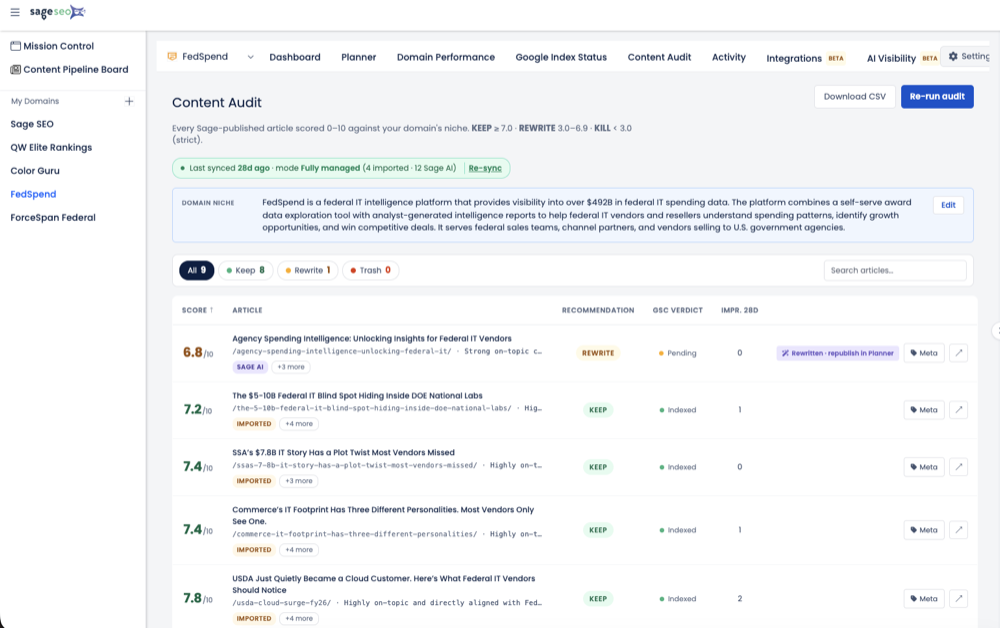
I unpublished it. Not updated — unpublished, because a thin page that ranks for nothing is worse than no page at all; it dilutes the domain’s quality signal and wastes crawl budget. The fix was simple: a hard stop before any query gets marked “approved for same-day,” asking whether the topic deserves more than a surface treatment. If the honest answer is yes, it goes to the standard queue instead, no matter how fresh the spike looks.
What This Workflow Actually Requires
This loop only works with four things in place, and skipping any one is how teams end up with no output or bad output.
- Verified Search Console access with clean historical data — if your domain isn’t properly verified, you’re flying blind on the signal itself.
- A publishing workflow flexible enough to move a draft from brief to live in hours, not through a multi-week approval chain.
- Someone with enough editorial judgment to spot a thin brief before it becomes a thin article.
- A genuine willingness to kill or unpublish weak output, even after the effort of writing it.
This is a repeatable discipline, not a one-off trick for a slow week. Teams that succeed with it treat it as a daily habit, not a quarterly sprint.
Speed Is the Advantage Now, Not the Shortcut
I used to think fast publishing was a compromise — something you did when you didn’t have time to do it right. I don’t believe that anymore. The real risk was never speed; it was speed without a checkpoint, a completely different failure mode. A same-day article with a real editorial gate behind it will outperform a “perfect” article that ships three weeks after the demand that justified it has moved on.
I also stopped judging these articles by pageviews a long time ago. The only question that matters is whether a same-day page eventually shows up as something that moved pipeline, not just rankings — the same lens I use whenever I’m building out a client reporting deck instead of a vanity-metrics dashboard.
Start with one spike this week. Run it through the full loop once, honestly, willing to kill it if it’s thin. Then decide if it’s worth a habit instead of a one-time experiment.