
- Practice area pages — not blog posts — drive legal consultations
- Content decay costs rankings before it costs client inquiries
- A quarterly refresh cycle replaces the need for a full-time writer
- Local specificity like named courts separates high-ranking pages
- Attorney review is mandatory before publishing updated legal content
I’ve audited law firm websites where the “attorneys” page gets refreshed every time someone makes partner, but the practice-area pages — the ones actually driving consultation requests — haven’t been touched since the site launched in 2019. I’m not exaggerating for effect. I pulled up a regional firm’s family law page last year and found a reference to a court filing fee that had changed three years earlier. Nobody noticed because nobody was looking. That’s the real story behind most underperforming law firm websites: not a lack of content, but a pile of aging content nobody owns.
If you’re a managing partner, marketing director, or office administrator wondering why your SEO for law firms strategy stopped working after the initial site launch, this is almost certainly why. You don’t need more pages. You need a process for keeping the dozen pages you already have alive.
Why Law Firm Practice-Area Pages Quietly Decay After Launch
The pattern is nearly identical across firms: an agency builds the site, writes the practice-area and location pages once, hands over the login credentials, and walks away. Nobody touches those pages again unless the firm adds a new attorney or rebrands. For a retail site or a media company, that’s a problem that blog content might paper over. For a law firm, it’s catastrophic, because practice-area pages — not blog posts, not the homepage — are the primary conversion path.
Someone searching “estate planning attorney near me” doesn’t land on your blog. They land on your estate planning page, read it for ninety seconds, and either picks up the phone or closes the tab. When that page describes services the firm stopped offering, or reads like it was template-filled with the city name swapped in, prospective clients notice, even if they can’t articulate why.
| Stage | At Launch | Three Years Later (Untouched) |
|---|---|---|
| Content specificity | Written for the firm’s actual services | Generic, outdated service descriptions |
| Local relevance | City name included once | No neighborhood, court, or local-statute references |
| Search intent match | Matched 2019-era query patterns | Misaligned with conversational, “near me” queries |
| Competitive position | Comparable to competitors | Behind firms that refresh content regularly |
Why Isn’t Anyone at Your Firm Updating These Pages?
Nobody owns practice-area content because nobody’s job description includes it. Attorneys and consultants bill hours; content maintenance isn’t billable, so it gets deprioritized every single time. If the firm has a marketing coordinator at all, that person is juggling intake calls, event sponsorships, and the firm’s social accounts — not rewriting the business litigation page for the third time this year.
Hiring a dedicated content writer or in-house SEO specialist doesn’t pencil out for a firm with a dozen practice-area pages. The math simply doesn’t work: you’d be paying a full salary to maintain content that needs maybe a few hours of attention per quarter once it’s in good shape. I’ve seen the same dynamic play out at resource-constrained nonprofit marketing teams — the problem isn’t unique to law firms, it’s structural to any organization where content upkeep isn’t anyone’s primary function. The pages just quietly fall behind while competitors update theirs and local competition intensifies.
What Does an Outdated Practice-Area Page Actually Cost You?
An outdated practice-area page costs a firm rankings first, then consultations, and the two are directly connected. Google’s own guidance on helpful, people-first content explicitly rewards pages that demonstrate real experience and get revisited as circumstances change — not pages frozen in time.
Here’s the mechanism, in plain terms. Search behavior has shifted toward conversational, specific queries: “do I need a lawyer for a car accident with no injuries” instead of “personal injury attorney.” A page written in 2019 was never built to answer that phrasing. Add in thin meta descriptions, duplicate boilerplate copied across three city pages, and zero mention of recent regulatory changes, and you’ve got a page that Google’s algorithm — and the prospective client reading it — both correctly read as stale.
The Direct Line From Content to Consultations
This matters more in legal and professional services than almost any other industry because the practice-area page is frequently the only page a prospective client reads before calling. There’s no cart abandonment email to recover a lost lead. If the page doesn’t rank, or doesn’t convince once they land on it, that inquiry goes to the firm whose family law page actually mentions the county court by name. I wrote about this exact dynamic — algorithm updates quietly punishing pages that look fine but aren’t — when Google rolled out its helpful content update; the firms that got hit hardest were the ones who hadn’t touched their core pages in years.
A Composite Example: The Mid-Size Firm With a Dozen Neglected Pages
Imagine a firm we’ll call Hargrove & Lane — purely hypothetical, built from patterns I’ve seen repeated across dozens of real audits. They practice estate planning, family law, and business litigation out of two city offices. Twelve practice-area and location pages total, all written during a 2020 redesign, none touched since.
Walk through what those pages likely look like. Service descriptions are generic enough to apply to any firm in the country. The two location pages are near-identical except for the city name and phone number. Meta descriptions are either missing or auto-generated from the first sentence of the page. There’s no mention of the state’s updated estate tax thresholds or recent family law procedural changes — both of which a prospective client researching the topic would actually want to know.
Skip the spreadsheets. Start Sage SEO free.
See how AI content ops transform your agency workflow in minutes.
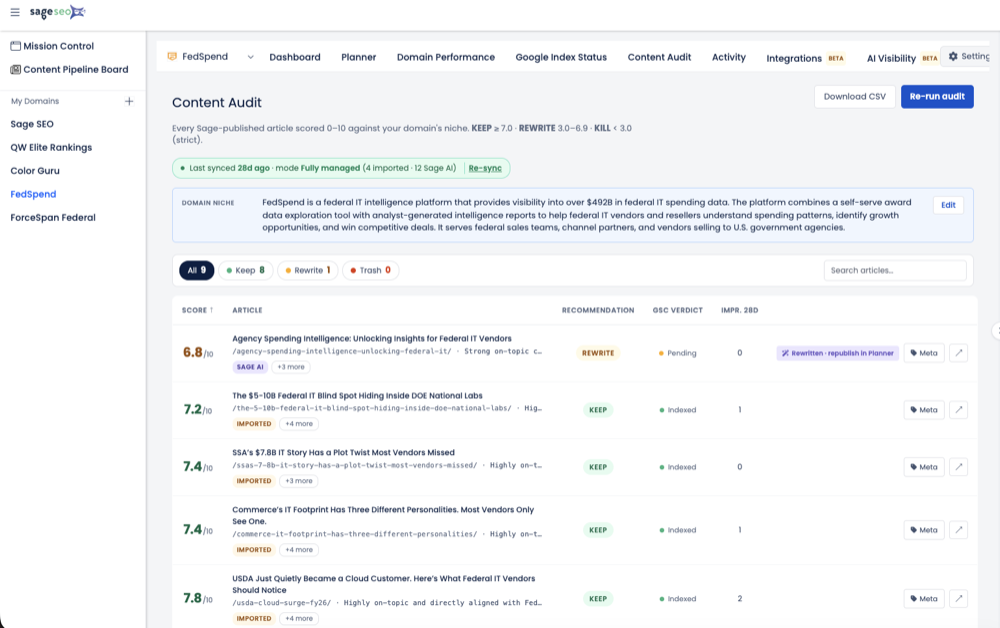
The diagnostic step is where most firms get stuck, and it’s also the easiest part to fix with the right process. Instead of guessing which pages need help, you score each one against the factors that actually move rankings: content depth, keyword alignment, local relevance, internal linking, and freshness signals.
| Factor | What It Measures | Common Failure on Neglected Pages |
|---|---|---|
| Content depth | Does the page actually answer the client’s question? | Surface-level, three paragraphs, no specifics |
| Keyword alignment | Does it match how people search today? | Written for 2019 query patterns |
| Local relevance | Named courts, neighborhoods, local statutes | Only the city name appears, once |
| Internal linking | Connections to related practice areas and attorney bios | Orphaned page, zero internal links in or out |
| Freshness signals | Recent updates reflecting current law or services | No edits since the original publish date |
Running that kind of structured scoring pass against a GSC export is exactly how I turn a confusing pile of rows into a prioritized on-page score in minutes rather than days. Once you have the scores, prioritization becomes obvious: not all twelve pages deserve equal attention. The estate planning page generating the most search volume, or the practice area with the highest average case value, goes first. A low-traffic page for a niche service line can wait a quarter.
How to Close the Content Gap Without Hiring a Writer
Closing this gap is a process problem, not a staffing problem — and that distinction changes the entire budget conversation. You don’t need a full-time content employee if you have a fast, repeatable way to evaluate and refresh what’s already published.
The workflow itself is straightforward:
- Audit and score every existing practice-area and location page against content depth, local relevance, and freshness factors.
- Identify the three or four highest-impact pages — the ones with the most traffic potential or the steepest ranking decline.
- Rewrite with specific, locally grounded language that reflects current services, regulations, and real client questions.
- Monitor rankings and engagement on the refreshed pages for 60 to 90 days.
- Repeat the cycle quarterly, rotating through the next tier of pages each time.
I’d lean on structured rewriting tools here rather than a blank Word doc — a drafting workflow that stays grounded in the firm’s actual voice and services, the way an AI writer built for voice-grounded drafts works, saves the back-and-forth of briefing an outside freelancer on legal nuance they don’t have. One caveat that matters enormously here: accuracy and compliance aren’t optional in legal content. Every rewritten page should be reviewed by a licensed attorney before publishing, both to avoid unauthorized-practice-of-law language and to stay inside the boundaries set by the ABA’s rules on attorney advertising. This applies just as much to accounting practices and consultancies — any multi-service, multi-location professional firm hits the identical structural wall.
What Do High-Performing Practice-Area Pages Look Like in 2026?
A high-performing practice-area page in 2026 reads like it was written by someone who has actually handled that case type, in that jurisdiction, recently. That’s not a stylistic preference — it’s the practical expression of Google’s experience and expertise signals, often shorthanded as E-E-A-T.
The firms winning these searches share a short list of traits:
- Locally specific language — named courts, counties, or neighborhoods, not a city name dropped into a template
- Direct answers to the questions real clients actually ask before hiring
- Visible credentials and attorney bios linked from the practice-area page itself
- Updated references to current laws, regulations, or service offerings
- Strong internal links connecting related practice areas and location pages to each other
| Element | Stale Boilerplate | Updated, Specific Language |
|---|---|---|
| Opening line | “Our experienced attorneys handle family law matters.” | “Our family law team has represented clients before the Jefferson County Family Court since 2014.” |
| Service list | Generic bullet list, same on every city page | Specific to local case trends and recent statutory changes |
| Meta description | Auto-truncated first sentence | Written to match how clients actually search |
None of this requires a content department. It requires knowing which pages to touch first and rebuilding the internal link structure so related pages reinforce each other — the same principle behind rebuilding topical authority on an older site through automated internal linking. I’d also argue this freshness discipline matters more now than it did three years ago, since the same stale-content problems that hurt classic rankings are showing up again in how firms get surfaced — or left out of — AI-generated search results.
How Do You Keep Practice-Area Pages From Going Stale Again?
You keep pages from going stale by treating the refresh as a recurring operational rhythm, not a one-time project. A single rewrite buys you twelve to eighteen months of improved performance at best — then the same decay cycle starts over if nobody’s watching.
Build a quarterly or biannual rescoring check into the firm’s calendar the same way you’d schedule a CLE renewal deadline. It doesn’t need to be a big lift: score the pages, flag the two or three that dropped, refresh them, move on. That’s the entire discipline. Firms that treat content maintenance as infrastructure, rather than a project that ends, are the ones still ranking for their core practice areas five years from now.
Stop Treating Your Website Like a Finished Project
Here’s my honest take after years of running these audits: the firms that lose ground online almost never lose it because of a technical disaster or a Google penalty. They lose it through neglect, one quarter at a time, until a competitor’s refreshed page simply outranks theirs. The fix isn’t more content, a redesign, or a full-time hire. It’s accepting that your existing pages are assets that depreciate without maintenance — and building a cheap, repeatable habit of checking and refreshing them before a competitor does it first.