

- AI Overviews can cut clicks even when rankings stay unchanged.
- Content extractability is the top differentiator for AI citation.
- SGE audits cover five dimensions traditional audits mostly skip.
- Answer-first structure in opening sentences boosts AI citation odds.
- Impression-vs-click divergence in Search Console reveals AI Overview impact.
I ran a traditional SEO audit for a B2B SaaS client in late 2024 and scored every page a 9 or 10 on keyword targeting, internal linking, and technical health. Three months later, half those pages had lost impressions to AI Overviews sitting above them, and clicks were down even though rankings hadn’t moved. That’s when I started asking a different question of every page: would an AI system trust this enough to quote it without sending anyone to click through? That question is the premise behind a content audit built for AI search, and it’s one traditional audits were never designed to answer.
An SGE SEO audit isn’t a rebrand of your old checklist. It’s a separate evaluation layer that sits on top of it, and if you skip it, you’re optimizing for a search result type that’s shrinking in relevance.
What Makes SGE Different From Traditional Search Results?
Search Generative Experience (SGE) and its production version, AI Overviews, synthesize an answer from multiple sources and place it above the organic results, so pages now compete to be cited inside a summary rather than to be clicked as a blue link. Google introduced generative answers in Search at Google I/O and has continued expanding AI Overviews into more query categories since. The mechanics matter less than the incentive shift: a page can hold position one and still lose the click if the AI Overview answers the question fully.
That shift changes what “ranking well” even means. I’ve watched clients celebrate a jump from position 6 to position 2, only to see traffic flatten because an AI Overview now sits above both spots and absorbs the intent. The gap between organic ranking position and AI citation behavior is one of the more important things I track for clients running content at scale.
| Dimension | Traditional Blue-Link Result | AI Overview / SGE Result |
|---|---|---|
| Primary goal | Earn a click | Earn a citation or mention |
| Success signal | Ranking position, CTR | Inclusion in the synthesized answer |
| Content shape rewarded | Keyword-optimized, link-worthy | Answer-first, extractable, well-sourced |
| User behavior | Scans results, clicks a link | Reads the summary, may never scroll |
Why Your Existing SEO Audit Isn’t Enough Anymore
A traditional audit checks keyword targeting, technical health, and backlinks, but none of those tell you whether an AI system can lift a clean, accurate answer off your page. Those fundamentals still matter, they just aren’t sufficient. I’ve seen technically flawless pages, fast, indexed, internally linked, get skipped by AI Overviews in favor of a thinner competitor page that simply states the answer in the first two sentences.
This is where content extractability comes in. It’s not a metric your rank tracker reports, but it’s the biggest differentiator I’ve found between pages that get cited and pages that don’t: can a machine reading the page in isolation pull out a correct, self-contained answer without surrounding context? If the answer is buried under three paragraphs of throat-clearing, the page fails that test regardless of ranking.
The Core Components of an SGE-Ready Content Audit
An SGE audit evaluates five things traditional audits mostly ignore: answer-first structure, structured data, E-E-A-T signals, content freshness, and content gaps against what AI Overviews already surface. Run through each of these deliberately, page by page, rather than relying on a single crawl score.
Content Clarity and Answer-First Structure
Does the page state its answer in the opening sentences, or does it wind up to it? I audited a nonprofit client’s resource pages last year and found the correct answer to their highest-impression query sitting in paragraph four. Moving it to paragraph one didn’t change the writing quality at all, it just changed whether a machine could find it fast enough to quote it.
Structured Data and Schema Markup
Proper markup, per schema.org’s vocabulary and implemented according to Google’s structured data guidelines, helps AI systems parse what a page is actually about before they ever read the prose. FAQ, HowTo, and Article schema are the three types I check first on any SGE audit, because they map directly onto the question-and-answer format AI Overviews tend to reward.
Skip the spreadsheets. Start Sage SEO free.
See how AI content ops transform your agency workflow in minutes.
E-E-A-T Signals and Demonstrable Expertise
Google’s own Search Quality Rater Guidelines spell out experience, expertise, authoritativeness, and trust as the framework its evaluators use to judge content quality, and generative systems built on top of the same index inherit that bias. A visible author byline with real credentials, first-hand experience described in the text, and outbound citations to primary sources all read as trust signals, not decoration.
Content Freshness and Factual Accuracy
Outdated statistics or ambiguous claims get quietly passed over. I keep a rolling list of any page referencing a “current” stat older than 12 months, because that’s usually the first thing that knocks a page out of contention when an AI system is choosing between two similar sources.
How Do You Actually Run an SGE Content Audit Step by Step?
Run an SGE audit in five stages: inventory your existing pages, score them against SGE-readiness criteria, find the gaps between your content and what AI Overviews already show, prioritize by traffic potential, and document the fixes clearly enough that someone else could execute them.
- Inventory high-impression pages. Pull Search Console data and sort by impressions rather than clicks; a page with rising impressions and flat clicks is often being summarized by an AI Overview already, which is exactly what happened with a client whose impressions on one topic cluster jumped fivefold in under a month while position stayed stuck in the high 20s. Tools like GSC Momentum tracking make that impression-versus-click divergence easy to spot without manually cross-referencing spreadsheets.
- Score each page against SGE-readiness criteria. Rate structure, schema, and authority signals on a simple scale so you can compare pages apples-to-apples instead of relying on gut feel.
- Identify content gaps. Search your target queries, read what the current AI Overview surfaces, and note every sub-question or angle it covers that your page doesn’t.
- Prioritize by traffic potential and difficulty. Fix the pages with the most impressions and the fewest structural problems first; don’t start with the page that matters most to your org chart.
- Document findings as specific fixes. “Improve content” is not an action item. “Add a two-sentence direct answer under the H1 and mark up the pricing table with schema” is.
| Audit Layer | Traditional SEO Focus | SGE Audit Focus |
|---|---|---|
| Structure | Heading hierarchy for crawlability | Answer-first sentence within first 100 words |
| Data | Meta tags, alt text | Schema types matched to content format |
| Authority | Backlink count | Author credentials, first-hand experience cues |
| Timeliness | Publish date recency | Fact-level accuracy of claims inside the page |
Common Content Gaps That Keep Pages Out of AI Overviews
Most excluded pages share the same handful of problems: they answer “what” but skip “why” and “how,” they lack extractable formatting, or they carry no clear authorship. I’ve traced this pattern across dozens of audits, and it repeats almost identically by vertical.
- Pages that define a term but never explain the reasoning or the process behind it
- Long paragraphs with no lists, tables, or numbered steps an AI system can lift cleanly
- Missing or generic bylines that give a machine no signal of who wrote this and why they’d know
- Thin or duplicate content that restates what’s already indexed elsewhere without adding a distinct angle
| Content Gap | What It Looks Like | Fix |
|---|---|---|
| What-only coverage | Defines a concept, stops there | Add a “how” section and a “why it matters” section |
| Unstructured answers | Wall of text, no lists | Convert key steps into an ordered list |
| No authorship signal | “Admin” byline or none at all | Add a named author bio with relevant credentials |
| Duplicate coverage | Rewords competitor content | Add original data, examples, or a contrarian take |
That last row is the one most teams underestimate. Running a proper content gap analysis against clustered search intent before you start rewriting tells you whether you’re missing a topic entirely or just missing an angle on a topic you already cover, and those require very different fixes.
Turning Audit Findings Into an Action Plan
Split your findings into quick structural wins and longer content builds, then treat the whole thing as a living document instead of a one-time report. Schema additions, answer-first rewrites of the opening paragraph, and byline fixes are quick wins, often a few hours of work per page. Net-new sections that cover a missing “how” or “why” angle are longer builds that belong on a content calendar, not a to-do list you’ll forget by Friday.
| Fix Type | Example | Typical Effort |
|---|---|---|
| Quick win | Move the direct answer into the opening sentence | Under an hour per page |
| Quick win | Add FAQ or HowTo schema to existing content | A few hours across a template |
| Longer build | Write a new section covering a missing “how” angle | Days, depending on research depth |
| Longer build | Replace a duplicate page with original data or examples | A full content cycle |
Ongoing monitoring matters more here than in a standard SEO program, because SGE behavior isn’t static. Google has continued adjusting which query types trigger AI Overviews and how sources get selected since the feature’s earliest rollout, so a page that gets cited this quarter can fall out next quarter for reasons that have nothing to do with your content quality. I track this the same way I’d track a ranking fluctuation, and tools built for cross-engine citation tracking are far more useful here than a plain rank tracker, since the thing you actually care about is whether you’re being cited, not just whether you’re indexed.
Getting Started With an SGE-Ready Content Audit
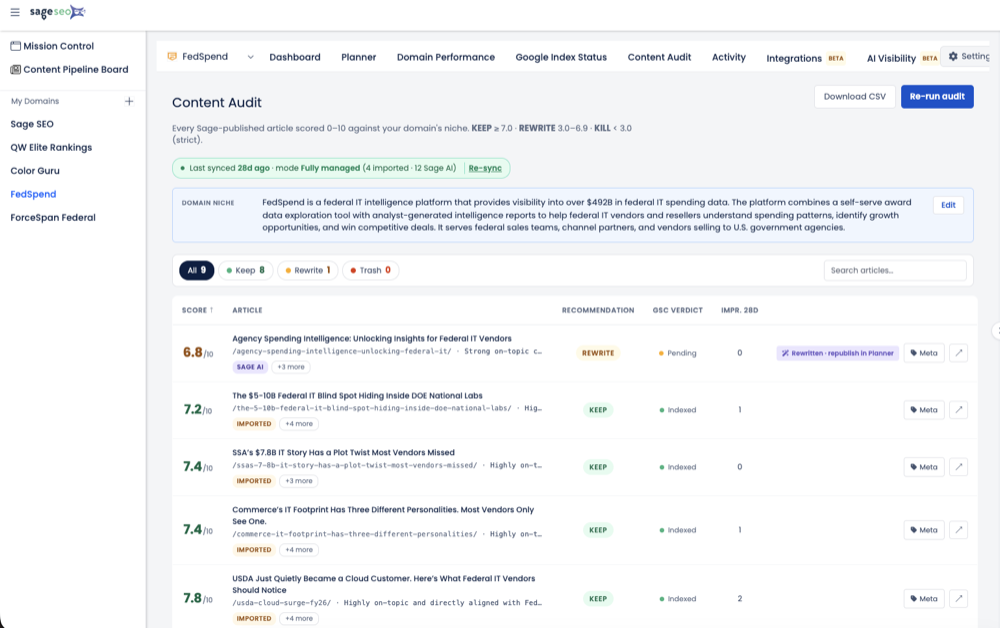
The shift is simple to state and hard to execute: you’re no longer auditing for rankings alone, you’re auditing for whether an AI system trusts your page enough to speak on its behalf. That requires a structured look at extractability, schema, authorship, and freshness that most standard audits never touch. If your team doesn’t have the bandwidth to run this analysis across a full site inventory, a dedicated content audit built around AI-search buckets is the faster path to the same answer.
The Bar Just Moved, and Most Sites Haven’t Noticed Yet
Here’s my take after running this audit type across a dozen-plus sites: most companies are still optimizing for a result type that’s disappearing for their most valuable queries. They’ll keep polishing meta descriptions and chasing backlinks while an AI Overview quietly absorbs the click they were counting on. The sites that win the next two years of search won’t be the ones with the most content, they’ll be the ones whose content is structured clearly enough that a machine trusts it to speak on their behalf. Audit for that now, while the competitive bar for SGE visibility is still low, and you’ll be ahead of teams that wait until impressions drop before they ask why.