- RAG retrieves content chunks, not whole pages, by semantic similarity.
- Backlinks now signal corroboration, not just ranking authority.
- Front-load direct answers under headers for retrieval-ready chunks.
- Niche-relevant links outperform high-DR general placements for RAG.
- Track AI brand mentions alongside traditional rankings and traffic.
Three months ago I watched a client’s top-ranked page hold position one for a $4,200-a-month software category while its branded mentions inside ChatGPT answers stayed at zero. The page did everything a 2021 SEO playbook would reward: strong backlink profile, tight keyword targeting, clean technical health. None of it mattered to the retrieval layer deciding what ChatGPT pulled into its answer. That gap between “ranks well” and “gets retrieved” is the whole story here, and it’s why most link-building conversations right now are aimed at the wrong target.
What Is RAG in SEO, and Why Should You Care Now?
Retrieval-augmented generation (RAG) is the architecture behind most AI search answers: a retrieval layer finds relevant content fragments, then a generation layer synthesizes them into a response. Google’s AI Overviews, Perplexity, and most “answer engine” products run on some version of this pattern. Instead of returning ten blue links ranked by an algorithm, the system searches a vector database for the passages most semantically similar to the query, pulls the top candidates, and hands them to a large language model to write a synthesized answer — sometimes with a citation, often without one.
That’s a fundamentally different scoring mechanism than classic search indexing. Traditional ranking algorithms evaluate whole pages against hundreds of signals and output an ordered list. Retrieval scoring works on chunks, not pages, and it optimizes for semantic fit and corroboration, not link equity alone.
| Dimension | Traditional Search Indexing | RAG-Based Retrieval |
|---|---|---|
| Unit evaluated | Whole page or URL | Individual content chunk/passage |
| Output | Ranked list of links | Synthesized answer, citation optional |
| Primary scoring input | Backlinks, on-page signals, crawl data | Vector similarity + corroboration across sources |
| Visible win | Position #1-10 in SERP | Being the fragment the model selects |
This matters now because a growing share of research-stage queries never reach a results page at all. The original breakdown I wrote on RAG and AI content creation covered the drafting side of this shift; this piece goes further into what it means for link building specifically.
How Do RAG Systems Decide What Content Gets Retrieved?
RAG systems retrieve content by converting both the query and your content into vector embeddings, then ranking passages by semantic similarity — with corroboration across independent sources acting as a tiebreaker for trust. I didn’t fully internalize this until I watched an audit where a client’s glossary page, which answered a definitional question in one tight paragraph, kept getting pulled into AI answers while a 3,000-word pillar page covering the same topic never showed up once.
Semantic Embeddings and Why Chunking Format Matters
Embeddings turn text into numerical vectors that capture meaning, not just keywords. A retrieval system compares the query’s vector against millions of content vectors and surfaces the closest matches. Content that’s broken into clear, self-contained chunks — a header followed by a direct, complete answer — embeds more cleanly than a sprawling paragraph that buries the answer on sentence nine. This is documented in the foundational retrieval-augmented generation research from Meta AI (Lewis et al.), which first formalized combining a parametric model with a non-parametric retrieval index.
Why Corroboration Across Sources Increases Citation Odds
A single unsupported claim on your site is a weak retrieval candidate. The same claim echoed — in different language, with different supporting detail — across three or four independent, topically authoritative domains is a strong one. This is where link building re-enters the picture: backlinks and mentions function as an external validation layer. They tell both crawlers and the data pipelines behind retrieval corpora that other credible sources agree with what you’re saying, which reinforces the perceived authority of your original fragment.
Do Backlinks Still Matter for AI Search Optimization?
Yes — backlinks still matter, but their job has shifted from pure ranking fuel to a corroboration signal that helps RAG systems trust and retrieve your content. I hear the opposite claim constantly from marketing leadership: “AI search doesn’t show links, so why are we still paying for a link-building program?” That question conflates two different things — the visible citation in a chat answer, and the underlying authority signal that got your content into the retrieval candidate pool in the first place.
Google and most retrieval-based systems still rely on crawled, indexed link-graph data to build their underlying corpora. Thin link equity and no topical corroboration means you’re less likely to be crawled deeply, embedded with confidence, or surfaced at all — citation or not. I made this mistake on my own site in 2023: I cut link outreach for two quarters to fund content volume instead, and watched my ranking position and my manually-tracked AI-answer appearance rate decline together, not independently.
What a Modern Search Engine Optimization Link Building Service Should Deliver
A link-building program built for this environment looks different from the one most agencies still sell. The table below is how I now brief link-building vendors and evaluate their placements.
Skip the spreadsheets. Start Sage SEO free.
See how AI content ops transform your agency workflow in minutes.
| Criteria | Legacy Link Building | RAG-Aware Link Building Service |
|---|---|---|
| Primary goal | Domain authority score, link volume | Topical corroboration + citation-worthy placement |
| Site selection | Any site with acceptable DA/DR | Sites likely indexed in retrieval training corpora on your topic |
| Content format | Generic guest post, link insertion | Data-backed studies, expert quotes, original frameworks |
| Success metric | Links acquired per month | Cross-source corroboration + AI mention tracking |
I covered the mechanics of earning that kind of durable authority in a breakdown of a data-driven on-page framework for a SaaS client — the same principles apply to off-page work now, just pointed at corroboration instead of volume.
How Do You Optimize Content for Retrieval-Augmented Generation?
You optimize for RAG by writing content that stands on its own when a system extracts a single paragraph with zero surrounding context. That’s the mental shift. Retrieval-ready content has to work as an orphaned fragment, not a chapter in a longer story.
| Chunk Signal | Weak Pattern | Retrieval-Ready Pattern |
|---|---|---|
| Answer placement | Buried after a long intro | First sentence under the header |
| Section scope | Mixes three ideas per block | One idea, fully resolved, per block |
| Supporting proof | Unsourced claim | Cited external data point |
- Front-load the direct answer. Put the complete answer in the first sentence after a header, not the third paragraph after a windup.
- Chunk content into self-contained sections. Each H2 or H3 block should make sense if someone read only that block and nothing else on the page.
- Cite credible external data to support claims. This builds human trust and gives the retrieval system a corroboration signal to weigh.
- Use consistent entity and terminology naming. If you call it “RAG-based retrieval” in one article and “generative retrieval scoring” in another, you dilute the topical signal tying those pages together.
- Interlink supporting pages explicitly. Internal links that connect related concepts reinforce the entity graph a crawler builds around your site.
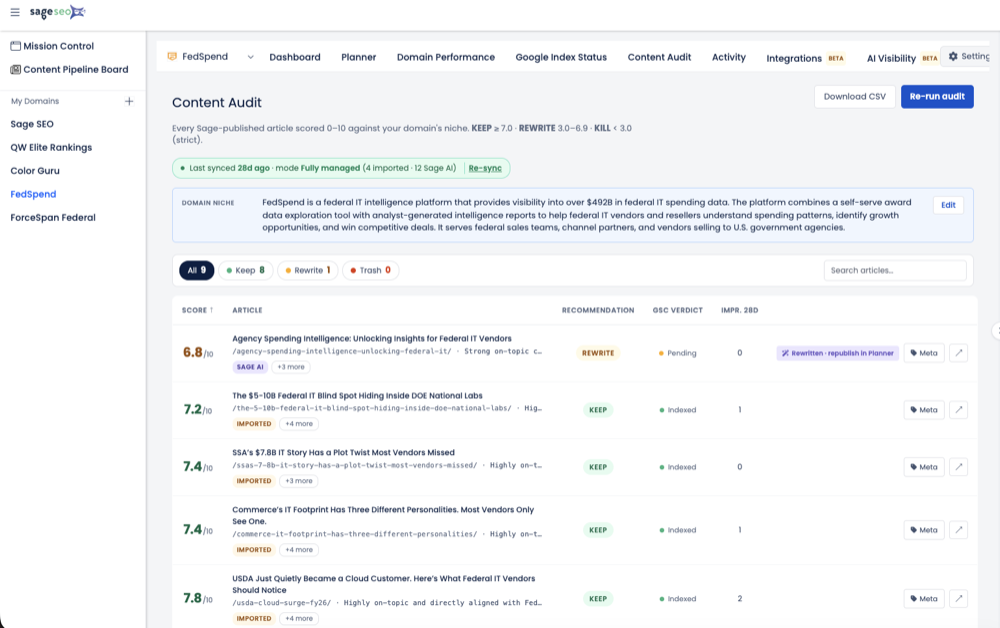
On that last point, I rebuilt an old client site’s internal link structure almost entirely around this idea after a topical-authority rebuild I ran on a legacy domain — the pages that got linked consistently with the same anchor language started surfacing in AI answers within about six weeks; the ones left isolated didn’t move at all. Auditing which pages are even candidates for retrieval in the first place is tedious work by hand, which is the exact problem a tool like Sage’s AI-search content audit is built to shortcut — it buckets existing content by how AI-search-ready it already is instead of making you guess.
How Should You Align Link-Building Strategy with RAG Optimization?
Align your link strategy by prioritizing placements on sites with genuine topical authority in your niche over sites that simply pass a domain-rating threshold. A link from a mid-size niche publication that regularly covers your category is worth more to a retrieval system’s corroboration math than a link from a high-DR general business site that happens to run an unrelated guest post program.
Citation Formats Worth Pursuing Over Generic Guest Posts
- Original data studies that other publications want to cite and link back to
- Expert roundups where your quote sits alongside other named practitioners
- Co-authored or contributed research with an industry association
- Syndicated or guest contributions on sites your buyers actually read
| Format | Corroboration Value | Typical Effort |
|---|---|---|
| Original data study | High | High |
| Expert roundup quote | Medium-High | Low |
| Guest contribution | Medium | Medium |
| Directory/low-relevance link | Low | Low |
On that last format — I still manage a handful of old guest contributions I no longer control hosting for, and the lessons from optimizing a guest post you can’t edit directly apply directly here: if you can’t update the piece, you can still shape what it links to and how it’s framed in outreach, which affects whether it reads as corroboration or filler.
I’d caution hard against high-volume, low-relevance link schemes here. They did little for classic rankings in the post-Penguin era, and they do even less for RAG corroboration — a pile of unrelated directory links doesn’t tell a retrieval system anything coherent about your topical authority, it just adds noise a spam classifier is trained to discount.
How Do You Measure SEO Success Beyond Traditional Rankings?
Measure success by tracking AI-platform brand mentions and citation frequency alongside your existing rankings and organic traffic, not instead of them. This is genuinely the least mature part of the discipline right now. There’s no universal “AI Overview position tracker” with the maturity of a rank tracker that’s been refined for twenty years.
What I do instead: manually sample 15-20 priority queries across ChatGPT, Perplexity, and Google’s AI Overviews monthly, and log whether and how the brand is mentioned. It’s imperfect, but directional trend lines across quarters tell you more than any single snapshot. I built a fuller version of this sampling method into an SGE audit framework piece if you want the full checklist. For teams that want this tracked systematically, cross-engine tools like Sage’s AI visibility tracking close that gap, and I compared several category options in a rundown of AI visibility tools for 2026.
None of this replaces rankings, impressions, or organic sessions. Those metrics remain the backbone of any defensible SEO program, and they correlate closely with retrieval visibility anyway — a page that’s crawled, indexed, and well-linked is simply a better retrieval candidate too.
The Loop, Not the Link, Is the Real Deliverable
I don’t think link building is dying, and I don’t think RAG makes rankings irrelevant — I think the two disciplines just finally have to talk to each other. For years, content teams wrote for readers and link teams chased authority metrics as if they were separate jobs feeding separate dashboards. RAG retrieval punishes that split immediately: a well-written, poorly-corroborated page and a well-linked, poorly-chunked page both lose to the competitor who did both at once. That’s the uncomfortable part of this shift nobody wants to hear, because it means more coordination, not a shortcut. The upside is that the work compounds faster once content and corroboration move together — which is the entire premise behind building an AI-first workflow instead of bolting AI onto a 2015 process.