
- AI visibility tracking emerged because answer engines cite brands before clicks
- Peec AI suits agencies needing multi-brand competitive benchmarking depth
- Profound delivers deep citation and sentiment analytics for large enterprises
- Otterly offers a low-cost, fast-setup entry point for smaller teams
- Sage connects AI visibility monitoring to content action in one platform
I watched a client’s AI visibility dashboard light up red on a Tuesday morning: their flagship product page had dropped out of three ChatGPT answers it used to show up in. The tool that flagged it did its job well. It had zero opinion on why, and no connection to the CMS where the fix lived. That gap is the entire story of this tool category in 2026.
Most buying guides for AI visibility tools rank products by prompt count and engine coverage. That’s a fine first filter, but not the decision that matters most. A standalone tracker can tell you your brand disappeared from a Perplexity answer; it can’t tell you which paragraph to rewrite, or whether that traffic ever converted. This guide compares four current category leaders, Peec AI, Profound, Otterly, and Semrush’s AI Toolkit, against where a bundled feature like Sage’s AI Visibility fits instead.
Why Did AI Visibility Tracking Become Its Own Tool Category?
AI visibility tracking split off from rank tracking because answer engines now summarize and cite brands before a searcher ever clicks a link. ChatGPT, Perplexity, Gemini, and Google’s AI Overviews changed what “ranking well” means; a page can win the citation inside an AI answer and still show zero clicks in Search Console. That’s exactly the disconnect I found after a GSC impression spike with no matching click growth on a client site; the demand was real, it just wasn’t landing the way it used to.
This is a young category. Most dedicated players launched or scaled meaningfully in 2024 and 2025, so pricing is still a moving target. Here’s the lay of the land before I break each option down.
| Tool | Best Fit | Engine Coverage Approach | Standout Strength |
|---|---|---|---|
| Peec AI | Agencies, multi-brand teams | Broad, prompt-level detail | Competitive benchmarking depth |
| Profound | Large enterprise | Broad, enterprise-tiered | Citation & sentiment analytics |
| Otterly | Small teams, first-time buyers | Narrower, some engines gated | Low cost of entry |
| Semrush AI Toolkit | Existing Semrush customers | Add-on, tiered engine access | Familiar workflow integration |
| Sage AI Visibility | Mid-market, in-house teams | Built-in, tied to content & attribution | One platform, one login |
What Should You Evaluate Before Choosing an AI Visibility Tool?
Evaluate engine coverage, prompt volume limits, whether the tool connects to action, and whether it fits your team’s actual structure, not just its feature list. I’ve sat through a half-dozen vendor demos this year, and the pitch always leads with engine logos. The pricing page tells a different story.
- Engine coverage and gating: Is ChatGPT, Perplexity, Gemini, Copilot, and AI Overviews included, or locked behind a higher tier?
- Prompt or query volume limits: How many tracked prompts does the base plan include, and what does the next 500 cost?
- Monitoring versus action: Does the tool stop at a dashboard, or connect to content recommendations and attribution?
- Team structure fit: One brand in-house, or five-plus client accounts needing a multi-domain view?
That last point trips up most shortlists. An agency managing a dozen clients and an in-house marketer tracking one brand have nothing in common, and shouldn’t shop the same tier.
Peec AI: Built for Multi-Brand, Multi-Engine Tracking at Scale
Peec AI is the strongest fit for agencies and enterprise teams that need granular, prompt-level visibility across several brands and markets at once. I’d point an agency running AI visibility reporting for a client roster toward Peec AI before most alternatives here, because the competitive benchmarking is built around that multi-client reality.
The depth is real: granular breakdowns of how often a brand shows up across prompts, how that compares to named competitors, and how share shifts over time. That’s reporting I used to stitch together by hand for an agency client two years ago, and it was painful.
Where Peec AI Falls Short for Smaller Teams
The tradeoff is setup overhead and pricing built for a team with someone whose job is AI-search ownership, not a generalist juggling four other responsibilities. If your team resists tools that demand a dedicated owner, you’ll recognize the pattern I wrote about when I stopped trusting SEO tools that ask for too much setup before they pay off.
Profound: Enterprise-Grade Answer Engine Analytics
Profound is built for large organizations that want deep, conversation-level analytics on how AI answer engines cite and characterize them. I’d recommend it to a company that already has a data or analytics function sitting next to marketing, because the output rewards that interpretation.
The sophistication shows up in citation and sentiment analysis that goes beyond “did we appear” into how favorably an engine framed the brand. For a large company worried about how an AI assistant characterizes its product against a competitor’s, that nuance matters more than raw mention count.
Why Profound Isn’t the Right First Tool for Most Teams
Cost and complexity are the honest tradeoffs. Profound typically prices toward enterprise budgets with sales-led onboarding, out of reach for a mid-market team’s first purchase. It also needs someone to interpret the output; the dashboard alone won’t tell a content team what to write next.
Otterly: A Lighter, More Accessible Entry Point
Otterly is the simplest on-ramp into AI visibility monitoring, built for teams testing the waters before committing to an enterprise platform. If a marketing manager asked where to start on a limited budget with no prior AI-tracking tool, Otterly is usually my first suggestion.
Setup is fast, pricing starts low relative to the enterprise players, and the interface doesn’t need a training session.
Skip the spreadsheets. Start Sage SEO free.
See how AI content ops transform your agency workflow in minutes.
The tradeoff shows up in breadth. Engine coverage is narrower than Peec AI or Profound, benchmarking features are thinner, and some advanced engines sit behind add-on pricing rather than the base plan. That gating pattern isn’t unique to Otterly, which brings me to a side-by-side worth seeing.
| Criteria | Peec AI | Profound | Otterly |
|---|---|---|---|
| Ideal team size | Agency / multi-brand | Large enterprise | Small team, first purchase |
| Engine breadth | Broad | Broad | Narrower, some gated |
| Competitive benchmarking | Deep | Deep, sentiment-focused | Lighter |
| Setup effort | Moderate to high | High, sales-led | Low |
| Connects to content action | Reporting-focused | Analytics-focused | Monitoring-focused |
Semrush AI Toolkit: Visibility Bolted Onto an Existing Suite
The Semrush AI Toolkit makes sense mainly for teams already paying for Semrush who want AI visibility inside a workflow they’ve already built. If your keyword data, rank tracking, and site audits already live in Semrush, adding the AI Toolkit avoids a new login and a new learning curve.
That familiarity is the real strength, not raw tracking depth. It’s an add-on bolted onto a suite built for a different era of search: coverage and benchmarking depth tend to lag dedicated trackers, and full access often depends on tier rather than plan name. I ran a similar exercise when I compared what Semrush’s On-Page SEO Checker actually delivered against its sticker price; the AI Toolkit follows the same pattern.
Is Semrush AI Toolkit Worth It?
It’s worth it if you’re already a Semrush customer who wants one bill instead of a new vendor relationship. It’s not worth it if dedicated, multi-engine AI citation analysis is the primary job, since that’s not the toolkit’s original design center.
Where Sage’s Built-In AI Visibility Feature Fits
Sage isn’t trying to out-track Peec AI or Profound on raw prompt volume or sentiment analysis; it’s closing the gap between seeing a visibility drop and fixing it. That’s an honest limitation to state up front: a dedicated tracker will out-report Sage on standalone citation depth alone.
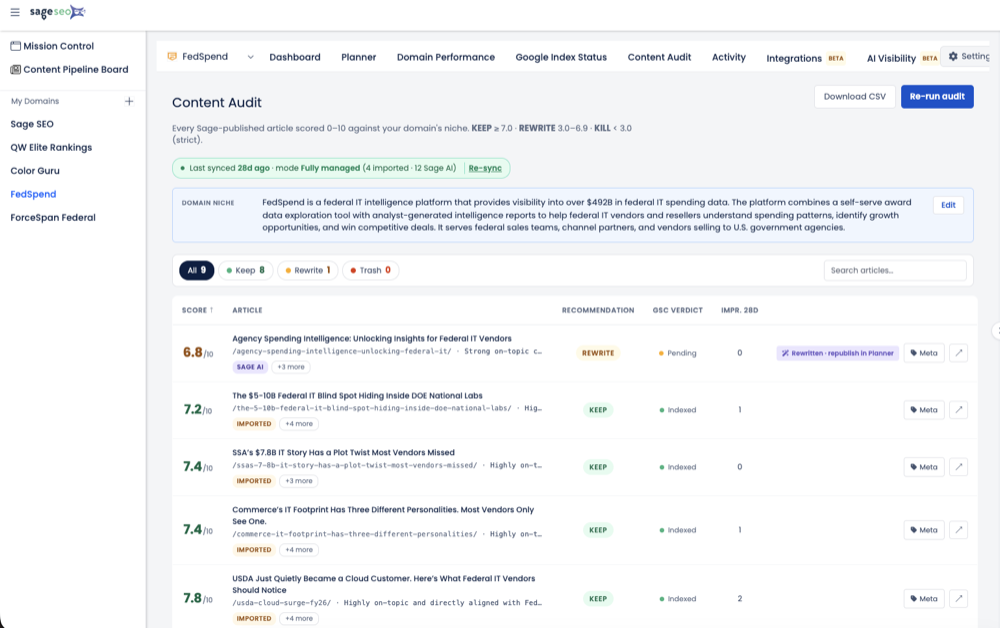
What Sage’s AI Visibility feature does instead is sit inside the same platform as content production and attribution. When a brand’s citation share drops in an AI answer, that signal lives next to the content audit and drafting workflow, so a strategist can trace the drop to a thin section or missing interlink and act without exporting a CSV into another tool.
Who Should Choose Sage Over a Standalone Tracker?
Mid-market teams and in-house SEO functions who want content, attribution, and visibility monitoring in one platform, rather than three vendors and three logins, are the clearest fit. The same logic behind my framework for auditing content against AI search is built into how Sage surfaces gaps in the first place.
Agencies managing a large roster of client brands, and enterprises needing multi-engine citation analytics as a standalone discipline, should still look at Peec AI or Profound first. That’s not a hedge; it’s where those tools genuinely win.
What Pricing Tiers Should You Watch For Before You Buy?
Confirm exactly which engines, prompt volumes, and seats are included at your actual price point, not just the plan name. Perplexity and Copilot show up behind higher tiers more often than ChatGPT or Gemini across this category, gated as add-ons rather than base-subscription features.
| What to Check | Why It Matters |
|---|---|
| Which engines are in the base tier | Perplexity and Copilot are the most commonly gated behind add-ons |
| Prompt or query volume cap | Enterprise-level tracking depth often requires a mid or top tier |
| Seats and client/brand limits | Agencies need multi-domain access, not a single-brand plan |
| Whether reporting exports require a higher plan | Some vendors lock competitive benchmarking behind premium tiers |
Treat any published comparison chart, including this one, as directional rather than gospel. This category moves fast enough that a tier structure accurate in January could shift by year’s end. Check current published pricing before budgeting off last quarter’s numbers.
Which AI Visibility Tool Should You Choose?
The right pick depends on team structure and whether you want monitoring connected to action, more than which tool tracks the most prompts. Here’s the shortlist I’d hand a team today.
- Agency managing five-plus client brands: start with Peec AI or Profound for the multi-client reporting depth, consistent with how I’ve seen agencies scale AI-search results across a growing client roster.
- Testing AI visibility for the first time on a limited budget: start with Otterly, or the Semrush AI Toolkit if you’re already a Semrush customer.
- Want visibility monitoring connected directly to content fixes and attribution in one platform: start with Sage.
None of these are wrong answers; they’re answers to different questions. The mistake I see most often is buying the enterprise tool before confirming you have headcount to use it.
My Honest Bet on Where This Category Goes Next
I don’t think the standalone AI visibility tracker survives as its own category past the next couple of buying cycles. Not because Peec AI or Profound are doing anything wrong, they track better than almost anyone right now, but because tracking without a connected fix is a half-built product. Buyers figure that out fast once the novelty wears off. The teams that win in 2026 won’t be the ones with the most dashboards open; they’ll be the ones who can see a citation drop and ship a fix before a competitor notices.