
- SGE audits prioritize extractable, citable passages over rankings alone.
- Content must answer questions directly in the first sentence.
- E-E-A-T signals decide whether AI systems attribute claims to your page.
- Fix technical blockers and cannibalizing pages before creating new content.
- Run SGE audits quarterly as AI Overview selection patterns shift.
SGE SEO Audits: The Definitive Checklist for AI Search Readiness
I watched impressions for “sge seo audits” and its close variants climb from 67 to 288 over about ninety days this year, on our own blog. That should have been a clean win. Instead, when I pulled the Search Console breakdown, I found three pages splitting the demand: one holding a strong average position of 3.3, and two others burying each other at 16.9 and 18.4. The query was growing. Our own content was fighting itself for it. That, more than any theory about how Google’s AI Overviews work, is the real lesson behind this audit.
Most “SGE checklists” floating around right now are traditional SEO checklists with “AI Overviews” pasted on top. That’s not an audit, it’s a rebrand. What follows is the process I actually run, step by step, after rebuilding it four times.
Why Is an SGE Audit Different From a Regular SEO Audit?
An SGE audit is stricter, not separate — it applies the same fundamentals of structure, trust, and relevance that classic SEO always claimed to care about, except now a generative system has to lift your sentence whole and defend it in a synthesized answer. Classic blue-link ranking rewards a page for being the best overall match. AI Overviews and generative search results reward a passage for being extractable, attributable, and safe to paraphrase without losing accuracy. A page can rank #1 on the old scoreboard and still get skipped entirely in a synthesized answer because the actual answer is buried in paragraph four behind three sentences of throat-clearing.
That gap is why a dedicated audit lens matters. It’s not about adding new tactics. It’s about removing the slack that classic SEO let you get away with for a decade.
| Audit Dimension | Traditional SEO Lens | SGE / AI Overview Lens |
|---|---|---|
| Headings | Keyword-containing, loosely organized | Direct questions, answered in the next sentence |
| Authorship | Byline optional | Named author with demonstrable, first-hand experience |
| Data points | Present somewhere on page | Dated, sourced, and isolated into a citable sentence |
| Page scope | One primary keyword | Full question cluster covered on one page |
| Success metric | Ranking position | Inclusion and attribution inside the synthesized answer |
This is a practical framework, not a theory piece. Run the five steps below in order, and you’ll know within an hour whether the problem is structure, trust, technical plumbing, coverage, or competition.
Step 1: Audit Your Content Structure and Extractability
Content extractability is the single biggest lever in an SGE audit, because a generative system has to lift a clean, self-contained passage, and most published content simply doesn’t hand it one. I audited a client’s top commercial page in 2024 that ranked #2 organically and never once appeared in an AI Overview for its own target query. The answer was in there. It just took two paragraphs of scene-setting to reach it.
Does Every Heading Answer a Real Question?
Check each H2 and H3 against actual search queries, then check whether the sentence immediately beneath it answers that question in full, without requiring the reader to scroll further. If the first sentence after a heading is a transition or a stat without context, that section will get skipped by extraction systems almost every time I’ve tested it.
Run this quick pass on every priority page:
- Does the heading match a phrase someone would actually type or ask?
- Is the direct answer in the first sentence, not the third paragraph?
- Are paragraphs short enough to lift as a standalone unit (roughly 50-70 words)?
- Is there at least one list or table breaking up dense narrative sections?
Content that’s “too narrative” — long lead-ins, buried thesis statements, anecdote-first structure with no payoff sentence — tends to get passed over even when the underlying expertise is strong. I don’t say that to discourage storytelling; I say it because storytelling needs a landing pad, a clear takeaway sentence right after it, or it never earns the citation.
Step 2: Audit Your E-E-A-T and Trust Signals
Trust signals determine whether an AI system is willing to attribute a claim to your page at all, and this is the step where I see the most unforced errors. Google’s Search Quality Rater Guidelines have leaned on experience, expertise, authoritativeness, and trust for years; AI Overviews simply raised the cost of ignoring them.
What Counts as a Trust Signal in Practice?
Start with the byline. A generic “Admin” author or no author at all is a red flag I flag on every audit now. Check for:
- A named author with a bio demonstrating relevant, first-hand experience in the topic
- Specific, verifiable examples rather than generic claims (“I audited,” not “businesses should”)
- External sources and data cited with dates, not vague phrases like “studies show”
- No outdated statistics presented as current — I’ve caught 2021 figures still live on pages in 2026
I once inherited an audit for an agency client where every statistic on their highest-traffic page traced back to a 2019 report. Nobody had checked it in five years. The page still ranked. It still doesn’t appear in AI Overviews for its core query, and I’d bet the stale sourcing is a meaningful part of why.
Skip the spreadsheets. Start Sage SEO free.
See how AI content ops transform your agency workflow in minutes.
Step 3: Audit Technical and Schema Readiness
Structured data and schema markup don’t guarantee inclusion in AI Overviews, but they remove ambiguity a generative system would otherwise have to guess at. Before touching schema, confirm the basics: the page is crawlable, indexed, loads fast on mobile, and isn’t buried behind a redirect chain. None of that is new. All of it is still a hard prerequisite.
Which Schema Types Actually Matter Here?
| Schema Type | Best Use Case | Why It Helps an SGE Audit |
|---|---|---|
| FAQPage | Pages answering multiple related questions | Mirrors the Q&A format generative answers already prefer |
| HowTo | Step-by-step processes or audits | Reinforces sequential structure for extraction |
| Article | Blog posts, guides, long-form content | Confirms authorship, publish date, and freshness signals |
| Organization | Site-wide trust layer | Supports entity recognition across your content |
I treat page speed and mobile usability as a floor, not a feature. A technically broken page rarely enters the conversation for a synthesized answer, no matter how well-written the content is.
Step 4: Audit Query Intent and Coverage Gaps
Query intent mapping exposes the gap between the one question your page answers and the eight questions a searcher actually has around that topic. This is where I most often find the “expand vs. create new page” decision gets made wrong.
Pull every related question, “People Also Ask” entry, and autocomplete variation tied to your target term. Map them against your existing page. If your content answers one narrow slice of that cluster, thin coverage is likely the reason it’s being summarized from a competitor instead of you. I’ve seen this exact pattern show up clearly once you understand how a keyword phrase connects to the broader set of related searches around it, rather than treating each term as an isolated target.
Expand the Page, or Build a New One?
Expand an existing page when the missing questions are close variations of the same core intent. Build a new page when the missing questions represent a genuinely different intent — commercial versus informational, beginner versus advanced. Getting this wrong is how sites end up with the exact cannibalization problem I described in the intro: three pages chasing one cluster, none of them winning cleanly.
Step 5: Run a Competitive and SERP Feature Audit
What currently shows up in the AI Overview for your target query tells you more than any keyword tool will. Before writing or revising anything, search your target term yourself, read what’s being synthesized, and note which SERP features surround it — Overview, People Also Ask, shopping carousels, video panels.
| What to Check | What It Tells You |
|---|---|
| Which domains get cited in the Overview | Whether established authority or structure wins this query |
| Content depth of cited competitors | Whether thin content can still compete, or depth is required |
| Format of cited passages (list, table, direct sentence) | The structural format you should mirror |
| Recency of cited sources | How aggressively you need to keep the page updated |
A pattern I keep seeing: AI Overviews tend to favor sources pairing a direct answer sentence with supporting structure right after it — a list, a table, a short explanation. Pages that hedge or bury the answer get passed over for a competitor that just says the thing.
How Do You Prioritize SGE Audit Fixes First?
Prioritize by effort versus impact, not by whichever fix feels most urgent emotionally. After running all five steps, you’ll have a long list. Don’t try to fix everything in one pass — I’ve watched that approach stall out more content programs than it’s saved.
- Fix technical blockers first — crawlability, indexation, speed. Nothing else matters until these pass.
- Consolidate cannibalizing pages before creating anything new.
- Rewrite direct-answer sentences under existing headings — high impact, low effort.
- Add missing schema and trust signals (bylines, sourcing, dates).
- Expand genuine coverage gaps last — this is the highest-effort tier.
| Fix Category | Typical Effort | Typical Impact |
|---|---|---|
| Consolidating duplicate pages | Low-Medium | High |
| Rewriting answer sentences | Low | High |
| Adding schema markup | Low | Medium |
| Building new coverage pages | High | Medium-High |
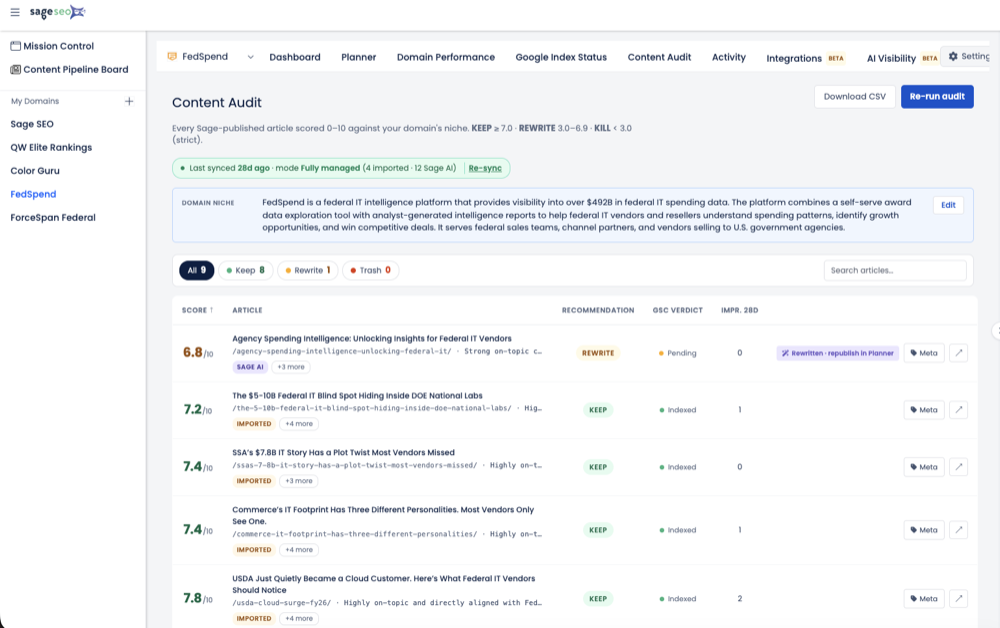
When I’m running this across a client’s full site rather than one page, I lean on a tool like Sage’s content audit view to bucket pages by what’s actually broken — structure, trust, technical, or coverage — instead of eyeballing a spreadsheet of three hundred URLs. Incremental, prioritized fixes beat a one-time overhaul every time I’ve compared the two approaches head to head.
How Often Should You Run an SGE Content Audit?
Treat this as a recurring quarterly habit, not a one-time project — AI Overviews and their underlying selection patterns shift often enough that a checklist from six months ago is already stale. I’ve rebuilt the data behind this audit twice in the last year alone as click patterns on AI-influenced queries kept moving.
At minimum, revisit your highest-impression pages every quarter. Monitor impressions versus clicks in Search Console specifically, since a page can hold position while clicks quietly erode as AI Overviews answer the query directly. I’ve folded this check into the recurring audit routine I run for clients, because waiting for an annual review catches the drop a quarter too late.
Fundamentals Don’t Expire, Even When the SERP Does
I’ll say the unpopular part plainly: if your content needed an “SGE rewrite” to pass this checklist, it was never actually good — it was ranking on inertia. The sites holding up through this shift aren’t the ones that learned new tricks in 2025. They’re the ones where someone, at some point, insisted on a real byline, a sourced statistic, and a direct answer in the first sentence, long before anyone used the word “SGE.” Run the audit. Fix the structure. But stop treating this as a new discipline. It’s the same bar, finally enforced.