- AI Overviews can bypass top-ranked pages with no click
- Ranking and AI citation rely on different content mechanics
- Answer-ready content states facts immediately rather than teasing clicks
- Five audit layers cover structure, entities, schema, trust, and competition
- Recurring quarterly audits beat one-time checks as AI formats shift
I pulled up a client’s Search Console data in January 2026 and almost missed it. Impressions were flat. Rankings hadn’t moved. But clicks on their top informational page had dropped 22% quarter over quarter, and nothing in the traditional audit explained why. The page still held position four. It was still “optimized.” It just wasn’t getting chosen anymore — because Google’s AI Overview was answering the query before anyone scrolled down to click.
That’s the gap a standard SEO audit doesn’t catch, and it’s why sge seo audits have become their own discipline instead of a checkbox inside a technical crawl. I’ve run both kinds of audits side by side over the past year, and the overlap is smaller than most teams assume. This piece updates and consolidates what I’ve learned running these audits for clients since AI Overviews went fully global, including the parts of my earlier frameworks that turned out to be wrong.
What Is an SGE SEO Audit, Really?
An SGE SEO audit evaluates whether your content can be extracted and reused by an AI system, not just whether it ranks. “SGE” originally stood for Google’s Search Generative Experience, the 2023 experiment that became AI Overviews. The term stuck in search marketing vocabulary even after the product renamed itself, and you’ll now see the more precise phrase sge ai seo audits rising alongside it as teams realize this is a distinct audit category, not a rebrand of the old one.
A traditional audit asks: does this page rank for the right keywords, is it crawlable, does it earn links? An SGE audit asks a sharper question: if a model is assembling an answer from five sources right now, would it reach for this page, and would it trust what it finds? Those are different tests, and a page can pass one while failing the other.
| Audit Dimension | Traditional SEO Audit | SGE / AI Search Audit |
|---|---|---|
| Primary question | Does it rank? | Can it be extracted and cited? |
| Content format focus | Keyword placement, length | Direct-answer paragraphs, scannable structure |
| Trust signal check | Backlinks, domain authority | Author credentials, citations, freshness |
| Technical check | Crawlability, site speed | Schema markup, entity clarity |
| Success metric | Ranking position | Inclusion/mention inside AI-generated answers |
Ranking vs. Being Quoted: The Aha Moment Most Audits Miss
A page can hold a top-three ranking and still never appear in an AI-generated answer, because ranking and quoting are judged by different mechanics. Traditional ranking rewards relevance and authority signals accumulated over time. Inclusion in a generated answer rewards something narrower: can the system lift a clean, self-contained statement out of your page without having to interpret tone, narrative framing, or buried qualifiers.
I call this the difference between click-ready content and answer-ready content. Click-ready content builds curiosity — it teases the answer to earn the click. Answer-ready content states the answer immediately, then supports it. For a decade, teasing was the smarter move because the click was the whole business model. That incentive has partly inverted, and most legacy content is still written for the version of search that rewarded hesitation.
Industry commentary on generative search has converged on a similar point: language models favor passages that read like standalone, directly-stated claims over ones wrapped in narrative buildup, because that’s the format that survives being lifted out of context and recombined with other sources. I ran a traditional audit for a B2B SaaS client in late 2024 that scored a 9 on every classic metric, and it still took a rewrite toward that answer-first structure before AI Overviews started citing the page at all.
The Core Components of a Modern AI Search Audit Framework
A modern AI search audit framework has five working parts, and skipping any one of them leaves a blind spot the others can’t cover. I built mine after watching single-dimension audits — schema-only, or content-only — consistently miss the actual reason a page wasn’t getting cited.
The Five Audit Layers
- Content structure — headers that match real query phrasing, direct-answer paragraphs near the top, scannable formatting instead of dense narrative blocks.
- Entity and topical authority — whether the site clearly and consistently establishes expertise on the subject across multiple interlinked pages, not just one.
- Technical signals — schema markup, clean crawlability, and page experience factors that help machines parse what a page is actually about.
- Trust signals — visible author bios, cited sources, visible freshness dates, and general E-E-A-T alignment.
- Competitive gap analysis — what the pages currently being cited in AI answers for your target queries are doing that yours isn’t.
That last layer is the one teams skip, and it’s usually the most revealing. I had a client ranking second organically for a commercial-intent term, invisible in the AI Overview, while the page cited in the answer sat at position six. The cited page had a dated author byline, three external citations, and a one-sentence direct answer in its second paragraph. My client’s page had none of those. A full framework walkthrough on exactly how to score each layer is worth running before you touch a single word of copy.
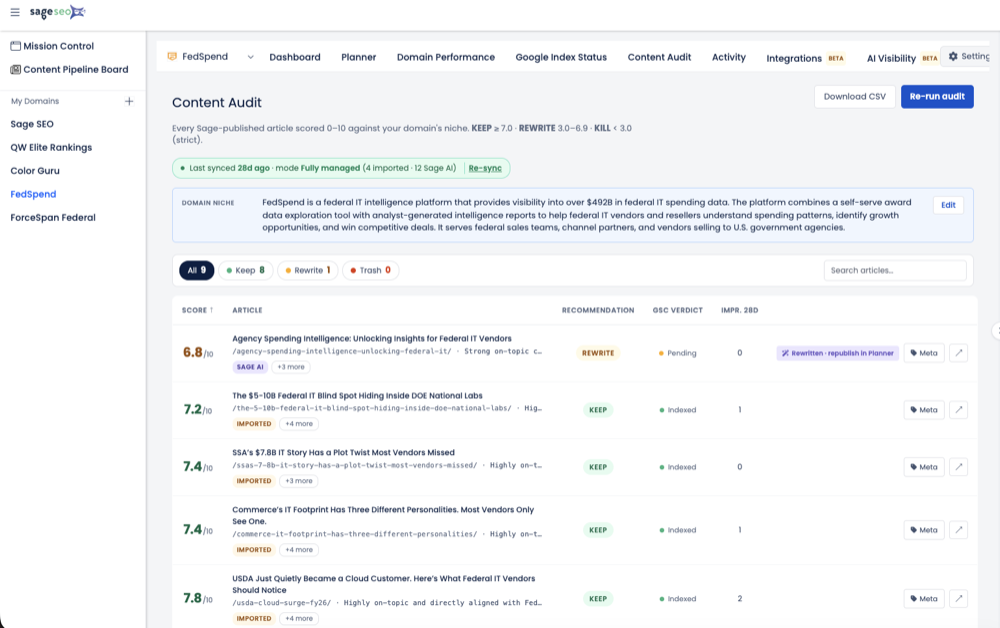
This is also where tooling earns its keep. Manually re-checking every page across a content library against five dimensions doesn’t scale past a few dozen URLs, which is why I now run this layer through a bucketed content audit built for AI-search criteria rather than a spreadsheet.
Skip the spreadsheets. Start Sage SEO free.
See how AI content ops transform your agency workflow in minutes.
How Is AI Search Reshaping Click-Through Behavior?
AI-generated answers are measurably suppressing click-through on a meaningful share of informational queries, which is forcing teams to track presence inside AI answers as its own metric. Search marketing publications covering the AI Overview rollout throughout 2024 and 2025 have documented declining click-through specifically on queries where the overview fully answers the question without requiring a source visit.
The practical shift is this: rank tracking alone no longer tells the whole visibility story. A brand can lose organic clicks on a query while gaining mentions inside the AI answer itself — exposure that drives awareness and eventual branded search, even without the click. I’ve started presenting both numbers to clients in the same report, because reporting rank position alone now understates or overstates visibility depending on the query type. Tracking that second layer across every engine your buyers use is exactly the gap a dedicated cross-engine citation tracking tool is built to close, since pulling it manually from five different AI chat interfaces every week isn’t a sustainable process for a small team.
| Metric | What It Measures | Where It Falls Short Alone |
|---|---|---|
| Rank position | Where a page sits in traditional organic results | Says nothing about whether an AI answer bypassed the click entirely |
| Click-through rate | How often a ranking actually converts to a visit | Can decline even when rankings are stable or improving |
| AI answer presence | Whether the brand is named or cited inside a generated answer | Doesn’t capture downstream branded search or conversion impact |
How to Run a Preliminary SGE Readiness Audit on Your Own Site
You can run a credible first-pass SGE audit in an afternoon using five sequential checks, starting with query selection and ending with a competitive benchmark. This won’t replace a full agency-grade audit, but it will tell you within a few hours whether you have a real problem.
- Identify your highest-impression queries. Pull Search Console data and sort by impressions where click-through has dropped despite stable or improving average position — that gap is your AI Overview signal.
- Check whether your content answers the query in the first 100 words. Open the ranking page and read only the first short paragraph. If it doesn’t fully answer the query without scrolling, a model will likely skip it too.
- Audit your structured data. Confirm Article, FAQ, or Organization schema is present and validates cleanly on key pages; missing or broken schema is one of the most common silent failures I find.
- Assess authorship and citation signals. Look for a real, credentialed author byline, a publish or update date, and outbound citations to credible sources — all signals models weight when deciding what to trust.
- Benchmark against whoever is currently being cited. Search the query yourself, note which domains appear in the AI answer, and compare their structure directly against your own page, paragraph by paragraph.
Run that same five-step pass quarterly rather than once, because the competitive set inside AI answers reshuffles faster than traditional rankings ever did.
Common Mistakes That Sink AI Visibility
Most AI visibility failures trace back to a handful of repeatable mistakes, and almost none of them are exotic. I see the same five show up across unrelated industries.
- Over-optimizing for keywords instead of clarity — content stuffed with variations of a phrase but never states the answer plainly anywhere on the page.
- Ignoring schema and structured data entirely, treating it as a technical nicety rather than a machine-readability requirement.
- Thin or missing authorship information, with no real name, credential, or update history attached to the content.
- Treating AI search as identical to traditional search, applying the same playbook and assuming ranking gains will automatically translate to citation gains.
- Auditing once and walking away, instead of treating this as a recurring review tied to publishing cadence.
That last one deserves its own section, because it’s the mistake with the longest tail of consequences.
Why Ongoing Audits Beat One-Time Checks
AI search formats and ranking mechanics are still changing quarter to quarter, which makes a single audit a snapshot that expires fast. I’ve watched a framework that worked in early 2025 need real revision by the end of that same year, simply because the AI answer formats themselves shifted.
| Approach | One-Time Audit | Recurring Audit Cycle |
|---|---|---|
| Timing | Single project, fixed scope | Tied to publish cadence, reviewed quarterly |
| Competitive benchmark | Captured once, goes stale | Refreshed as AI answer sets reshuffle |
| Best fit for | Initial diagnosis | Ongoing visibility maintenance |
I build this cadence into every benchmark-based content program I run now, because a content calendar that doesn’t loop audit findings back into the next publishing cycle just repeats the same structural mistakes at scale.
The Real Shift: From Ranking for Clicks to Being Trusted for Answers
The teams winning this transition aren’t the ones with the biggest content libraries. They’re the ones who accepted early that extraction, not ranking position, is the new unit of visibility, and rebuilt their audit process around it. I think most of the industry is still a year behind that realization, which is actually good news if you’re reading this now — the early movers on sge ai seo audits are compounding an advantage that gets harder to close every quarter someone else waits.