
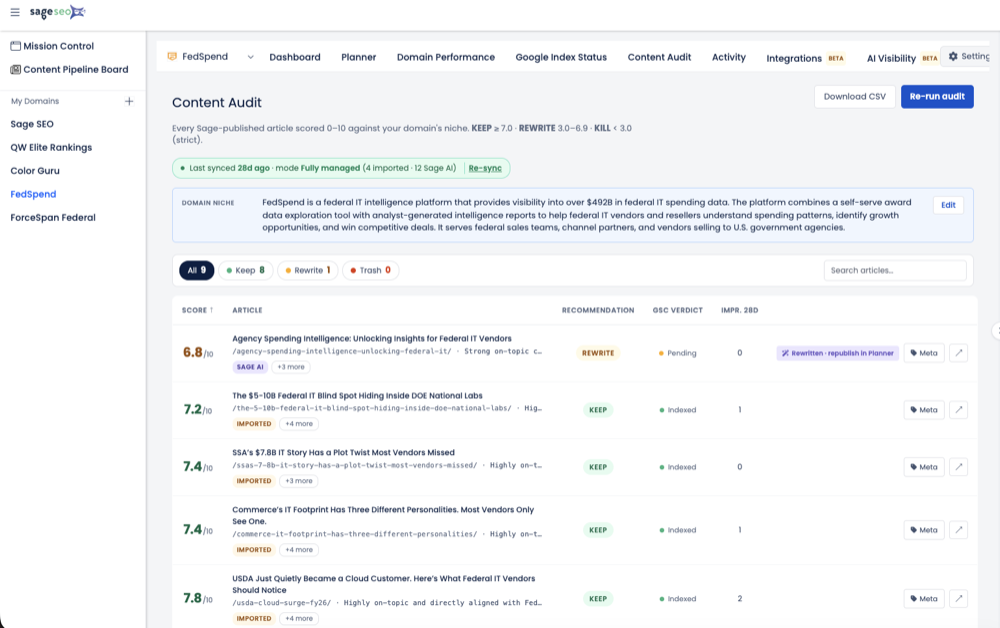
- Manual weekly checks used to consume hours per client site
- Automation shrinks per-site review to a few minutes
- Quick-win lists capped at five items get done; longer ones don't
- A separate Wednesday publish block prevents fixes from stacking
- Weekly small fixes compound better than quarterly big audits
I used to put “weekly SEO check-ins” in every proposal I sent, and I meant it when I typed it. Then client number seven showed up on my roster, and the weekly check-ins quietly turned into monthly ones, then quarterly ones, then whatever I could squeeze in before a renewal call. I told myself the problem was discipline. It wasn’t. The problem was math: a real weekly check used to take almost as long as a full audit, and nobody — not me, not you, not anyone running more than three accounts solo — has eight extra hours a week lying around for upkeep. Once that per-site check actually shrank to minutes, the weekly cadence I’d been promising for a decade finally became something I could keep.
Why “Weekly SEO Maintenance” Used to Be a Lie I Told Clients
Weekly SEO maintenance failed for years not because consultants lacked discipline, but because a genuine weekly check required near-audit levels of manual work. I’d open Search Console, export the data, cross-reference it against last month’s crawl, eyeball rankings in a spreadsheet, and try to remember what I’d already fixed. For one client, that was manageable. For twelve, it was a part-time job I hadn’t billed for.
Here’s the honest breakdown of what a “real” weekly check actually demanded back when I was doing it manually:
| Task in a Manual Weekly Check | Rough Time Cost Per Site | Why It Broke the Weekly Cadence |
|---|---|---|
| Export and review GSC performance data | 20–30 minutes | Had to be repeated from scratch each week, no memory of prior state |
| Re-crawl site for technical flags | 30–45 minutes | Crawls are slow and easy to postpone under deadline pressure |
| Manually prioritize fixes | 20–40 minutes | No consistent scoring meant re-litigating priorities every time |
| Write up findings for the client | 15–20 minutes | Felt like overkill for “just a check-in,” so it got skipped |
Add that up across a dozen accounts and you’re looking at a full day, minimum, just to stay current. So the weekly promise quietly became a quarterly one, dressed up as “ongoing maintenance” in the invoice line item. Clients rarely called this out, but they felt it — in the form of issues that sat unresolved for ten or twelve weeks at a stretch.
What Actually Changed the Math Behind Weekly SEO Maintenance
The shift wasn’t a new strategy — it was the grunt work finally getting automated out of the critical path. Manual crawling, manual scoring, and manual prioritization used to be the bottleneck standing between “I should check this weekly” and “I actually do.” When that step compresses from half a day to a few minutes per site, weekly cadence stops being aspirational.
I want to be precise about what this does and doesn’t do. It doesn’t replace strategic thinking — deciding which keyword cluster to go after next, or whether a client should build topical authority in a new service area, still takes judgment. What it removes is the busywork that used to eat the hours you’d need for that judgment in the first place. Tools like GSC Momentum turn the “pull the data and figure out what moved” step into something closer to a glance than a project, which is the only reason the routine below is structurally possible for one person managing a full client load.
Monday Morning: Running the GSC Review and Score Check (9:00–9:40)
The entire weekly routine anchors on a 40-minute Monday block that didn’t exist in my calendar three years ago, because there was never enough spare time to justify it. Coffee first, always. Then I open Search Console for each active client, one tab per site, and scan for anything that moved: an impressions drop, a cluster of new queries, a sudden spike in coverage errors.
What I’m actually scanning for
This isn’t a deep audit. It’s a pulse check, and the goal is noticing change, not re-discovering the whole site from scratch. Specifically, I’m watching for:
- Pages whose optimization score dropped since last week’s check
- New technical flags that weren’t there Friday — broken redirects, newly thin pages, duplicate titles
- Query volatility that signals a ranking shift worth investigating further
- Any page that crossed from “fine” into “needs attention” territory
Then I run the per-site score check — the fast version of what used to be a crawl-and-cross-reference exercise. I built a related workflow around exactly this moment, walking through how a raw GSC export turns into an on-page score in roughly the time it takes to read it. The mental shift here matters more than the tooling: this block used to not exist, period, because there was never a spare 40 minutes for twelve clients every single Monday. Now it’s the anchor the whole week hangs on.
Building the Quick-Win List for Each Client (9:40–10:15)
The 35 minutes after the score check go entirely to triage — separating what gets fixed this week from what just gets watched. Not every flag deserves action. A meta description issue on a page getting meaningful traffic is a fix-now item. A thin-content flag on a page nobody’s visited in two years is a watch item, maybe forever.
Impact versus effort, not “fix everything”
I triage against a simple matrix rather than working top-to-bottom through every flag a crawl throws up:
Skip the spreadsheets. Start Sage SEO free.
See how AI content ops transform your agency workflow in minutes.
| Issue Type | Fix Now | Watch |
|---|---|---|
| Meta description missing or duplicated | On a page with real impressions or rankings near page one | On a low-traffic or orphaned page |
| Broken internal link | Links from a high-authority page into a priority cluster | Links buried in old blog posts with minimal link equity |
| Thin content flag | On a page targeting a commercial keyword | On an informational page that’s stable and ranking fine |
| New technical error | Anything touching indexation (noindex, canonical, 404) | Cosmetic or non-blocking warnings |
I cap the list at three to five items per client, on purpose, even when the check surfaces more. A ten-item list looks thorough and gets ignored. A five-item list gets done. This list, not a monthly slide deck, has become the actual deliverable clients see — I stopped rebuilding a reporting deck from scratch every month once a running log of small, visible fixes did the job better and took a fraction of the time.
Midweek: The Publish Block Where Fixes Actually Ship
Wednesday afternoon is reserved entirely for implementing whatever Monday’s list produced — nothing new gets added mid-week unless something breaks. This is where the routine lives or dies. A list without an execution block is just a to-do pile, and I’ve watched consultants (myself included, back in 2019) build beautiful triage systems that never converted into shipped fixes.
Batching across accounts, not working account-by-account
I batch by task type rather than by client. All the meta description rewrites happen in one pass, across every account that needs one, because switching between fix types costs more focus than switching between client logins. The same logic applies to drafting new copy for thin-content flags — I lean on a workflow that goes from the flagged signal straight to a publishable draft rather than starting each rewrite from a blank page, and I schedule the actual publish dates through a shared content calendar so nothing slips between accounts.
The real discipline test isn’t the fixing — it’s not letting the list carry over. If a Monday quick win is still sitting there the following Monday, that’s the signal the routine is breaking, not a reason to just add it to next week’s pile on top of the new ones. I send clients a two- or three-line note after the publish block: what got fixed, what moved, nothing heavier than that.
What This Weekly SEO Workflow Replaced
This routine replaced the quarterly “big audit” model, where every issue on a site sat unresolved for weeks before anyone looked at it again. Under that model, a broken canonical tag discovered in January could sit untouched until the April audit, quietly suppressing a page’s visibility the entire time.
| Quarterly Big-Audit Model | Weekly Maintenance Loop | |
|---|---|---|
| Issue discovery | Every 90 days, in one large batch | Within days of appearing |
| Fix latency | Weeks to months after discovery | Typically fixed within the same week |
| Client visibility | One dense report, four times a year | A short running log, every week |
| Consultant workload | Spiky — brutal audit weeks, quiet gaps between | Flat and predictable |
Small, frequent fixes compound differently than infrequent overhauls. This tracks with general crawl-freshness and content decay principles that get discussed constantly in SEO circles: search engines reward sites that show consistent, incremental signs of upkeep over sites that get a single dramatic overhaul and then go stale again. The psychological benefit for a solo consultant is just as real as the ranking benefit — there’s no more audit-day scramble, no more dread building toward a quarterly deadline, and client relationships get steadier because they’re seeing progress every week instead of a report every ninety days.
How to Build Your Own Weekly SEO Maintenance Checklist
You don’t need my exact time blocks — you need the four structural decisions underneath them. This isn’t one-size-fits-all; a solo consultant with eight accounts, an in-house marketer with one site, and an agency running fifty domains will all tune the cadence and batch size differently.
- Pick one anchor day for the review-and-score step, and protect it like a client meeting — not something that slides whenever the week gets busy.
- Define what “check” means for your stack before you start — is it a GSC pull, an on-page score, a crawl report, or some combination?
- Cap the quick-win list at a number you can realistically close out before the next check — three to five per site works for most solo loads.
- Protect a separate publish block later in the week so triage and execution never collapse into the same rushed hour.
If you’re managing a dozen accounts and need the agency-level version of this, a shared view across every domain’s score and flags — something like an agency dashboard — makes the Monday block scale past the point where tabbing between twelve GSC properties stops being realistic. Weekly maintenance stopped being aspirational the moment the checking step stopped being the bottleneck. It’s the same shift that killed the monthly status meeting once Slack made daily updates nearly free.
The Routine Only Works Because the Audit Stopped Being the Job
I spent a decade treating the audit as the deliverable and the fixes as an afterthought squeezed in whenever time allowed. That was backwards. Clients don’t pay for a document that describes their problems — they pay for the problems getting smaller, visibly, every week. The weekly rhythm I run now isn’t more disciplined than what I was doing in 2015. It’s just finally fast enough to be real, and once you feel the difference between a maintenance promise and a maintenance habit, you won’t go back to quarterly either.