
- Most SEO tools were built for the wrong site type.
- Listing pages are thin and gone before audits finish.
- Neighborhood guides carry the same thin-content risks as listings.
- Enterprise SEO suites are overkill for most brokerages.
- Per-page scoring at publish beats sporadic quarterly audits.
I sat in on a kickoff call last year with a brokerage marketing coordinator who had just run her first “deep SEO audit.” The tool flagged 412 issues. She spent a week triaging them before realizing most sat on listings for homes that had already sold. The audit was accurate. It was also useless — nobody built it for a site where a quarter of the URLs churn every quarter.
That’s the real problem with SEO for real estate agents: the tooling was built for a different kind of website.
The Real Estate SEO Problem Nobody’s Tool Was Designed For
Most SEO tools assume you have a small number of important pages worth a deep, slow audit — real estate sites have the opposite problem entirely. Picture a 200-listing brokerage site: active listings, neighborhood guide pages, agent bios, maybe a blog nobody’s touched since 2023. A SaaS company audits five pages that matter enormously. A brokerage has two hundred pages that matter a little, all at once, and half of them will be gone by next quarter.
I didn’t fully get this until a crawl-based audit on a client’s IDX-powered site tried to prioritize 180 near-identical listing URLs as if they were cornerstone content. The table below is the mental model I now walk every real estate client through before picking a tool.
| Attribute | Typical SaaS / Enterprise Site | 200-Listing Brokerage Site |
|---|---|---|
| Number of “important” pages | 5–20 | 150–300+ |
| Average page lifespan | Years | Weeks to a few months |
| Content depth per page | Deep, strategic | Thin, templated, MLS-fed |
| Audit cadence needed | Quarterly, deep crawl | Continuous, per-page, fast |
| Who runs the audit | Dedicated SEO hire | Agent, coordinator, or assistant |
The right tool for that second column isn’t the most powerful one on the market. It’s the one built for volume and turnover, not depth.
Why Real Estate Listing Pages Break the Assumptions Most SEO Tools Make
Listing pages break conventional SEO tooling because they’re thin by design and gone before a typical audit cycle finishes. A listing page is address, price, beds, baths, and a description someone pasted straight out of the MLS feed. There’s no content strategy to “deepen” there — the format is the format.
Worse, listings on the same site frequently read as near-duplicates of each other: same template, same boilerplate disclosures, same three comps in the “similar homes nearby” block. That’s not sloppy marketing — it’s structurally how MLS-fed listing pages work at scale, and exactly the pattern that trips thin-content and duplicate-content flags.
Then there’s turnover. Brokerage inventory cycles constantly — listings go live, go pending, and disappear within weeks, not years. A four-hour forensic audit is a poor trade when the page’s shelf life is shorter than the audit itself. I’ve watched teams “perfect” a listing that was off the MLS before the edits were even indexed.
What this means for your workflow
- Treat listings as a template-optimization problem, not a page-by-page writing project.
- Prioritize speed of review over depth for any single listing.
- Build SEO checks into the publish moment, not a separate quarterly cycle.
Neighborhood Guide Pages: High Volume, Low Differentiation
Neighborhood pages create the same thin-content risk as listings, except nobody treats them with the same urgency. Brokerages love spinning up “Homes for Sale in [Neighborhood]” pages because local intent is real. The problem is execution: most of these pages get built from the same template with the neighborhood name swapped in and a couple of sentences reshuffled. Google’s own guidance on people-first content has been consistent for years — content built mainly to target a keyword variation, with minimal unique value, is exactly the pattern search engines are tuned to deprioritize.
Here’s the part nobody wants to hear: manually rewriting 40 neighborhood pages isn’t realistic for a team of one or two people, especially when that same team handles open house flyers and the Instagram calendar too. I’ve tried to get clients to commit to “we’ll rewrite five a week” and watched that plan die by week three, every time. Automated, scalable scoring that tells you which pages are thinnest first beats a manual queue that never gets worked through.
Why Enterprise SEO Suites Are Overkill for Brokerage Sites
Enterprise SEO platforms are built for deep technical crawls across a few thousand strategic URLs — a 200-listing site doesn’t need that, and paying for it wastes budget a brokerage could spend elsewhere. Crawl budget analysis, JavaScript rendering audits, internal-linking architecture modeling — real problems for an enterprise e-commerce catalog, not for a brokerage.
What a brokerage needs is for every new listing page to hit basic on-page fundamentals fast: a real title tag, a usable meta description, one clear H1, a description that doesn’t read like MLS boilerplate. That’s the job.
I wrote previously about why I stopped trusting SEO tools that take thirty seconds just to load a single page — and that problem compounds in real estate, where you’re often checking a dozen pages in one afternoon. Thirty seconds times 200 pages is over ninety minutes of spinners before you’ve fixed anything.
Skip the spreadsheets. Start Sage SEO free.
See how AI content ops transform your agency workflow in minutes.
| Criterion | Enterprise SEO Suite | Per-Page Scoring Tool |
|---|---|---|
| Setup required | Full-site crawl configuration | Point at one URL, get a score |
| Who can interpret output | Dedicated SEO specialist | Agent, coordinator, assistant |
| Best suited for | A few thousand strategic pages | Hundreds of fast-turnover pages |
| Typical pricing model | Seat-based, enterprise tier | Usage/volume-friendly |
There’s also a staffing reality underneath this. Enterprise tools generally require someone on staff who can interpret a crawl report. Most brokerages, even sizable ones, don’t have that person — they have an agent, a coordinator, or a part-time marketing hire wearing six hats. The tool has to meet that person where they are.
Why Manual On-Page Optimization Doesn’t Scale for Real Estate Marketers
Manual SEO checks on every new listing become a full-time job once volume passes roughly ten to twenty updates a week — and that job always loses to whatever’s more urgent that day. “Doing it manually” means checking the title tag, writing a meta description, confirming header structure, and making sure the copy uses the neighborhood name instead of “this home.” Multiply that by every new listing, price change, and back-on-market relist.
I mass-edited a batch of listing meta titles for a real estate client years ago, felt efficient, and watched three of those listings get pulled off the market within two weeks — the work evaporated before it earned a single ranking. I wrote more about that pattern in the meta-title workflow I used to dread rewriting at scale, and the lesson transfers directly: batch manual work without repeatability is wasted motion.
When an agent or coordinator is juggling social posts, email campaigns, and open house promotion, SEO gets skipped first — not because it doesn’t matter, but because it has no deadline attached, right up until traffic quietly drops.
What Actually Matters: Speed and Per-Page SEO Scoring
The fix isn’t a deeper audit — it’s a fast, repeatable per-page score you can run every time a listing or neighborhood page goes live. Instead of a 40-page PDF delivered once a quarter, a brokerage needs a spot-check: run the new page through a scoring pass, get a short list of fixes — title’s too long, missing H1, description under 150 words — and act in minutes, not days. That’s the same discipline I describe in letting benchmark data lead every content decision rather than gut feel, just applied at listing scale instead of blog-post scale.
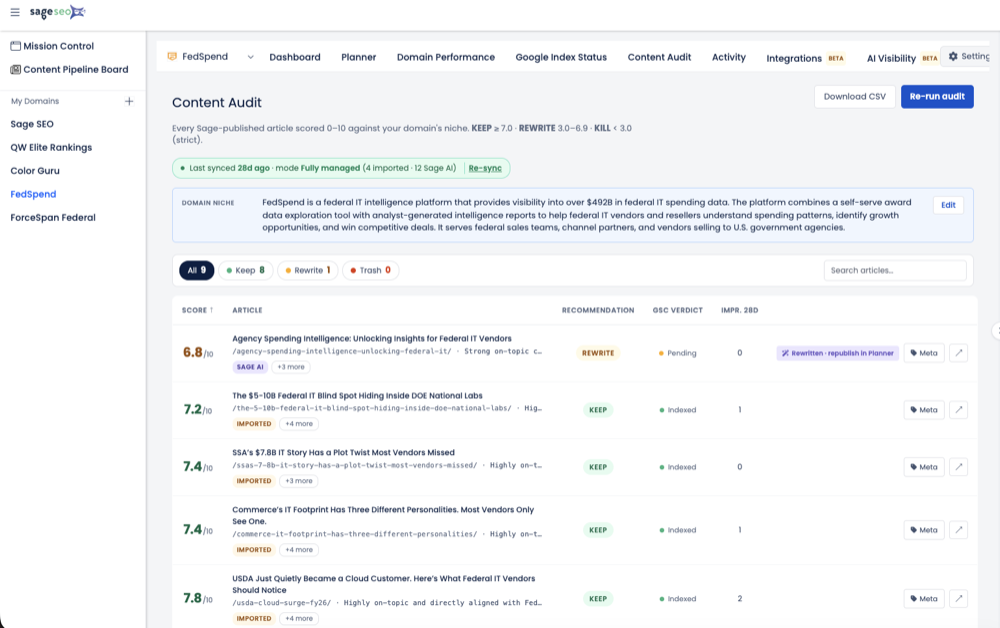
That’s the gap tools like Sage SEO’s AI-search bucketed content audit are built to close for high-page-count sites — scoring pages individually and flagging thin or duplicate patterns in plain language instead of a jargon-heavy report nobody on a three-person team has time to decode.
To be clear, per-page scoring doesn’t replace foundational technical work — site speed, mobile usability, and structured data for listings still matter. What it replaces is the false choice between “do nothing” and “run an exhaustive audit we’ll never finish.” Here’s roughly how I’d triage a new listing page in under five minutes:
- Run the new page through a per-page score the moment it’s live.
- Fix anything flagged as missing — title tag, H1, meta description.
- Check the description for duplicate phrasing against your last three listings.
- Confirm the neighborhood name and key local terms actually appear in the copy.
- Re-run the score after edits to confirm it moved before moving to the next listing.
What to Look for in a Real Estate SEO Tool
The right real estate SEO tool is judged on speed, plain-language output, and usability by a non-specialist — not on enterprise feature count. When advising a brokerage, I ignore the feature checklist most vendors lead with and focus on four questions instead.
| Question to Ask | Why It Matters for Real Estate |
|---|---|
| Can it score a single page without a full crawl setup? | You’re publishing one listing at a time, not relaunching a site |
| Does it flag thin/duplicate content in plain language? | The person acting on it usually isn’t an SEO specialist |
| Is it usable by an agent or coordinator, not just an SEO hire? | Most brokerages don’t have a dedicated technical SEO role |
| Does pricing fit ongoing, high-frequency use? | You’ll run this weekly, not once a quarter |
I’d add a fifth, unofficial test: how does the tool talk about high-volume, low-depth page sets in its marketing? If a vendor’s pitch centers on deep audits for a handful of flagship pages, the product wasn’t built with your page count in mind.
The goal was never the most comprehensive tool on the market. It’s the one that matches how often, and how fast, your content actually changes.
Back to the 200-Listing Brokerage: What Actually Changes
Shift from sporadic manual reviews to a quick per-page check at publish time, and the realistic outcome is consistency — not a dramatic overnight traffic spike. More listings get basic SEO hygiene applied the day they go live instead of whenever someone finds a free hour. Fewer neighborhood pages sit untouched for a year because nobody had the bandwidth. The work that used to fall through the cracks during a busy month — and in real estate, every month is a busy month — actually gets done, because it takes minutes instead of hours.
That’s not flashy. It’s the difference between SEO being something the team means to get to and something that actually happens, week after week, listing after listing.
The Real Metric Is Throughput, Not Polish
I’ll say the thing most vendors won’t: a perfectly optimized listing page published three weeks late is worth less than a decent one published on time. Real estate SEO isn’t a depth problem and never was — it’s a throughput problem, won with speed and repeatability, not the most exhaustive crawl report your budget can buy. Pick the tool that fits how fast your inventory actually moves, not the one with the flashiest feature list in a sales demo.