
- SEO scores measure HTML structure, not content quality
- Tools scan raw HTML before any JavaScript rendering occurs
- The same page can score differently across multiple tools
- Fix indexability issues before optimizing structural elements
- A score is a diagnostic starting point, not a finish line
A B2B SaaS client of mine once ran the same URL through three different SEO tools in the same afternoon and got scores of 58, 74, and 91. Same page, same hour, wildly different numbers. He forwarded me the screenshots with one line: “which one is lying?” None of them were. They were just reading different slices of the same page, and none of them were grading the writing at all.
That’s the confusion I see constantly: people treat an SEO score like a teacher’s grade on an essay, when it’s closer to a machine-readability check. Once you understand what the number is actually measuring, the gap between tools stops feeling mysterious and starts feeling obvious.
The SEO Score Isn’t an Opinion, It’s a Reading of What’s Detectable
An SEO score measures how legible a page is to an automated system, not how good the content is. I’ve watched founders stare at a 62 and ask what’s wrong with their writing, when the real answer was a missing H1 and three empty alt attributes. The tool never read a sentence for quality. It scanned structure.
Think of it like a spell-checker for machine-readability. A spell-checker won’t tell you your novel is boring, but it will catch every typo that makes a reader (or in this case, a crawler) stumble. An on-page SEO score works the same way — it’s a detector for structural and semantic clarity, not a verdict on whether your argument is compelling.
Here’s a quick gut-check table I give clients before we even open a tool, because it resets expectations fast:
| What You Assume the Score Measures | What It Actually Measures | Why the Gap Exists |
|---|---|---|
| How well-written the content is | Whether structural elements (titles, headings, tags) are present and well-formed | Tools parse markup, not meaning |
| Whether the page will rank | Whether the page is technically legible to a crawler | Rankings depend on competition, intent match, and links too |
| A single objective truth | One tool’s interpretation of detectable signals | Each vendor weights signals differently |
| Content quality or expertise | Machine-readable structure and indexability | Quality assessment requires human or deep-model judgment |
Why Does Google’s First Pass Start With Raw HTML, Not the Rendered Page?
Google — and nearly every serious SEO tool — reads the raw HTML response before anything touches a rendering engine, because that’s literally the order crawling happens in. I didn’t fully internalize this until I audited a client’s React site that looked flawless in Chrome and was nearly invisible in Search Console. The content existed. It just didn’t exist yet at the moment the crawler first looked — the same crawled-but-not-indexed gap that shows up constantly in Search Console exports once you know where to look.
Crawling and Rendering Are Two Separate Jobs
Google’s own JavaScript SEO documentation lays out the sequence plainly: Googlebot fetches a URL, parses the raw HTML, queues anything that needs JavaScript execution for a separate rendering pass, and only then merges what it finds into the index. That second pass isn’t instant. It depends on available rendering resources, and Google has been candid that it can lag behind the initial crawl.
A scoring tool that skips rendering isn’t cutting corners. It’s mimicking the exact conditions of that first, most consequential pass — the one where a crawler decides whether a page is even worth coming back to.
| Phase | What Happens | What Governs the Timing | Risk If a Signal Only Exists After This Phase |
|---|---|---|---|
| Crawl / Parse | Googlebot fetches raw HTML and reads it as-is | Crawl budget, server response time | None — this is the baseline every tool and crawler sees first |
| Render Queue | Page is queued to execute JavaScript | Available rendering resources, page complexity | Content may sit unindexed until this pass completes |
| Render / Index Merge | Rendered DOM is reconciled with the crawl data | Success of the JS execution itself | Errors here mean rendered-only content never gets counted |
The practical implication is one I repeat to every client now: if a signal only exists after JavaScript runs, treat it as a real crawlability risk, not a theoretical one. Instant, raw-HTML-first analysis isn’t a shortcut around the “proper” audit — it’s a more honest simulation of what the crawler actually does first.
What Signals Actually Get Pulled From the Raw HTML?
A scoring tool reads a fixed set of structural and semantic markers directly from the page’s source code, not from how the page looks in a browser. This is the part people find oddly mechanical once I walk them through it — the “magic” is really a checklist.
- Title tags and meta descriptions — presence, length, and whether they’re duplicated across pages
- Heading structure (H1–H6) — whether it forms a logical hierarchy or jumps around
- Image alt attributes — present, empty, or missing entirely
- Internal linking patterns — anchor text visible in the static HTML, not injected later
- Structured data / schema markup — whether it exists in the raw source at all
- Canonical tags and robots meta directives — the basic indexability flags
- Word count and text-to-code ratio — a rough proxy for content depth versus markup bloat
I once watched a client’s “perfect” product page score low purely on text-to-code ratio — a bloated component library buried 400 words of actual copy under thousands of lines of div soup. The content was fine. The ratio of signal to noise wasn’t.
Skip the spreadsheets. Start Sage SEO free.
See how AI content ops transform your agency workflow in minutes.
| Signal | Where It Lives in the HTML | Why a Scanner Flags It |
|---|---|---|
| Canonical tag | <link rel="canonical"> in the head | Tells a crawler which version of a page is authoritative |
| Robots meta directive | <meta name="robots"> in the head | Can block indexing outright if misconfigured |
| Heading hierarchy | H1–H6 tags in document order | Signals topical structure and semantic organization |
| Schema markup | JSON-LD or microdata in the source | Helps a crawler understand entities, not just text |
None of this requires interpreting prose. It requires parsing tags that are either present, absent, or malformed — which is exactly why Googlebot’s documented behavior treats the static document as the primary artifact of record.
Do These Signals Actually Map to Google’s Ranking Factors?
Some of them do directly, and most of them support rankings indirectly by keeping a page crawlable and understandable — the score is a proxy for technical health, not a position predictor. This is the distinction I wish more vendors made clearly instead of implying “100 means you’ll rank.”
Google’s own Search Essentials documentation confirms a handful of things outright — mobile-friendliness and page experience among them. Everything else in a typical on-page score — clean headings, present alt text, a sensible canonical — sits in the “best practice” bucket: it doesn’t guarantee a ranking, but its absence creates friction that keeps good content from competing at all.
I use a resume analogy with every client who gets defensive about a low score. Good formatting on a resume doesn’t guarantee the job. But a resume with no clear headers, a buried job title, and inconsistent fonts guarantees a recruiter skims past it in six seconds. An SEO score works the same way — it’s a filter for whether your content gets a fair read, not a judge of what’s written.
| Signal Type | Example | Confirmed Ranking Factor? | What It Actually Does |
|---|---|---|---|
| Direct, confirmed | Mobile-friendliness, page experience | Yes, per Google’s own documentation | Directly influences ranking eligibility |
| Best-practice, crawlability | Clean heading hierarchy, canonical tags | No — but supports understanding | Reduces friction so content can compete |
| Best-practice, semantic | Descriptive alt text, structured data | No — contextual support | Helps a crawler parse meaning accurately |
If you want the fuller mechanics of how individual factors actually get weighted into a ranking outcome, the deeper breakdown of rank calculation is worth a read once this foundational layer clicks.
What Can’t an SEO Score Measure (And Why That’s Fine)?
A score can’t judge content quality, expertise, or how well a page actually satisfies a searcher’s intent — those require human or deep-model judgment an HTML parser was never built to make. I say this to every client who treats 100 as the finish line.
- It can’t measure whether your argument is persuasive or your expertise is real
- It can’t account for off-page factors like backlinks, brand signals, or authority
- It can’t fully simulate rendered JavaScript behavior without a separate rendering stage
- It can’t tell you if the content actually answers the question the searcher had
None of that makes the score useless. It makes it a diagnostic starting point, not a finish line. I’ve shut down more than one internal debate by reminding a team that the fastest way to lose a ranking isn’t a mediocre score — it’s fixing a vanity metric while ignoring whether the page actually helps anyone.
How Should You Actually Use an SEO Score Without Chasing a Number?
Treat the score as a punch list ordered by consequence, not a grade you’re trying to maximize. I made this mistake myself early on — spent an afternoon polishing meta descriptions on a client site while a robots directive was quietly blocking half the section from being indexed at all.
- Fix indexability first. Robots directives, canonical errors, and broken heading structure — anything that stops a page from being read correctly at all.
- Address structural clarity second. Title tags, heading hierarchy, and internal linking that helps both crawlers and humans understand the page.
- Layer in semantic depth third. Alt text, schema markup, and content-depth signals like text-to-code ratio.
- Re-check the score after meaningful changes — not after every minor tweak. Chasing single-point swings wastes more time than it saves.
- Judge success by crawl and index behavior, not just the number going up, by watching how Search Console responds over the following weeks.
This is exactly the sequencing problem I built into how I think about restructuring a page’s internal links without breaking what already works — fix the load-bearing issues before you touch the cosmetic ones. And if you’ve ever let “we’ll optimize it later” become permanent, you already know what that delay actually costs over a quarter.
A Score Is a Mirror, Not a Verdict
I trust tools that show their work. The moment a vendor can explain exactly why a page scored a 71 — which tag was missing, which heading broke the hierarchy — that number stops being a black box and starts being useful. That’s the whole case for transparency in scoring: it’s not a marketing nicety, it’s the difference between a tool you can audit and one you just have to believe.
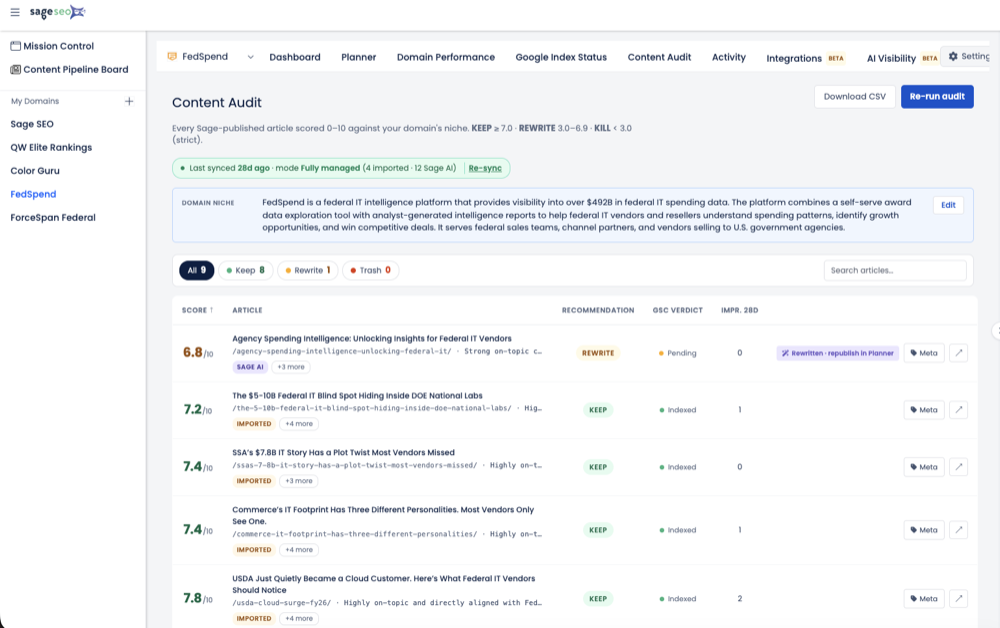
That’s the same raw-HTML-first philosophy behind Sage SEO’s content audit view — fast because it mirrors the crawler’s first pass, and legible because every flagged signal traces back to something actually sitting in the page’s source. If you’ve got a score staring at you right now and no idea why, that’s usually where the real answer lives — not in a rewrite, but in the markup you haven’t looked at yet.
Frequently Asked Questions
Why does the same page get different scores in different SEO tools?
Does a perfect SEO score guarantee a higher ranking?
Why do SEO tools analyze raw HTML instead of the rendered page?
What should you fix first when you have a low SEO score?
What can an SEO score not measure?

Related Posts
-
Why Instant Page Analysis Beats the ‘Crawl and Wait’ SEO Audit Model
Eleven minutes. That’s how long I sat on a client call last spring watching a…
-
The Basics of SEO: Understanding the Connection Between Keywords and Content (Se Keywords Explained)
A B2B SaaS client of mine texted me on a Tuesday morning: “did we rank…
-
Mastering Keyword Strategy: The Power of AI in Strategic Planning (Keyword Se & Se Keyword Guide)
Three weeks ago I pulled a Search Console export for a cluster of pages built…