- AI-first SEO restructures workflows, not just adds AI tools
- Entity clarity and schema matter more than keyword density
- Results still take 3–12 months despite faster AI tooling
- Continuous dashboards replace static monthly PDFs in reporting
- Ask providers for sample briefs and AI citation tracking metrics
I sat in on a sales call last spring where a prospective agency told a client, “we’re AI-first too,” and then described a process that was just a human writer pasting a brief into ChatGPT before sending it to an editor. That’s not AI-first. That’s a traditional agency with a faster typewriter. I’ve audited a dozen agencies that claim the label in the last two years, and maybe three of them actually restructured anything about how they find demand, brief content, or report results. The rest just added a tool to the same old pipeline.
That gap matters more than it used to, because the thing Google and the AI engines are now rewarding isn’t the same thing a traditional keyword-rank tracker measures. If you’re evaluating ai first seo services for your business right now, the question isn’t “do they use AI.” It’s whether their entire workflow is built around the machine-readable signals that large language models actually pull from when they answer a question. That’s a structural difference, not a speed upgrade, and it’s the one most buyers miss.
What “AI-First SEO Services” Actually Means
An AI-first SEO service is one where research, content briefs, structured data, and reporting are built around continuous, machine-readable signals from the start, not an agency that simply uses AI tools to work faster. The distinction sounds academic until you watch it play out in a client account. A traditional agency optimizes toward ten blue links. An AI-first one optimizes toward being the answer an LLM cites, which depends on entity clarity, schema, and topical depth far more than it depends on keyword density.
I’ve started separating the two in client conversations with a simple table, because “AI-first” has become marketing wallpaper and people need a gut check before they sign a contract.
| Aspect | “Uses AI tools” agency | Structurally AI-first agency |
|---|---|---|
| Where AI sits | Bolted onto an existing manual workflow | Embedded in research, briefing, and QA from step one |
| Optimization target | Keyword rank position | Entity clarity and citation-worthiness for answer engines |
| Content briefs | Written once, rarely revisited | Updated against live search and AI-citation signals |
| Reporting cadence | Monthly PDF, rank-position focused | Continuous dashboard tracking rankings and AI mentions |
The second column is where the real workflow shift agencies are being forced to make actually shows up, and it’s why the term deserves more scrutiny than most buyers give it.
How Does AI-First SEO Differ From Traditional SEO?
AI-first SEO differs from traditional SEO in the cadence of iteration: traditional agencies run a quarterly audit and a static report, while AI-first providers treat optimization as a continuous loop fed by live data. I ran traditional quarterly audits for years. You’d spend two weeks crawling a site, build a 40-tab spreadsheet, hand over a PDF, and by the time the client’s dev team actioned even half the fixes, the SERP had already shifted under you. That lag is the single biggest weakness of the old model, and it’s why the “crawl and wait” audit model keeps losing ground to tools that score a page the moment it’s published.
Content briefing is the other place the gap shows up fast. A traditional brief is a keyword list and a word count target. An AI-first brief pulls from intent clustering, competitor entity coverage, and the questions AI engines are already answering for that topic, then updates itself as those answers shift. I watched a B2B SaaS client’s brief process go from a static Google Doc to a living document that flagged new “People Also Ask” entries weekly, and the writers started closing content gaps within days instead of waiting for the next quarterly review.
Static Reporting vs. Continuous Signal Tracking
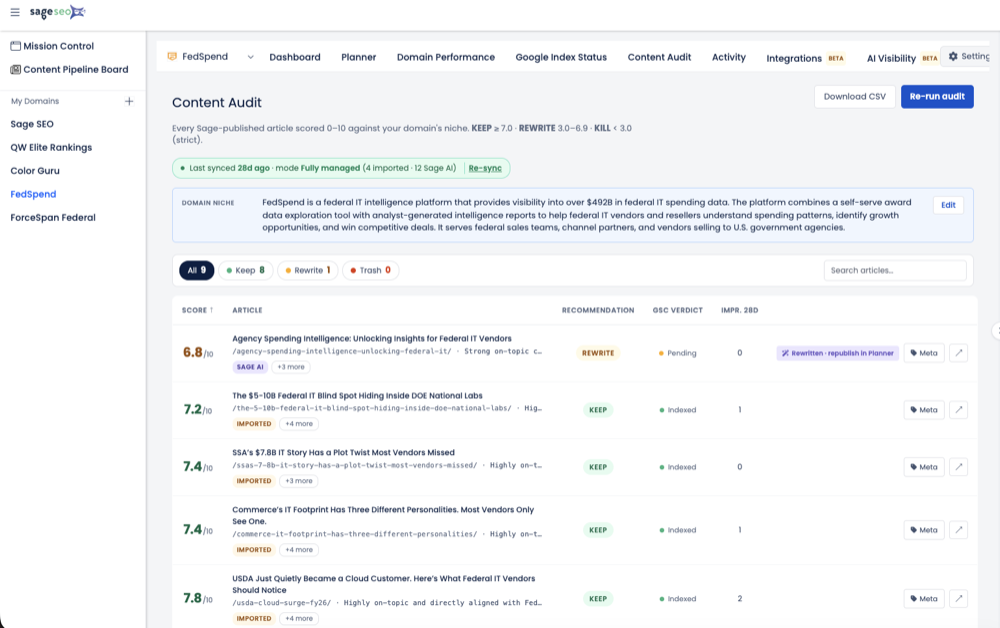
Reporting is where the philosophical difference becomes a practical one. A monthly rank report tells you what happened. A continuous dashboard tells you what’s happening, including whether your pages are showing up inside AI Overviews and chat answers, which traditional rank trackers were never built to measure.
| Function | Traditional Agency | AI-First Agency |
|---|---|---|
| Technical audit | Scheduled crawl, delivered as a static report | Continuous scoring as pages publish or change |
| Content briefs | Fixed keyword + word count template | Dynamic, intent-clustered, revisited as queries shift |
| Tracking | Google rank position only | Rank position plus AI engine citation visibility |
| Client reporting | Monthly PDF | Always-on dashboard with revenue-linked metrics |
The Core Components of an AI-Driven SEO Strategy
An AI-driven SEO strategy rests on four pillars: technical foundation, content architecture, entity and structured data optimization, and continuous performance monitoring, each re-scoped to serve both traditional crawlers and answer engines. Skip any one of these and the other three underperform, because the pillars feed each other.
Technical Foundation and Structured Data Optimization
Your technical audit still needs to catch the basics, crawlability, site speed, canonical issues, the same checklist I’d run before migrating a site to a new CMS. What’s different is the weight given to schema markup and entity disambiguation. LLM-driven search leans heavily on structured data to understand what a page is actually about, separate from the words on it, which is a muscle most legacy technical audits never built.
Skip the spreadsheets. Start Sage SEO free.
See how AI content ops transform your agency workflow in minutes.
Content Architecture and Entity-Based SEO
Content architecture shifts from keyword silos to topic clusters built around named entities, people, products, concepts, and the relationships between them. Preparing a page this way is close to what it takes to get content ready for AI-generated search results: comprehensive coverage of a subtopic, clear entity labeling, and internal links that reinforce topical authority rather than just passing link equity.
Performance monitoring is the pillar most agencies still half-build. Tracking rank position is table stakes. Tracking whether your brand or pages get cited inside an AI Overview or a Perplexity answer requires a different kind of visibility tracking, which is exactly the gap cross-engine citation tracking tools are built to close.
| Pillar | Traditional Search Goal | AI Answer Engine Goal |
|---|---|---|
| Technical foundation | Crawlability, speed, indexation | Clean structured data for machine parsing |
| Content architecture | Keyword coverage per page | Entity depth and topic completeness |
| Structured data | Rich snippet eligibility | Disambiguation for LLM sourcing |
| Performance monitoring | Rank tracking | Citation and mention tracking across engines |
How Long Does It Take to See Results From AI SEO Tools?
AI SEO tools speed up the research and production loop, but they don’t shorten the time Google and AI engines need to trust a site, so most businesses should still expect a multi-month timeline, not an overnight one. This is the part sales decks tend to gloss over, and it’s worth saying plainly because I’ve watched clients churn an agency at month two for not “working,” when two months is barely enough time for a new content cluster to get indexed, let alone ranked.
Industry guidance on this has stayed remarkably consistent for years. Search Engine Journal and similar trade publications commonly describe a general arc: early technical and content fixes can show movement within the first one to three months, meaningful ranking gains tend to show up between three and six months, and durable, compounding authority usually takes six to twelve months or longer in competitive niches. AI-first providers don’t break that arc. What they change is how much ground you cover inside it, because a tighter, data-driven content engine means less time wasted on briefs and audits that don’t move the needle.
| Timeframe | What Typically Happens | What AI-First Tools Change |
|---|---|---|
| 0–3 months | Technical fixes, initial content gaps closed | Faster audits, briefs generated in days not weeks |
| 3–6 months | Early ranking movement on lower-competition terms | Faster iteration based on live performance data |
| 6–12+ months | Compounding authority, competitive term gains | Continuous reprioritization toward what’s working |
Treat any provider who promises top rankings inside 30 days as a red flag, no matter how much AI they claim to use. Google’s own public guidance has repeatedly stressed that there’s no fixed timeline for SEO results, and that hasn’t changed with the rise of generative search.
How to Evaluate an AI-First SEO Provider Before Hiring
Evaluate an AI-first SEO provider by asking exactly where AI touches their deliverables and who signs off on strategy, not by taking the label at face value. I’ve sat through enough of these pitches now to have a short list of questions that separate real process from a slide with a robot icon on it.
- Ask for a sample content brief. A real AI-first brief shows intent clustering and entity coverage, not just a keyword and a word count.
- Ask how often reporting updates. If the answer is “monthly,” the tooling is bolted on, not built in.
- Ask whether a human strategist reviews AI output. Good providers treat AI as a first draft generator, not a final decision-maker.
- Ask what they track beyond rank position. If AI Overview or chat-engine citation visibility doesn’t come up, press further.
- Ask for a technical audit sample. Compare how it reads against how an SEO score actually gets measured on a well-built platform, it should explain the “why,” not just list errors.
Providers that lean on the phrase “AI-first” without a visible process difference are the ones worth walking away from. If you want a working example of what a transparent methodology looks like end to end, this breakdown of AI-first SEO services is a reasonable benchmark to compare against.
Is an AI-First Approach Right for Your Business?
An AI-first approach tends to pay off fastest for growth-stage companies, content-heavy sites, and anyone competing in a crowded niche where speed of iteration is the differentiator. If you’re publishing a handful of pages a year in a low-competition category, the structural overhead probably isn’t worth it yet.
- Growth-stage SaaS and e-commerce brands scaling content output
- Sites with large existing libraries that need re-optimization for AI citation
- Competitive niches where traditional agencies have plateaued
- Teams frustrated by slow reporting cycles and vague monthly PDFs
Whatever you decide, judge the provider on process transparency, not the label on their homepage. “AI-first” means nothing if you can’t see how the AI actually touches the work.
The Label Isn’t the Strategy
I’ll say the unpopular part plainly: most of the “AI-first” positioning in this industry right now is marketing copy wrapped around the same workflow agencies ran in 2019. The real split isn’t between agencies that use AI and agencies that don’t anymore, almost everyone touches a model somewhere. The split is between agencies that rebuilt their process around machine-readable signals and agencies that just got faster at the old one. Ask to see the brief. Ask to see the dashboard. Ask who’s still making the calls. If a provider can’t answer those three things clearly, the label isn’t buying you anything, no matter what it costs.
Frequently Asked Questions
What makes an SEO agency truly AI-first versus one that just uses AI tools?
How long does AI-first SEO take to show measurable results?
What questions should I ask an AI-first SEO provider before signing?
What are the four pillars of an AI-driven SEO strategy?
Is AI-first SEO worth it for smaller businesses or low-competition niches?

Related Posts
-
The On-Page Checklist I Run Before Migrating a Site to a New CMS
Three weeks before a client’s WordPress-to-Webflow launch, I crawled the staging site and found something…
-
What Does an SEO Score Actually Measure? How Sage SEO Reads a Page Like Google Does
A B2B SaaS client of mine once ran the same URL through three different SEO…
-
Why Instant Page Analysis Beats the ‘Crawl and Wait’ SEO Audit Model
Eleven minutes. That’s how long I sat on a client call last spring watching a…