
- AI-first SEO is an operating model, not a tool stack.
- Generative answer engines changed what ranking means for brands.
- Content engines treat publication as a midpoint, not a finish line.
- Intent clusters and entity maps come before any page is drafted.
- Ask what an agency examines before keywords to vet them quickly.
I sat across from a founder last year who’d just gotten off a call with an agency pitching itself as “AI-first SEO.” He asked them one question: “Before you write anything, what do you look at first?” They said “keyword volume and difficulty.” That’s not AI-first. That’s a traditional agency with a ChatGPT subscription, and the gap between those two things is the entire subject of this article.
I’ve run content programs for SaaS clients and agencies for over a decade, and the last five years I’ve watched “AI-first” go from a niche phrase to a label slapped on every agency homepage. Most of them are lying, not maliciously, just imprecisely. An AI-first SEO agency isn’t defined by which tools sit in its stack. It’s defined by what happens before a single word gets drafted.
What Does “AI-First SEO” Actually Mean?
AI-first SEO is an operating model, not a tool stack — it means an agency builds its research, prioritization, and content architecture around how AI systems and modern search engines model topics, intent, and entity relationships, rather than bolting AI onto a keyword-first workflow after the fact.
That distinction matters because three labels get used interchangeably and shouldn’t be. AI-generated content means a model wrote it with little human judgment involved. AI-assisted means humans still run the old playbook — keyword list, brief, draft — but use AI to speed up drafting or editing. AI-first flips the sequence: the modeling of topical relationships and entity relevance happens before anyone decides what page to build.
| Approach | Where It Starts | Role of AI | Typical Output Quality |
|---|---|---|---|
| AI-generated | A prompt or topic, no strategic layer | Writes the entire draft, often unedited | Inconsistent, frequently generic |
| AI-assisted | A keyword list, same as traditional SEO | Speeds up drafting inside an old workflow | Faster, but strategically unchanged |
| AI-first | A model of intent clusters and entity relationships | Shapes research, architecture, and prioritization | Structured for both search engines and answer engines |
I’d push this one step further than most definitions I’ve read: an AI-first agency designs its workflow around how a generative engine like ChatGPT or an AI Overview panel decides what to cite, then works backward into page structure, internal linking, and on-page optimization. The content looks like a normal article on the surface. The decision tree behind it is not the same tree a traditional shop uses.
Why Is “AI-First SEO” Suddenly Everywhere?
The term spiked because the search results page itself changed, not because of a marketing trend. Google’s AI Overviews now sit above the traditional blue links for a large share of informational queries, and conversational tools like ChatGPT and Perplexity have become a genuine discovery surface for research-stage buyers, not just a novelty.
A keyword-first model assumes a searcher types a phrase, scans ten links, and clicks one. That assumption is breaking down. Generative engines synthesize an answer from multiple sources and often never show the underlying list at all. I watched this play out directly on a client audit I ran against generative answer panels — pages that ranked well in traditional results were nowhere in the synthesized answer, because they’d been optimized for a ranking algorithm, not for extraction. If you want the mechanics of fixing that gap, I wrote about it in detail in a piece on preparing content for AI-generated search results.
None of this means keywords stopped mattering. It means keywords became an input to a bigger model instead of the whole model.
Traditional SEO Agency vs. AI-First SEO Agency: The Core Differences
The split shows up in three places: what triggers the work, how fast it repeats, and how wide the lens is. A traditional shop starts from a keyword list and drafts a page against it. An AI-first shop starts from an intent-and-entity map and decides which pages need to exist at all.
Speed compounds this difference. Traditional research cycles are manual — a strategist pulls a keyword tool, eyeballs SERPs, writes a brief, hands it to a writer. That loop can take a week per topic. An AI-first shop systematizes that loop into something closer to a repeatable engine, where the same decision logic runs across dozens of topics instead of being reinvented each time. I learned this the hard way on an agency engagement where we were hand-building briefs one at a time; by the time we shipped topic 12, the competitive landscape for topic 1 had already shifted.
| Dimension | Traditional SEO Agency | AI-First SEO Agency |
|---|---|---|
| Starting point | Keyword list and search volume | Intent clusters and entity relationships |
| Research cycle | Manual, one topic at a time | Systematized, repeatable across a topic set |
| Content scope | Single-page optimization | Topical cluster and internal-relationship mapping |
| Success definition | Keyword rank position | Rank position plus citation in AI-generated answers |
Scope is the most underrated difference. A traditional brief optimizes one page for one primary keyword. An AI-first process maps how that page relates to a dozen adjacent pages, because clustering keywords around shared intent is what actually signals topical authority to both a search engine and a generative model scanning for a trustworthy source.
What a Data-Driven Content Engine Looks Like in Practice
A content engine is a repeatable system that turns demand signals into published, interlinked pages — not a pile of one-off deliverables sitting in a shared drive. I’ve seen both versions up close. One client had 340 published posts and no system connecting them. Another had a fraction of that output but every piece fed the next one.
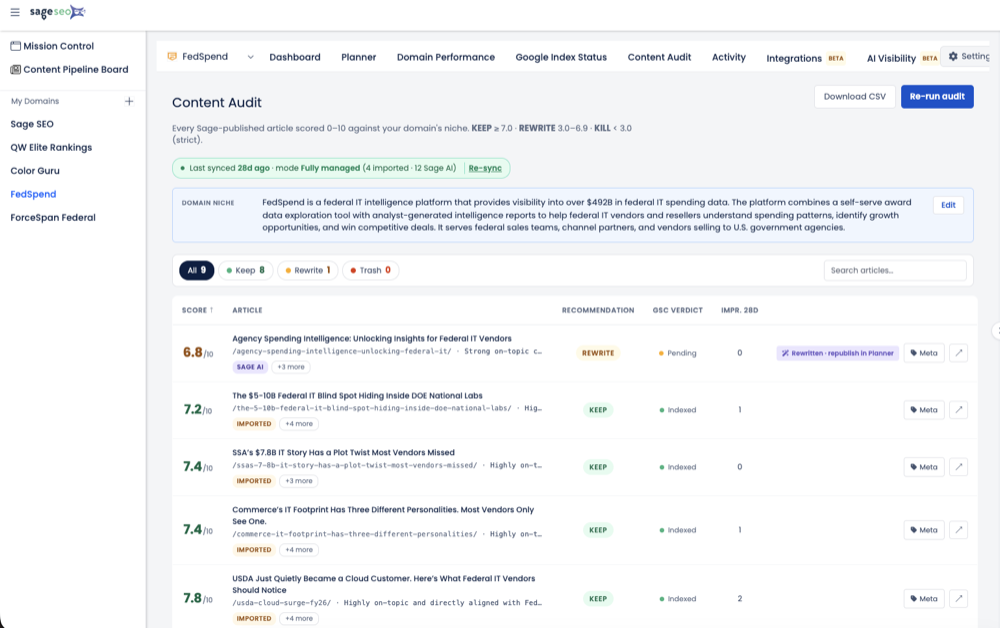
Skip the spreadsheets. Start Sage SEO free.
See how AI content ops transform your agency workflow in minutes.
The Four Stages
Every data-driven engine I’ve built or audited breaks into roughly the same four stages, even when the tooling differs:
- Research and topic modeling — identifying real demand signals and mapping how topics relate to each other before anyone decides what to write.
- Content architecture — deciding page structure, internal linking, and which entities and sub-topics each page needs to address.
- On-page optimization — applying the structural and relevance signals that make a page legible to both crawlers and generative models, a discipline I go deeper on in this breakdown of on-page SEO fundamentals.
- Iterative refinement — revisiting pages as performance signals come in, rather than publishing and walking away.
That last stage is where most traditional engagements quietly die. Agencies ship a batch of articles, invoice for them, and move to the next client before anyone checks whether the pages actually ranked or got cited anywhere. A real engine treats publication as the midpoint of the process, not the finish line — the same logic behind how ranking factors actually get calculated and weighted over time rather than fixed at launch.
Why does structure matter this much? Because relevance, to both a ranking algorithm and an AI answer engine, is inferred from relationships — how a page connects to the entities and sub-topics around it — not just from the words on the page itself. A data-driven engine treats that relationship map as the product, and the published page as one visible output of it.
Common Misconceptions About AI-First SEO
Three myths cause most of the confusion when brands evaluate this category, and all three collapse under a basic process question.
Myth: AI-First Means AI-Generated With No Human Oversight
It doesn’t. AI-first describes where the strategic modeling happens, not whether a human reviews the output. I’ve never seen a credible AI-first process skip human review — the modeling is automated, the judgment calls about accuracy, voice, and claims are not.
Myth: It’s Just a Marketing Label
Plenty of agencies use the term with no process behind it, which is exactly why the label got diluted. But the presence of imposters doesn’t erase the real distinction — ask any genuinely AI-first shop to walk you through their research step, and the answer looks structurally different from a keyword list.
Myth: AI-First Sacrifices Quality for Speed
I’ve found the opposite to be true when the process is built correctly. A systematized research and architecture stage actually reduces the rushed, under-researched briefs I used to see under tight traditional deadlines, because the modeling work isn’t being redone from scratch every time.
How to Tell If an SEO Agency Is Truly AI-First
Ask what they look at before they look at keywords — the answer separates genuine AI-first shops from relabeled traditional ones in under two minutes. I use a short set of questions whenever I’m sanity-checking a vendor for a client, and I’d encourage you to steal them.
- How do you decide what to write about before you touch a keyword list?
- What does your content architecture process look like for a new topic cluster?
- How do you define success beyond rank position?
- What happens to a page after it’s published — is there a refinement step?
- Can you show me how a single post moves from idea to live page?
| Question You Ask | Traditional-Shop Answer (Red Flag) | AI-First Answer (Green Flag) |
|---|---|---|
| What do you look at first? | Keyword volume and difficulty | Intent clusters and entity gaps |
| How is success measured? | Rank position only | Rank position plus AI-answer citation |
| What happens post-publish? | Nothing, on to the next brief | Ongoing refinement against performance signals |
I actually walked a founder through exactly this checklist in an earlier piece on choosing an AI-first SEO agency, and the pattern holds regardless of which agency you ultimately sign with — the questions matter more than the vendor’s logo.
Why Sage SEO Approaches AI-First SEO This Way
Our methodology starts from the same premise this whole article argues for: model the relationships first, write second. We built our process around mapping intent clusters and entity relevance before a brief ever gets drafted, because that sequencing is what determines whether a page can compete in both a traditional results page and a generative answer.
Part of that means treating visibility across AI engines as its own discipline worth watching, not an afterthought bolted onto rank tracking — which is the thinking behind our cross-engine citation tracking. We’re not claiming a specific lift or a client number here; we don’t fabricate statistics we haven’t measured for your situation. What we’ll stand behind is the philosophy: structure and relevance signals come before drafting, and refinement never stops at publish. If you want to see the fuller process, our AI-first SEO services page walks through it in more depth.
Pick the Process, Not the Pitch Deck
Every agency can say “AI-first” in a sales call. Far fewer can describe, in specific terms, what happens in their process before a keyword ever enters the conversation. That one question — what do you look at first — is the cleanest filter I know for separating the real category from the relabeled one. Ask it before you sign anything.