
- AI-first agencies embed AI across strategy, not just tooling
- Proprietary content engines signal genuine AI-first capability
- Real performance data separates true AI-first from marketing claims
- Evaluation should include automation depth and measurable outcomes
- Ask agencies to show engine-level data, not just case studies
The last time a founder asked me to sanity-check an “AI-first” agency he was about to sign, I asked for one thing: walk me through how a single blog post goes from idea to published page. Ninety seconds in, it was obvious. They pasted a keyword into ChatGPT, got a draft, ran it through Surfer, and shipped it. That’s not AI-first. That’s a 2015 content workflow with a chatbot bolted to the front. I’ve built and killed hundreds of articles over twelve years, and the last five I’ve spent obsessed with this exact distinction — because it’s the difference between an agency that compounds results and one that just produces faster mediocrity.
What Does an “AI-First SEO Agency” Actually Mean?
An AI-first SEO agency is one where AI shapes strategy, prioritization, and the iteration loop from the start — not one that merely uses AI to draft paragraphs faster. The label describes a philosophy, not a tool stack.
Here’s the cleanest test I’ve found. In a genuinely AI-driven SEO agency, artificial intelligence informs what you write about, in what order, and how you revise it after publishing. In an AI-assisted shop, AI just accelerates the typing. Same tools, completely different operating model.
This distinction matters more now that drafting is commoditized. When HubSpot’s 2025 AI Trends research found that roughly 66% of marketers worldwide already use AI in their role — and 74% in the US — the ability to generate a competent draft stopped being a differentiator. Everybody has that. If drafting is table stakes, then the ai seo agency meaning worth paying for has to live somewhere else: in the judgment about which demand signal to chase and how fast you can learn from what you shipped. I learned to think about keywords and content as a single connected system, not two separate tasks — the same logic covered in this breakdown of how keywords and content actually connect.
Why Is “AI-First” So Easy to Fake?
“AI-first” is easy to fake because it’s a marketing checkbox with no enforcement — anyone can claim it, and most buyers can’t yet tell the difference on a sales call. The term got cheap fast.
I’ve sat on the vendor side of these pitches. The pattern repeats. A slick deck, the word “AI” on every slide, and zero visibility into what actually happens between “we agree on topics” and “here’s your draft.” That gap is where the truth hides.
These are the red flags I now watch for the moment an agency says “AI-first”:
- Vague capability claims — “we leverage AI” with no description of which decisions AI actually informs.
- A black-box process — they can’t or won’t show you the path from search signal to published page.
- Generic output with no strategy layer — content that reads like it was generated, not decided.
- No feedback mechanism — they publish and move on, never circling back to what the data said.
- Rankings as the only scoreboard — no mention of revenue, citations, or AI-search visibility.
Any one of these alone might be forgivable. Three together and you’re buying a buzzword.
How Do You Evaluate an AI-First SEO Agency? A Five-Point Framework
Evaluate an AI-first agency on five things: how AI informs prioritization, whether a feedback loop exists, how human expertise is layered in, how transparent the process is, and how fast they actually iterate. This is the framework I hand every client asking how to choose an ai seo agency.
- Does AI inform prioritization — or just generation? Ask whether AI helps them decide which topics to chase and in what sequence. A real answer sounds like intent clustering and demand modeling. I’ve watched teams cut months of wasted effort by letting AI group and rank opportunities first, an approach I detail in this guide to using AI for keyword research and intent clustering.
- Is there a feedback loop? The single biggest tell. A genuine AI-first agency feeds live search performance data back into strategy and adjusts. If they can’t describe how last month’s results changed this month’s plan, there is no loop — just a conveyor belt. This is exactly the data-driven decision-making most teams claim and few practice.
- How is human expertise layered in? AI-first does not mean human-absent. Ask who owns editorial oversight, brand voice, and E-E-A-T judgment calls. Google has been explicit that quality is judged regardless of how content is produced — their guidance states that using automation to manipulate rankings violates spam policy, but AI used to create genuinely helpful content is fine.
- Can they explain the process, or is it a black box? Transparency is a proxy for competence. If they can whiteboard the pipeline end to end, they understand it. If they hide behind “proprietary AI,” be skeptical.
- How fast do they actually iterate? Ask for a concrete before/after on cycle time — qualitative is fine, invented numbers are not. A traditional retainer measures work in weeks. An AI-first process compresses that dramatically, which is the whole point.
Run all five. The gaps light up fast.
| Dimension | AI-Assisted Agency | AI-First Agency |
|---|---|---|
| Role of AI | Drafts paragraphs faster | Informs strategy, prioritization, iteration |
| Feedback loop | Publish and move on | Performance data retrains the plan |
| Human role | Edits AI output | Owns judgment, E-E-A-T, brand voice |
| Process visibility | Black box | Explainable end to end |
| Primary metric | Rankings | Revenue + AI-search citations |
What Does an AI-Driven Content Engine Look Like in Practice?
A real AI content engine is a closed loop: data-informed topic selection, structured briefs, AI drafting, human review, publication, and performance monitoring that feeds the next cycle. The word that matters is loop, not line.
Most agencies run a line. Idea goes in one end, article comes out the other, everyone claps, nothing learns. An ai content engine seo setup bends that line into a circle so every published piece teaches the system what to do next.
Skip the spreadsheets. Start Sage SEO free.
See how AI content ops transform your agency workflow in minutes.
Here’s the architecture I coach teams to build, and it’s the shape our own approach at Sage takes too:
- Topic selection from real demand — start from a genuine search signal, not a brainstorm.
- Structured briefs — intent, entities, format, and internal-link targets defined before a word is written.
- AI drafting — grounded in the brief and the brand’s voice, not a raw prompt.
- Human review — the judgment layer for accuracy, experience, and E-E-A-T.
- Publication and interlinking — the piece wired into its cluster on day one.
- Performance monitoring — search and AI-citation data flow back to reshape the next brief.
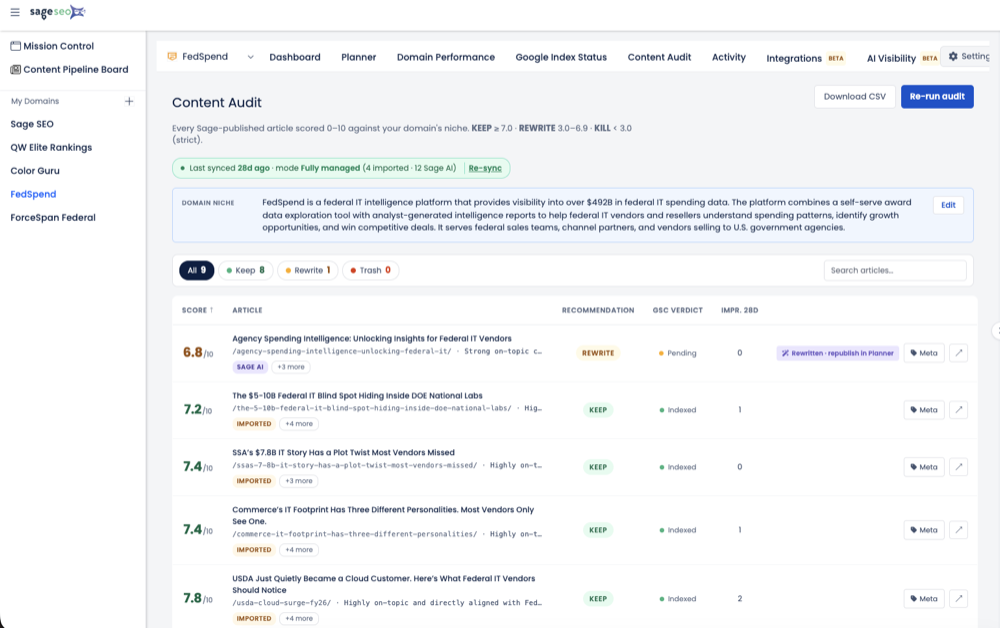
Our process is built around continuous feedback from search performance data — that’s the honest, qualitative version, and I won’t dress it up with invented figures. What I will say from experience: the monitoring step is where most “AI-first” claims collapse, because closing it requires connecting real analytics, not screenshots. Sage’s AI-first SEO services are built to run that whole loop rather than just the drafting slice of it, and the editorial outcome loop is the piece that ties published content back to what actually moved.
Here’s my contrarian take, and it’s cost me arguments with people who sell automation: a fully automated content engine is a worse product than a well-run AI-first one. Remove the human judgment layer and you don’t get scale — you get a faster way to publish content nobody cites. AI-first means humans are freed from repetitive drafting so they can spend their time on the calls only humans make. That’s an upgrade to the human role, not a deletion of it.
What Questions Should You Ask Before Hiring an AI-First SEO Agency?
Ask questions that force the agency to reveal its process, its data sources, and how it measures success beyond rankings. Vague answers to specific questions are the answer.
These are the ones I’d put on the table in a first call:
- “Walk me through how one piece of content goes from idea to published page.” Listen for a loop, not a line.
- “What data source triggers a topic, and where does the performance data go afterward?”
- “Who reviews drafts, and what’s their editorial standard for accuracy and experience?”
- “Show me a time you changed strategy because the data told you to.” No example means no loop.
- “How do you measure success beyond rankings — revenue, conversions, AI-search citations?”
That last one separates the field. With Semrush and Datos research showing AI Overviews appearing on 13.14% of queries by March 2025 — double the January figure — ranking #1 no longer guarantees you’re the answer a user actually sees. An agency that still reports only blue-link rankings is measuring a shrinking slice of reality. Ask how they think about attribution across AI referrals; the GA4 versus first-party tracking comparison is a good primer on why that’s getting harder and more important.
Is an AI-First SEO Agency Right for Your Business?
An AI-first agency pays off most for content-heavy sites, competitive niches, and lean teams that need scale without surrendering quality. It’s less essential if you publish twice a year and compete with nobody.
The best fit I’ve seen is the B2B SaaS client with a big addressable topic map and a two-person marketing team. They can’t out-hire a big agency, but a tight AI-first loop lets them out-iterate one. Competitive niches reward the same thing: speed of learning beats size of budget.
The legitimate concern is quality control and brand-voice drift — I’ve cleaned up sites where “AI-first” meant “unread.” A well-run process addresses this head-on with a human editorial gate and voice grounding, and it’s worth auditing your existing library before you scale, using something like this method for auditing content for AI-search readiness. If budget is the sticking point, the tradeoffs are laid out plainly in this piece on AI SEO agency pricing and ROI.
Where’s this heading? As AI Overviews and generative search reshape the SERP, the agencies that win won’t be the ones that generate the most content. They’ll be the ones whose loop learns fastest which content earns citations. That’s the shift, and it’s already underway.
The Real Dividing Line Isn’t the Tools — It’s the Loop
Stop asking whether an agency uses AI. Everyone does now; it tells you nothing. Ask whether AI reaches back into strategy and closes the loop, or whether it just makes bad decisions arrive faster. The agencies bolting a chatbot onto a 2015 workflow will keep calling themselves AI-first, and for another year or two some of them will get away with it. But the buyers who learn to spot the loop in a single sales call — you now have the questions to do exactly that — will hire the ones that compound, and quietly leave the rest behind.