

- Rank Math and Yoast solve identical technical SEO problems.
- Neither plugin compares your content to live SERP competitors.
- Rank Math bundles more features free than Yoast's paid tier.
- Content platforms add competitive gap analysis plugins cannot provide.
- A green plugin score never guarantees your content will rank.
Last year I ran a WordPress migration for a B2B SaaS client — new domain, cleaner URL structure, the whole move. Rank Math handled it beautifully. Schema stayed intact, every 301 redirect fired correctly, the sitemap regenerated, and not a single technical error surfaced in the crawl afterward. Green checkmarks everywhere. And one of their best-performing pages still lost its footing and never fully recovered its position for weeks. Nothing in the plugin could tell me why.
That gap — between “technically flawless” and “actually competitive” — is the whole reason I stopped treating the Rank Math vs Yoast decision as the important one.
The Real Question Isn’t Rank Math vs Yoast — It’s Plugin vs. Platform
Both plugins solve the same category of problem, so the decision that actually moves your rankings is whether you need something beyond either of them.
Rank Math and Yoast are the two default answers for WordPress SEO, and picking between them is a legitimate call. Yoast is the incumbent — testing by Zapier puts it at over 10M-plus active installations, one of the most-installed plugins in the ecosystem. Rank Math is the challenger, with 4M-plus active installations per WordPress.org and a famously generous free tier.
But here’s the thing nobody selling you a plugin comparison wants to admit. They live in the same lane. Both are on-page technical SEO tools. Choosing one over the other is like arguing about which wrench to buy when your actual problem is that you don’t have an engine diagram. Here’s the layer each tool really occupies:
| Tool | Category | What it optimizes | Core question it answers |
|---|---|---|---|
| Rank Math | On-page SEO plugin | The page’s HTML, schema, redirects | Can Google read and index this page? |
| Yoast | On-page SEO plugin | The page’s HTML, readability, metadata | Can Google read and index this page? |
| Sage SEO | Content optimization platform | The content itself vs. live SERP + intent | Is this page competitive enough to rank? |
Same first column for both plugins. That’s not an accident — it’s the point.
What Rank Math and Yoast Actually Do Well
Both plugins are excellent at the “make sure Google can read and trust your page” layer — schema, sitemaps, redirects, metadata, and readability checks.
I don’t need Rank Math or Yoast for this layer anymore — the Sage SEO WordPress plugin ships it natively: the full schema graph, canonical tags, Open Graph and Twitter cards, sitemap hygiene, 301 redirects, and instant indexing pings. And if you keep one of them installed anyway, they coexist cleanly — Sage mirrors its metadata into their fields and steps aside on schema so nothing gets emitted twice. Either way, this layer is genuine, load-bearing infrastructure. Where they overlap, they both deliver:
- Schema markup — structured data so search and AI engines can parse what your page is about
- XML sitemaps — automatic, self-updating index maps for crawlers
- Meta tag control — titles, descriptions, canonical tags, Open Graph
- Breadcrumb handling and readability scoring
Where they diverge is mostly about what you pay for. Rank Math bundles an unusual amount into free — its own listing shows a smart redirection manager, a built-in 404 monitor, internal link suggestions, and multi-keyword optimization all in the free plugin. As one agency review put it, many of those are features Yoast reserves for Premium.
Yoast counters with maturity: a longer support track record, a training academy, and Premium extras. Here’s the honest split.
| Capability | Rank Math | Yoast |
|---|---|---|
| Redirect manager | Free | Premium |
| Built-in 404 monitor | Free | Not included |
| Internal linking suggestions | Free | Premium |
| Multiple focus keywords | Free | Premium |
| Rank tracking | Built-in (paid tiers) | Via Wincher add-on |
| Paid entry price (2026) | ~$7.99/mo, unlimited personal sites | $118.80/yr per site |
Those figures are current as of 2026: Yoast Premium runs $118.80/year per site (ex VAT), up from its long-standing $99, while Rank Math Pro lands around $7.99/month and covers unlimited personal sites. If you want the deeper mechanics of on-page fundamentals, I’ve written before about how keywords and content actually connect. But notice what this whole table measures: setup, hygiene, and cost. Not competitiveness.
Why Isn’t My Content Ranking Despite Good Technical SEO?
Because neither plugin evaluates your content against what’s actually ranking — they check your page against generic best practices, not the competitors you’re up against.
This is the ceiling, and it’s the same ceiling for both. A green light in Rank Math means your HTML is compliant. It does not mean your content is better than the ten results already sitting above you.
Three specific blind spots I hit over and over:
- No competitive read. The plugin never looks at the live SERP. It can’t tell you the top results average 2,400 words with a comparison table and you shipped 700 words of prose.
- No intent match. You can score a perfect green writing a listicle when Google clearly wants a step-by-step guide. The plugin has no opinion on search intent alignment — and intent mismatch is one of the most common reasons a technically clean page flatlines.
- No post-publish monitoring. Both plugins are set-it-up-once tools. When a page slips three weeks after publishing, neither one raises a hand or explains why.
Readability and keyword-density scores are a proxy for quality, not a measure of it. I’ve watched dense, high-scoring pages lose to a shorter, sharper competitor that simply answered the question better. The score was never the signal.
One more wrinkle worth knowing: Google fully retired FAQ rich results on May 7, 2026, and dropped How-To results back in 2023. Your plugin still generates that schema — but the visible SERP payoff it was sold on is gone. Structured data now matters more for AI answer engines parsing your page than for a rich snippet that no longer renders. The plugin can’t tell you that either.
Skip the spreadsheets. Start Sage SEO free.
See how AI content ops transform your agency workflow in minutes.
A Real Scenario — Rank Math Did Its Job and Still Left a Gap
On that SaaS migration I mentioned, Rank Math checked every technical box flawlessly — and a key page still couldn’t hold its ranking, with no signal from the plugin about why.
Let me walk it plainly, because it’s the clearest example I’ve got of where a plugin stops.
The migration itself was clean. Rank Math mapped the old URLs to the new ones, every 301 resolved, the schema carried over, canonicals pointed where they should. I ran the crawl afterward expecting trouble and found none. By every measure the plugin surfaces, that page was healthy.
And it still stalled. It had checked every box Rank Math shows you, yet something about the content itself wasn’t competitive anymore. The plugin had no way to say “the three pages now outranking you added a pricing comparison and a decision framework you don’t have.” That’s not a Rank Math failure. It’s genuinely outside the job description of an on-page plugin. The tool did exactly what it’s built to do — verify the container is sound — and then went silent on the only question that mattered.
I ended up doing by hand what I now do with a platform: pulled the top results, mapped what they covered that we didn’t, rewrote for the gap, and reworked the internal links pointing in. The page recovered. If you’ve ever rescued a single underperforming page in an afternoon, you know the work — and you know your plugin didn’t hand you the diagnosis.
What a Platform Like Sage SEO Is Built to Answer
Rank Math and Yoast optimize the container; a content optimization platform evaluates the content inside it against live competitive and intent signals.
That’s the category difference in one line. It’s not plugin-versus-platform as a cage match — it’s two different layers of the same job. Here’s how the layers split.
| Job | On-page plugin (Rank Math / Yoast) | Content platform (Sage SEO) |
|---|---|---|
| Technical foundation | Schema, sitemaps, redirects, meta | Assumes the plugin handles this |
| Competitive gap analysis | Not evaluated | Designed to compare against ranking pages |
| Search intent matching | Not evaluated | Built to flag format/intent mismatch |
| Ongoing content health | One-time setup | Monitors after publish |
A platform in this category is designed to help you see what a plugin can’t: where your coverage is thin against the pages already winning, whether your format matches what the query wants, and when a published page starts drifting. That’s the thinking behind a content-first approach to SEO — treat the words as the product, not the metadata wrapper around them.
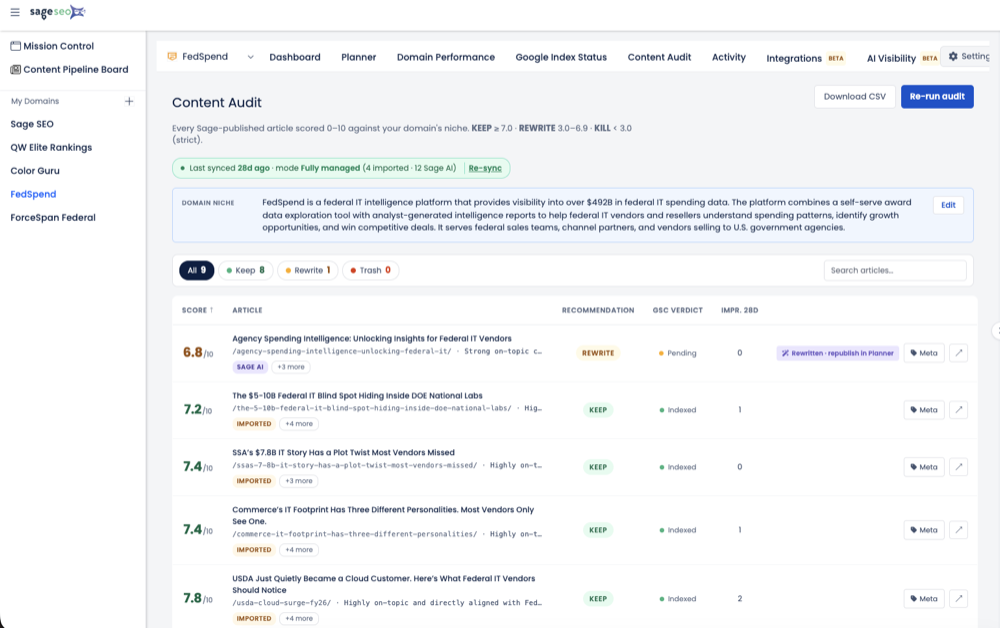
Two things I want to be flat about. First, this is a complementary layer, not a replacement. You still need Rank Math or Yoast for the technical foundation — a platform assumes that plumbing exists. Second, I’m describing what the category does in functional terms, not throwing proprietary numbers at you. The value is qualitative and structural: a bucketed audit of your existing library tells you which pages to fix first, and that’s a decision a keyword-density score will never make for you.
What the Sage SEO WordPress Plugin Already Handles
Full disclosure, since this is our own comparison: Sage ships a WordPress plugin with the platform, and it has absorbed nearly all of the technical layer this article has been describing. Here is the honest capability map.
| Capability | Sage SEO plugin | Rank Math | Yoast |
|---|---|---|---|
| Meta titles & descriptions | Yes — written by the platform, set per post automatically | Yes (manual) | Yes (manual) |
| Canonical URLs, Open Graph, Twitter cards | Yes | Yes | Yes |
| Schema markup (Organization, WebSite, Article, breadcrumbs) | Yes — full JSON-LD graph, plus FAQ schema shipped inline with every enriched article | Yes | Yes |
| XML sitemap hygiene | Yes — trims tag/author noise, noindexes thin archives | Yes | Yes |
| 301 redirect manager | Yes | Free | Premium |
| Instant indexing (IndexNow + Google recrawl requests) | Yes — automatic on every publish and update | IndexNow built in | Via add-on |
| Keyword research, content generation, performance loop | Handled upstream by the platform itself | Editor hints only | Editor hints only |
So when would you still keep Rank Math or Yoast alongside Sage? Three honest cases: you publish content types that need niche schema (recipes, HowTo blocks, LocalBusiness markup for a storefront), you run WooCommerce and want its product-SEO specifics, or your writers draft directly in wp-admin and live by the traffic-light analysis habit. None of those conflict — the Sage plugin detects Yoast, Rank Math, or SEOPress and lets them own the schema graph while mirroring its metadata into their fields. If none of those cases apply, the plugin-plus-platform combination covers the entire stack this article has been walking through.
Do You Actually Need Both? A Simple Decision Framework
Keep the plugin for technical hygiene; add a platform when content competitiveness — not indexing — becomes your bottleneck.
Here’s the read I give clients, in order:
- Your content stalls despite clean technical SEO. If pages plateau while every plugin check stays green, that’s a content-layer problem, and no plugin setting fixes it.
- You publish faster than you can competitor-audit. If you’re shipping at volume and can’t manually pull the SERP for every article, a platform adds ongoing value a plugin structurally can’t.
- You’re small and early, and hygiene is still the gap. If your biggest issue is missing schema or messy redirects, a plugin alone may genuinely be enough for now. Don’t buy a layer you’re not ready to use.
Match that to the tools like this:
| If this is you… | Your move |
|---|---|
| New site, technical gaps | Rank Math or Yoast, free tier |
| Want the most free features | Rank Math |
| Established, agency support matters | Yoast Premium |
| Clean tech, content won’t rank | Keep the plugin, add a content platform |
Stop Pitting the Plugins Against Each Other
Here’s my honest position after a dozen years of this: the Rank Math vs Yoast debate is real but small. Pick whichever fits your workflow and budget — Rank Math if you want maximum free capability, Yoast if you’re invested in its ecosystem — and treat that as a settled, separate decision.
The bigger question is the one your plugin will never answer for you. A green checkmark means your HTML is compliant. It does not mean your content is competitive. Conflating those two is, in my experience, the single most common reason WordPress sites plateau with “perfect” technical SEO. Sort your foundation with a plugin. Then, when content is the thing holding you back, layer on something built to measure your pages against the competition you’re actually fighting.