
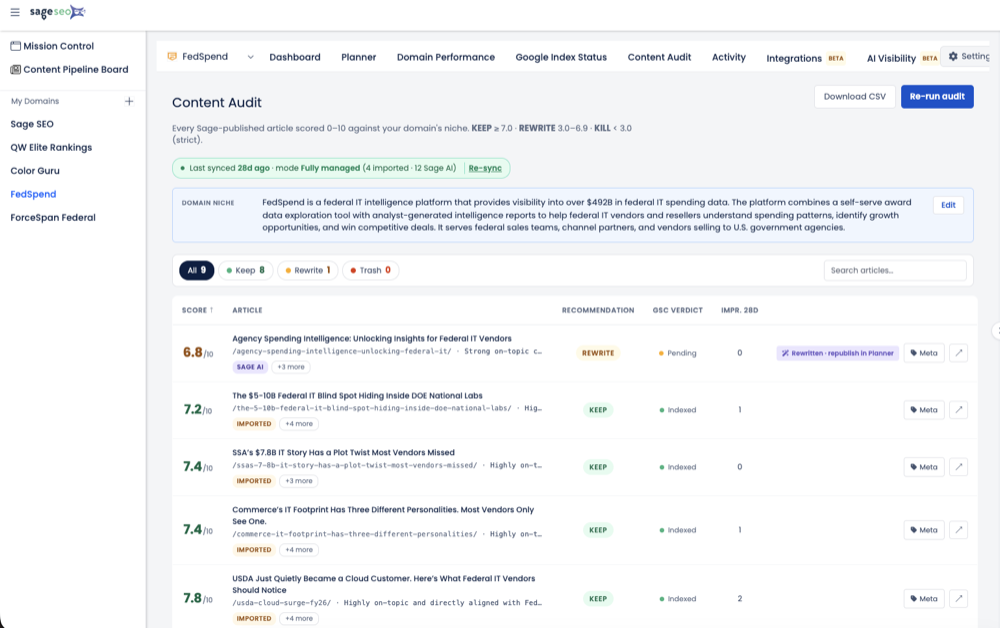

- POP benchmarks competitors; Sage SEO prioritizes speed-first briefs.
- Per-article setup time is POP's biggest workflow cost.
- Team size and publishing cadence should drive your tool choice.
- Granular NLP scores don't guarantee better rankings alone.
- High-volume teams often gain more from faster brief generation.
I’ve sat in enough vendor demos to know the pitch by heart: “our scoring engine is more accurate.” Nobody ever asks the question that actually matters for a working content team, which is accurate for what, and at what cost to your calendar? When I get asked about a PageOptimizer Pro alternative, I don’t answer with a features list. I answer with a question back: how many articles does your team ship in a month, and who’s waiting on the brief?
PageOptimizer Pro (POP) and Sage SEO aren’t really competing on the same axis. POP is built around a competitor-benchmarked, math-based NLP scoring model — it pulls the top-ranking pages for your target keyword and runs term-frequency analysis against them before you ever open a doc. Sage SEO is built around a no-render, speed-first model that skips that benchmarking step on purpose. Neither approach is wrong. They optimize for different bottlenecks, and this piece is about helping you figure out which bottleneck is actually yours.
PageOptimizer Pro vs Sage SEO: What’s the Core Philosophy Difference?
The short answer: POP optimizes for analytical depth per article, and Sage SEO optimizes for speed and volume across a publishing calendar. Everything else — setup time, output format, who each tool suits — flows from that one design choice.
| Dimension | PageOptimizer Pro | Sage SEO |
|---|---|---|
| Core methodology | Competitor-benchmarked NLP term-frequency scoring | No-render, direct-to-brief optimization |
| Where the “thinking” happens | Per-article, at benchmarking time | Pre-built into the logic before you start |
| Primary strength | Defensible, data-referenced recommendations | Fast time-to-brief for high publishing cadence |
That table is the whole argument in miniature. Now let’s get into how each one actually behaves once you’re inside it.
What PageOptimizer Pro Actually Does
PageOptimizer Pro pulls a set of top-ranking competitor pages for your target keyword and runs NLP-based term-frequency math against them to generate usage targets for your writer. You give it a keyword, it scrapes and analyzes the current top results, and it hands back a report with recommended term counts, related entities, and a numeric score you optimize toward as you write or edit.
I get the appeal. There’s something reassuring about a report that says “use this term 4 to 7 times” instead of a vague brief that says “cover the topic thoroughly.” For a technical SEO who wants to walk into a client meeting with a number, that specificity is a selling point in itself. It’s a defensible, benchmarked recommendation, not a gut call.
The tradeoff is time. Before a writer can start, someone has to run the benchmarking pass, wait for the competitor pages to be pulled and scored, and then interpret a fairly dense report to translate it into a usable brief. On a single high-stakes page — a pillar page, a competitive commercial term — that’s time well spent. Across twenty articles a month, that per-article setup tax compounds fast, and I’ve watched it become the reason a content calendar slips.
What Sage SEO Actually Does
Sage SEO skips live competitor scraping and rendering entirely, which means a writer can get from keyword to working brief in minutes instead of waiting on a benchmarking pass. That’s the no-render philosophy in one sentence: rather than re-analyzing the SERP fresh for every single article, the optimization logic is built ahead of time so the setup step mostly disappears.
I’ve written before about exactly why skipping a headless browser is a deliberate trade-off, not a shortcut — you give up some of the “watch it render exactly like Chrome would” fidelity, and in exchange you get a tool that doesn’t choke your queue every time you need five briefs by Thursday. For teams whose bottleneck is publishing cadence, not competitive granularity, that trade is a clear win.
The output reflects the philosophy too. Instead of a dense scoring dashboard you have to decode, Sage SEO leans toward action-oriented guidance a writer can act on immediately inside the voice-grounded drafting workflow, and a publish-cadence calendar that keeps the whole queue moving instead of stalling on one report. This isn’t a stripped-down version of POP’s model. It’s a different bet on where a content team’s time is best spent.
How Do Setup Time and Output Format Actually Compare?
Setup time is the single biggest practical difference between these two tools, and it cascades into everything from learning curve to ideal team size. POP requires more upfront configuration per article — pulling competitors, running the analysis, reading the report — before writing begins. Sage SEO is designed to get a writer into a brief within minutes of picking a keyword.
Skip the spreadsheets. Start Sage SEO free.
See how AI content ops transform your agency workflow in minutes.
| Factor | PageOptimizer Pro | Sage SEO |
|---|---|---|
| Setup time per article | Higher — requires a competitor benchmarking pass before writing starts | Lower — no live rendering step, brief-ready quickly |
| Methodology | Competitor-benchmarked NLP scoring | No-render, speed-first optimization |
| Output format | Dense scoring report with term-usage targets | Streamlined, action-oriented brief |
| Learning curve | Steeper — reports need interpretation to be actionable | Flatter — designed to be usable without an SEO strategist decoding it |
| Ideal team size | Agencies and specialist teams with dedicated SEO analysts | Lean in-house teams and agencies publishing at volume |
| Best fit use case | Competitive, jargon-heavy niches needing defensible reports | High-frequency publishing where speed is the constraint |
Read the setup-time and ideal-team-size rows together, because that pairing is the actual decision point. A two-person in-house team publishing a handful of posts a month can absorb POP’s per-article setup cost without much pain. A team running a real content audit across hundreds of URLs and shipping weekly cannot — the report-reading step alone becomes a second job.
Which Tool Fits Which Team?
Team size and publishing cadence, not tool sophistication, should drive this decision. I’ve watched teams pick the “smarter” tool and then quietly stop using it three months later because nobody had time to run it properly. Here’s how I’d map it out.
- Solo bloggers and small in-house teams: speed and minimal setup matter more than granular scoring — lean toward Sage SEO’s direct-to-brief approach.
- Agencies managing many clients: POP’s competitor-benchmarked reports can double as a client-facing deliverable that justifies the invoice with numbers.
- High-volume content operations: weigh whether granular NLP scoring adds enough incremental ranking value to justify a slower per-article setup — for most volume-first teams, it doesn’t.
- Teams without a dedicated SEO strategist: favor whichever tool requires less interpretation expertise to turn a report into a finished page.
| Team Profile | Actual Bottleneck | Better Fit |
|---|---|---|
| Solo blogger / one-person marketing team | Time to publish, not competitive depth | Sage SEO |
| Agency with dedicated SEO analysts per account | Client-facing proof of methodology | PageOptimizer Pro |
| High-volume in-house content team | Report interpretation time per article | Sage SEO |
| Team in a hyper-competitive, jargon-heavy niche | Term-level precision against tough SERPs | PageOptimizer Pro |
I ran an audit for an agency client two years ago that was using a heavily benchmarked tool across all eleven client accounts. Only one account — a legal niche with brutal competition — actually needed that depth. The other ten were losing roughly half a day a week to report interpretation that never moved rankings. That’s the pattern I see over and over: the tool wasn’t wrong, the team-to-workflow match was.
Where Does PageOptimizer Pro’s Methodology Genuinely Shine?
PageOptimizer Pro earns its keep in highly competitive, jargon-dense niches where a defensible, data-referenced recommendation matters more than speed. I want to be straight about this, because too many comparison posts pretend the competitor has no real strengths, and that’s not honest and it’s not useful to you either.
In a niche like enterprise legal software or medical device compliance, the top-ranking pages already use a very specific, narrow vocabulary. A competitor-benchmarked model that tells you exactly which entities and terms the ranking pages share is genuinely valuable there — it’s the kind of granularity that’s hard to fake with intuition alone. And if you need to walk into a stakeholder meeting with a number that says “this page scores 82 against the SERP average,” that math-based framing does real persuasive work internally, independent of whether it moves rankings.
The honest caveat: that level of granularity is overkill for most publishing workflows. Most content teams aren’t fighting for the number-one spot in a hyper-competitive vertical with three qualified writers on staff. They’re trying to get twelve solid, well-targeted articles out the door in a month without every single one requiring a specialist to babysit the report.
What Are the Biggest Misconceptions About On-Page SEO Tools?
The biggest misconception is that a more granular score always produces a better-ranking page — it doesn’t, because on-page term usage is one ranking input among many, not the whole game. There’s a long-running discussion across the SEO industry about the limits of NLP-based content scoring, and the honest version of that discussion is that these scores are a proxy for topical coverage, not a guarantee of relevance signals Google actually weighs the way the tool implies.
- Myth: more granular scoring means better rankings. A term-frequency score correlates with topical coverage, not with backlinks, search intent match, or page experience — all of which still decide outcomes.
- Myth: a faster tool means a “dumber” tool. The real difference is where the thinking happens — per-article benchmarking versus logic built ahead of time — not whether thinking happens at all.
- Myth: this is a checklist decision. The right call maps to your actual publishing cadence and team structure, not a side-by-side feature count.
I’d encourage you to run this test before you subscribe to either tool: pull your last quarter’s publishing calendar and count how many articles per month you actually shipped. That number tells you more about which tool fits than any demo will.
The Real Decision Is a Calendar Problem, Not a Scoring Problem
Stop asking which NLP engine is smarter. Both tools do real, defensible optimization work — the question that actually predicts whether you’ll still be using the tool in six months is whether your bottleneck is analytical depth per page or throughput across a calendar.
If you’re fighting for rankings in a narrow, hyper-competitive niche with a small number of pages that each need to be perfect, POP’s benchmarked depth is worth the setup tax. If you’re running a real publishing operation — a content calendar with weekly deadlines and writers waiting on briefs — that per-article setup cost is the thing quietly capping your output, and it’s worth pressure-testing a no-render workflow against your own numbers before you renew anything.