

- Standard SEO tools assume weeks; newsrooms operate in hours.
- Skipping metadata at volume means roughly 900 missed title tags yearly.
- Non-blocking checks flag issues without stopping anyone from publishing.
- Prioritize evergreen and cornerstone content for deeper SEO attention.
- Specific, actionable flags get fixed; vague warnings get ignored.
I audited a 40-person digital newsroom a few years back and found the SEO problem in about ten minutes: the “SEO checklist” lived in a shared doc nobody had opened since the last site redesign. Not because editors didn’t care — because the checklist assumed forty-five idle minutes per draft, and a newsroom publishing six or eight stories a day doesn’t have those minutes. SEO for online publishers fails most often not from ignorance but from a scheduling mismatch — the tooling was built for a cadence newsrooms abandoned a decade ago.
The fix isn’t a better checklist. It’s accepting that SEO checks have to run alongside editorial work instead of gating it, so optimization happens without anyone waiting on it.
Why Standard SEO Workflows Break Down in Newsrooms
Most SEO tooling assumes a content lifecycle measured in weeks — brief, draft, review, revise, publish — and a newsroom publishing 30 to 40 stories a week operates on a timeline measured in hours. That mismatch is the root of almost every newsroom SEO workflow that quietly collapses.
Enterprise SEO platforms were built for marketing teams shipping four or five pieces a month, with time for a dedicated reviewer to run a page through a scoring tool before anyone touches publish. A reporter filing a same-day story doesn’t have that luxury, and shouldn’t be asked to pretend otherwise.
| Dimension | Traditional Enterprise SEO Review | Newsroom Reality |
|---|---|---|
| Typical content cycle | Days to weeks per piece | Hours, often same-day |
| Review step | Sequential gate before publish | Skipped or routed around under deadline |
| Who checks SEO | Dedicated SEO reviewer or team | One overloaded editor, if anyone |
| Tooling assumption | Time to iterate before going live | No time to iterate before going live |
| Consistency across writers | Enforced by process | Varies wildly by contributor |
When a manual review becomes a bottleneck, editors route around it — and once that happens once, it happens every time. The result is predictable: most high-volume publishers either skip on-page SEO almost entirely or apply it inconsistently depending on which writer happened to remember the headline-length rule that week.
The Hidden Cost of Skipping SEO at Volume
Small, repeatable SEO gaps — a weak headline, a missing meta description, a thin internal link — don’t matter much on one article, but they compound fast across dozens published every week. A publisher running 35 stories a week that skips metadata on even half of them is shipping roughly 900 unoptimized title tags a year, each one a small missed opportunity in the search results.
This matters more now, not less. Trade press outlets like Digiday and Nieman Lab have spent years documenting how unreliable social platforms have become as a distribution channel, as algorithm changes repeatedly throttle outbound link reach. Organic search is one of the few channels a publisher still controls directly — leaving it on the table is a genuinely expensive habit, not a cosmetic one.
I’ve seen publishers with strong domain authority and good reporting rank behind weaker competitors simply because their on-page execution was inconsistent. Authority buys you a chance to rank. It doesn’t guarantee the click.
What Does Non-Blocking SEO Optimization Actually Look Like?
Non-blocking SEO means checks run in parallel with editorial production and surface issues without stopping anyone from hitting publish. No gate, no approval step, no waiting.
The practical version of this is a short list of lightweight, automatable checks that fire the moment a draft is created or a story goes live, rather than a human reading the piece first.
- Headline-to-title-tag alignment, flagged automatically when they diverge in ways that hurt click-through
- Missing or duplicate meta descriptions across the content management system
- Header structure — skipped H2s, missing H1s, or headers used purely for visual styling
- Internal link suggestions pointing new articles toward existing high-value or cornerstone content
- Image alt text gaps, especially on photo-heavy news and feature pages
The distinction that matters is pre-publish flags versus post-publish optimization, and conflating the two is where most tooling goes wrong for a newsroom.
| Check Type | When It Runs | Who Acts On It |
|---|---|---|
| Pre-publish flags | Instantly, at draft or publish | Writer glances, fixes in seconds, or ignores |
| Post-publish optimization | Batched weekly or monthly | Editor reviews a short list during a set review window |
Tools built specifically around this problem — rather than retrofitted enterprise suites — tend to get the distinction right, which is why I point deadline-driven teams toward lighter-weight options when evaluating on-page tools built for fast publishing workflows instead of scoring engines designed for slower review cycles. The goal is surfacing issues, never creating a checkpoint a writer has to clear — the moment SEO becomes a gate, newsrooms find a way around it. I’ve watched that happen at three different publishers, and it never once improved compliance.
An Illustrative Scenario: A Mid-Size Publisher’s Workflow
Here’s a hypothetical worth walking through, because the shape of the problem repeats across almost every mid-size newsroom I’ve seen. Picture a composite I’ll call Harbor Weekly — not a real client, but a stand-in for a type I’ve advised more than once: a dozen staff writers and freelancers publishing 30 to 40 articles a week across politics, local business, and lifestyle beats.
Skip the spreadsheets. Start Sage SEO free.
See how AI content ops transform your agency workflow in minutes.
Before any workflow change, SEO review at a publisher like this usually looks like one of two things: completely skipped, or handled ad hoc by a single overloaded audience editor squeezing it in between real priorities. Neither survives past a few months — the overloaded person burns out or quietly stops, and nobody notices until a quarter of flat search traffic shows up in the analytics.
How the Non-Blocking Version Could Work
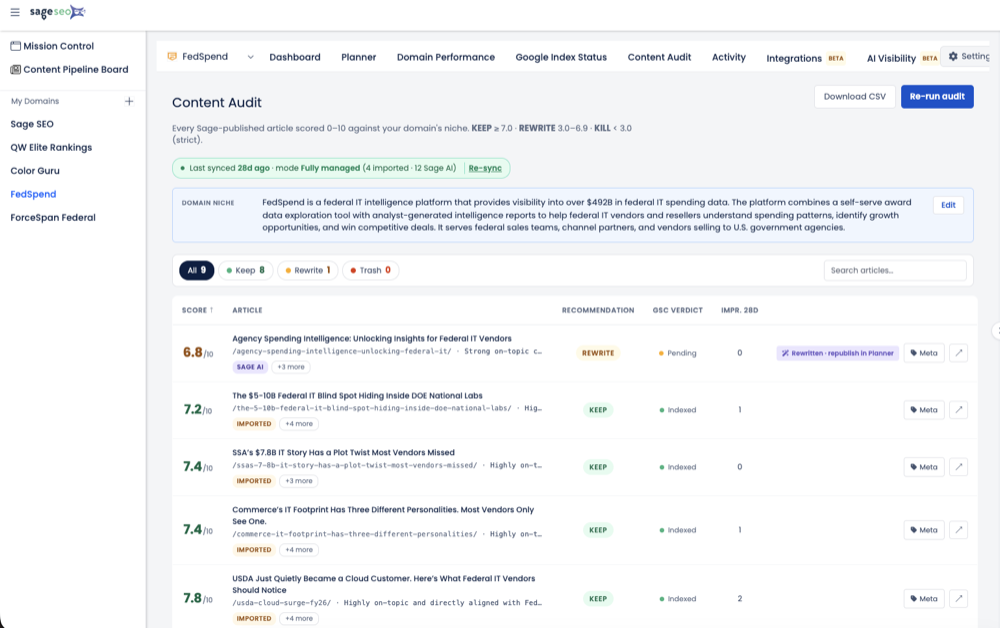
In a non-blocking setup, automated checks run the instant an article is drafted or published, landing in a dashboard editors can glance at during a morning standup — alongside whatever already tracks the week’s publish cadence across beats — rather than something that interrupts the writing process. Nobody waits on a scan. Nobody learns a new publishing step.
Prioritization matters as much as detection here — not every flag deserves same-day action.
- Flag issues automatically at the moment of publish, without blocking the publish button
- Route high-impact, low-effort fixes (missing meta description, broken internal link) into a daily glance-list
- Batch lower-priority or cosmetic issues into a weekly review cycle instead of real-time alerts
- Reserve deeper optimization passes for cornerstone and evergreen pieces, not daily news posts
- Review recurring patterns monthly to catch systemic issues, not just one-off article problems
Could this reduce articles shipping with zero metadata? Plausibly. Would it eliminate every gap? No — and that’s fine. The point isn’t perfection on every story. It’s catching the fixes that move the needle without anyone stopping to wait on a scan.
Building an SEO Workflow That Respects Editorial Culture
SEO workflows survive in newsrooms only when editorial leadership sees them as support, not oversight. I learned this the hard way on a publisher engagement where I rolled out SEO flags without looping in the managing editor first — writers read it as surveillance, and adoption died in about three weeks.
Specificity Beats Volume
A vague “improve SEO” flag gets ignored every time. A one-line, specific suggestion — “add ‘budget’ to the title, it’s the term people are searching” — gets fixed in the time it takes to read it. The difference between the two is the difference between a tool writers tolerate and a tool writers trust.
Batch the Noise, Show the Patterns
Real-time alerts on every minor issue train writers to ignore the dashboard entirely. Batching low-priority issues into a weekly or monthly digest keeps attention on what matters. Giving individual writers visibility into their own recurring patterns — “you skip meta descriptions on about a third of your stories” — changes behavior faster than flagging the same mistake article by article, because it reframes the fix as a habit rather than a correction.
Finally: don’t make anyone learn a new interface. A workflow that requires writers to leave their CMS to check an SEO score gets abandoned within a month, no matter how good the scoring is.
What to Prioritize When You Can’t Review Everything
When time is the constraint, prioritize cornerstone and evergreen content over daily news — it has a longer shelf life and more compounding search value per hour invested. A breaking-news post has a shelf life measured in days. An explainer, buying guide, or evergreen feature can pull search traffic for years, which makes it worth a genuinely higher level of SEO attention.
| Content Type | Shelf Life | SEO Attention Level |
|---|---|---|
| Breaking news | Hours to days | Pre-publish automated checks only |
| Trending / timely features | Days to weeks | Automated checks + light internal linking |
| Evergreen explainers / guides | Months to years | Full review: titles, metadata, internal links, refresh cadence |
| Cornerstone / pillar content | Years, with refreshes | Highest priority; recurring optimization passes |
Two tactics punch above their time cost. Internal linking from new articles into existing high-value content is the highest-leverage, lowest-effort move available — seconds per article, compounding across the archive, which connects directly to how ranking factors actually get calculated. Title tags paired with meta descriptions disproportionately affect click-through rate once a page ranks, which is why Google’s documentation on title links and its guidance on snippets are worth building your first automated check around.
If I had to automate one check before any other, it’s metadata presence. I’ve rewritten meta titles at scale before and watched a single batch fix move a cluster of pages within weeks — worth reading if you haven’t tackled a meta title rewrite at scale yet. Pair that with a bucketed content audit sorting your archive by what deserves a second pass, and you’ve covered most of the leverage without reviewing every story by hand.
Making SEO a Habit, Not a Hurdle
The shift that actually sticks isn’t a one-time audit — it’s moving SEO from a gate before publishing to a continuous process running quietly alongside editorial work. Newsrooms that treat it as infrastructure, something that just runs, keep it. Newsrooms that treat it as a project eventually let it lapse the first time deadlines get tight, which in a newsroom is always.
SEO That Runs in the Background Beats SEO That Blocks the Byline
I’ll say the unpopular part plainly: most SEO advice aimed at publishers is written by people who’ve never sat in a 9am meeting with six stories due before noon. A checklist that assumes idle time gets ignored, and it should — a newsroom’s job is to publish, not satisfy a scoring tool. The publishers who win the next few years of organic search won’t be the ones with the most thorough SEO process. They’ll be the ones who made SEO invisible enough that nobody had to choose between it and the deadline.