
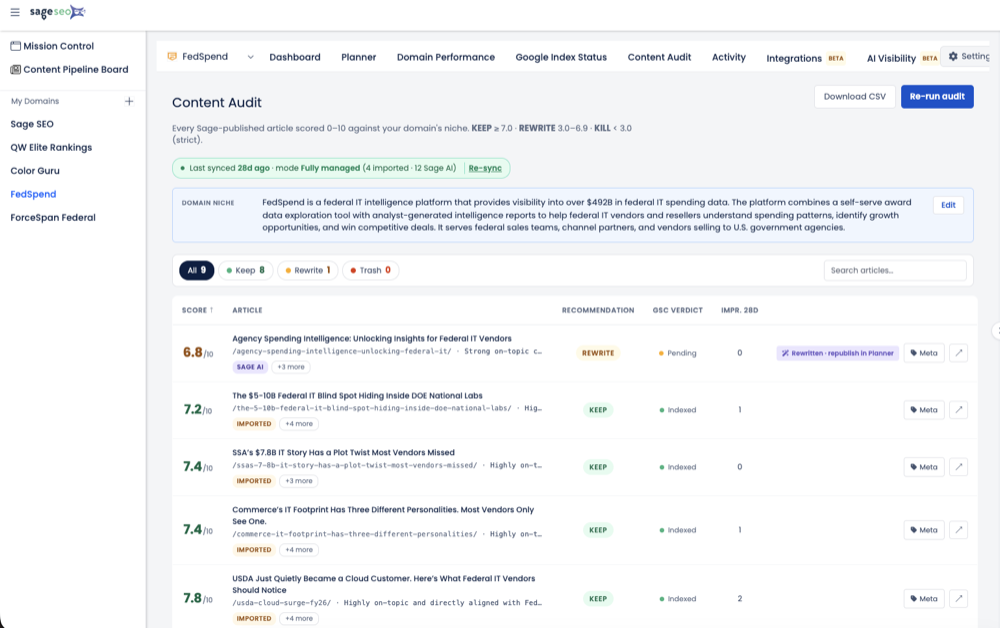

- Data-driven SEO directs decisions before publishing, not after.
- Four inputs matter: intent, competitive gaps, technical health, content signals.
- AI enables teams to publish 42% more content per month.
- Every roadmap item must trace back to a specific data point.
- A five-step repeatable loop outlasts any one-off audit.
The first audit that actually moved revenue for me started with a spreadsheet I almost deleted. A B2B SaaS client had 340 published posts and a dashboard the team stared at every Monday. They called it “data-driven.” But not one of those 340 decisions had been made because of data — the data just described the wreckage afterward. We killed 90 posts, rebuilt 40 around real query signals, and organic pipeline roughly doubled over two quarters.
That’s the gap this article is about. Most teams treat data as a rearview mirror. The teams that win treat it as a steering wheel.
What “Data-Driven SEO” Really Means (And Why Most Teams Get It Wrong)
Data-driven SEO means using data before and during strategy formation to decide what to build, what to kill, and when to change course — not just to report on decisions you already made.
Here’s the misconception I fight in almost every kickoff call: teams believe that owning more tools makes them data-driven. It doesn’t. I’ve watched companies with Ahrefs, Semrush, GA4, and three BI dashboards run the exact same content calendar they’d have run on gut instinct. Access to analytics is not the same as a decision framework.
The difference is directional. Reactive reporting looks backward and asks “what happened?” A genuine data-driven SEO strategy looks forward and asks “what should we build next, and why?” One produces slide decks. The other produces prioritized roadmaps you can defend to a CFO.
Below is the split I sketch on the whiteboard for skeptical marketing directors — the same reframe from rearview mirror to steering wheel.
| Dimension | Rearview-Mirror SEO (reactive) | Steering-Wheel SEO (data-driven) |
|---|---|---|
| When data is used | After publishing, in monthly reports | Before and during strategy decisions |
| Primary question | “What happened last month?” | “What should we build or kill next?” |
| Output | Traffic dashboards | Prioritized, defensible roadmaps |
| Success metric | Pageviews, rankings | Pipeline, revenue, conversions |
| Cadence | One-off audits | Continuous feedback loop |
If your reporting can’t be traced back to a decision it caused, you’re not data-driven. You’re just documented.
The Core Components of a Data-Driven SEO Framework
Every real SEO analytics framework runs on four inputs: search intent analysis, competitive gap analysis, technical performance data, and content performance signals — feeding one prioritization engine.
Skip any of the four and you get lopsided decisions. I learned that the hard way on my own site in 2024, when I chased a competitive gap for six weeks without checking intent. The pages ranked. Nobody who landed on them wanted what I was selling. Traffic up, pipeline flat.
The four inputs that actually shape decisions
- Search intent analysis — what the searcher actually wants, read off the live SERP, not off a tool’s intent label. Intent is the input everyone underweights.
- Competitive gap analysis — where competitors rank and you don’t, filtered by whether that gap is winnable this quarter.
- Technical performance data — indexation, crawlability, Core Web Vitals; the plumbing that decides whether good content ever gets a fair shot.
- Content performance signals — engagement, conversions, assisted pipeline — not just rank position.
Intent isn’t a nice-to-have. According to an expert consensus compiled by LinkBuilder’s 2025 ranking-factors review, sources from Backlinko to Search Engine Land rank satisfying searcher intent as effectively Google’s number-one goal. Content that mismatches intent underperforms regardless of how technically clean it is. That’s why I refuse to greenlight a brief until the SERP has been read by a human.
Here’s how each input maps to the decision it’s supposed to shape — the reason all four have to be on the table at once.
| Input | Data source | Decision it shapes |
|---|---|---|
| Search intent | Live SERP + query analysis | What format and angle to build |
| Competitive gap | Rank-tracking, keyword tools | Which gaps are winnable now |
| Technical performance | Search Console, crawlers | Whether the page can rank at all |
| Content performance | GA4, conversion + pipeline data | What to update, keep, or kill |
These four inputs don’t matter individually. They matter because they feed a single prioritization decision: what gets built first. If your keyword and clustering work isn’t wired into that decision, it’s decoration — a point I’ve made before about grouping keywords by intent instead of volume. And the loop has to be continuous. A one-time audit is a photograph. You need the video.
Why Has AI Changed What “Data-Driven” Can Mean?
AI changed the definition by collapsing the time and cost of analyzing large keyword sets, SERP features, and content gaps — so the loop that used to take a quarter can now close in a week.
For most of my career, “data-driven” was throttled by human bandwidth. You could analyze 5,000 keywords by intent and cluster them into topical maps — if you had three analysts and a month. So teams sampled, guessed, and shipped. AI removed that bottleneck.
The productivity signal is real and measured. According to Ahrefs’ 2025 AI SEO data study, marketers using AI publish 42% more content — a median of 17 articles a month versus 12 without it. Speed isn’t the point by itself; speed lets you run more experiments per quarter, and experiments are how a data-driven program actually learns.
Skip the spreadsheets. Start Sage SEO free.
See how AI content ops transform your agency workflow in minutes.
AI matters because of which loop steps it closes, not because it “transforms everything”:
- Finding demand — pattern recognition across thousands of queries and SERP features at once, surfacing gaps a human would sample past.
- Drafting — turning an intent-mapped brief into a first draft in minutes, grounded in a real voice rather than generic filler.
- Interlinking — mapping a new page into existing clusters automatically instead of hoping someone remembers.
- Attribution — connecting a published URL back to pipeline so the next decision is sharper.
This is the operational core of a genuine AI-first SEO approach: not a chatbot bolted onto old workflows, but automation wired into every step of the demand-to-revenue loop. The context has shifted too — with Google’s AI Overviews now settling at roughly 16% of queries per Semrush’s 2025 AI Overviews study, the data you optimize against now includes generative surfaces, not just ten blue links.
How Do You Know If Your SEO Strategy Is Actually Data-Driven?
A strategy is data-driven only if every decision traces back to a specific data point, follows a documented prioritization framework, and is validated by measured experiments.
I hand this checklist to founders before they sign any agency — including, honestly, before they re-sign me. If the answers are vague, the “data-driven” label is marketing.
- Traceability — Can they point to the exact query, gap, or metric behind each item on the roadmap? “Best practice” is not a data point.
- A documented prioritization framework — Is there a repeatable rule for what ships first, or does the loudest stakeholder win?
- Live experimentation — Are they running tests with a hypothesis and a measured result, or shipping and hoping?
- A tie to business metrics — Does the reporting connect SEO activity to pipeline and revenue, not just sessions?
Red flags that a strategy isn’t data-driven
Watch for these three. Vague reporting that celebrates “impressions up 20%” with no revenue line. Zero experimentation — a program that never tests anything is guessing on a schedule. And no traceable link between the work done and a business outcome, which is where the editorial-to-outcome attribution loop earns its keep. When I audit an agency for a client and ask “why this page?”, a real answer takes ten seconds. A bad one takes a paragraph of hedging.
What Published Industry Data Actually Shows
Independent, published research consistently shows that structured, intent-first, experiment-driven SEO outperforms best-practice guesswork — and that the ground is shifting faster than annual playbooks can track.
I won’t quote a single first-party number here, because I don’t have one that’s honest to share — and that restraint is the point. Every figure below is external and linked, which is exactly the standard you should hold any provider to.
| Finding | What the data shows | Source |
|---|---|---|
| AI raises output | 42% more content published; median 17 vs 12 articles/month | Ahrefs, 2025 |
| Generative surfaces are now standard | AI Overviews settled near 16% of queries in 2025 (peaking ~24.6% in July) | Semrush, 2025 |
| Intent leads ranking factors | Expert consensus ranks searcher intent as Google’s top priority | LinkBuilder review, 2025 |
Read those together and the conclusion writes itself: Semrush found AI Overview triggering swung from 6.49% of queries in January to 24.61% in July before settling — that volatility alone breaks any strategy built on a static annual audit. You cannot report your way into keeping up with a SERP that reshapes itself month to month. You have to run a loop.
The other quiet lesson is about authority. Programs that publish consistently and build topical depth get cited more, in classic results and AI answers alike — the compounding return of running the four-input loop while competitors ship one-off posts.
Building a Repeatable Data-Driven SEO Process
A repeatable process runs five steps on a loop — audit, prioritize, implement, measure, iterate — with every step documented so wins survive staff turnover.
The differentiator was never a single clever tactic. It’s repeatability. I’ve seen brilliant one-off wins evaporate the moment the analyst who understood them left. Documentation is what turns a lucky quarter into a compounding system.
The five-step loop I run
- Audit — pull intent, gaps, technical health, and content performance into one prioritized view. Not a photograph; a live read.
- Prioritize — score opportunities by winnability and business value, using a documented rule anyone can apply.
- Implement — draft against an intent-mapped brief, interlink into the right cluster, ship fast. This is where I often start by rescuing an existing underperforming page instead of writing net-new.
- Measure — track against pipeline and conversions, and watch AI-citation visibility, not just rank.
- Iterate — feed what you learned back into the next audit. The loop tightens every cycle.
Automation supports each step — surfacing demand, drafting, interlinking, and tying results back to revenue — which is why a small team can now run a loop that used to need a department. Tooling like Search Console momentum tracking turns the “measure” step from a monthly export into a continuous signal, and preparing each draft for AI Overview and ChatGPT citation is now part of implement, not an afterthought.
Data Is a Steering Wheel, Not a Report Card
Here’s my position, earned from killing hundreds of posts that looked fine on a dashboard: the report card is the least valuable thing data can give you. If you’re only looking at data after the decision, you’ve already spent the money.
The teams that compound let data steer — they audit, prioritize, ship, measure, and iterate on a loop that tightens every cycle. That doesn’t just win more often. It wins more defensibly, because every call traces back to a signal you can point to. Guesswork gets lucky once. A documented loop gets right repeatedly, and the gap between you and the competitor still shipping one-off posts widens every quarter you keep it turning.